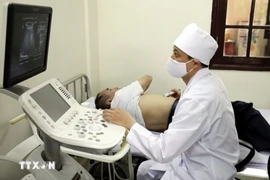
Hanoi (VNA) – Behind the closed doors of operating rooms, where surgeons work tirelessly through the night with pinpoint precision, and families wait anxiously outside, lies the unwavering support of Vietnam’s healthcare system - operating seamlessly around the clock.
Historically, Vietnamese Doctors’ Day on February 27 has been a day to honour the unwavering commitment and sacrifices of medical workers. Today, however, the healthcare sector is also gaining recognition for its exceptional professional expertise, bolstered by cutting-edge technology and state-of-the-art medical facilities. As a result, complex organ transplants, advanced cardiovascular interventions, and life-saving intensive care procedures are now routinely carried out with remarkable success. Increasingly, patients are placing their trust in the expertise of Vietnamese doctors rather than seeking treatment abroad.
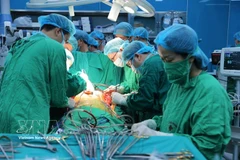
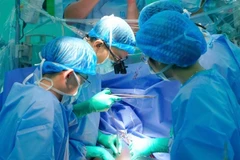
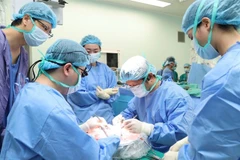
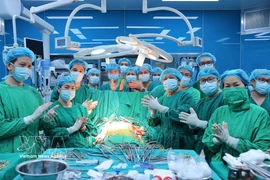
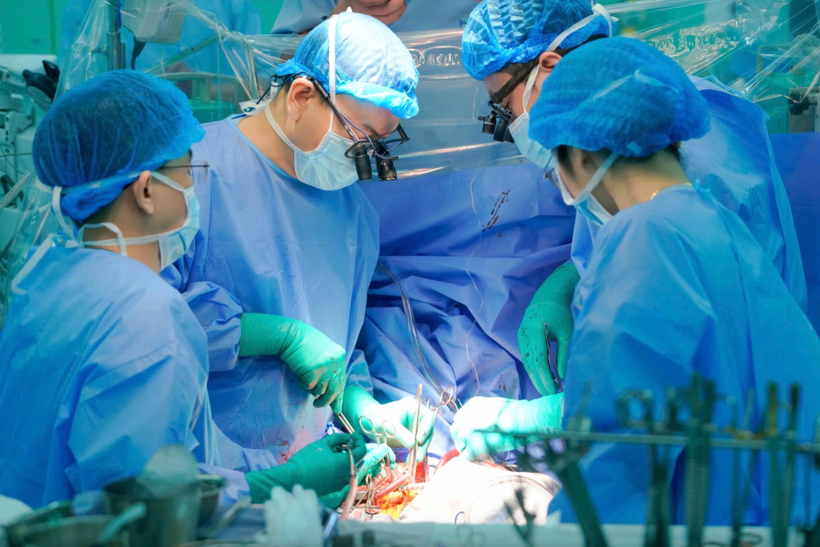
A striking example of this occurred during the final days of the Year of the Snake, 2025. On the 27th day of the last lunar month, while families across the country prepared for the celebrations of the Year of the Horse, 2026, doctors at the University Medical Centre Ho Chi Minh City were racing against time to save a patient suffering from severe stroke complications. After the patient was declared brain-dead, the family made the selfless decision to donate organs, saving the lives of four others. After the brain-death determination on the 28th day of the lunar month, over 200 doctors, nurses, and medical staff from multiple specialties came together to conduct five synchronised surgeries, including one organ retrieval, one heart transplant, one liver transplant, and two kidney transplants. The complex procedures were carried out overnight and completed by the 29th day of the month.
Assoc. Prof. Dr. Nguyen Hoang Dinh, Deputy Director of the hospital, remarked that the operations posed both significant professional and organisational challenges, especially as most of society had slowed down for the Lunar New Year.
He emphasised that the success was not only a technical achievement but also a reflection of the remarkable dedication and responsibility shown by the medical staff. Many had returned to the hospital immediately after receiving the call, even though they were traveling home for the Tet holiday. “What moved me the most was not only the technical success but the spirit of nearly 200 doctors, nurses, technicians, and staff members who came together to accomplish that extraordinary feat,” Dr. Dinh said.
He expressed deep gratitude for the team’s unwavering sense of responsibility and compassion, noting that their actions embodied true dedication to their patients.
Professional excellence and dedication
Organ transplantation, Dr. Dinh explained, is a race against time that requires flawless coordination across multiple departments, from emergency care and surgery to anesthesia, testing, blood banks, and post-transplant care. The hospital’s ability to mobilise nearly 200 staff members during the holiday period demonstrated its constant state of readiness, with no “days off” when patients' lives are at stake.
When patients pull through from the brink of death, when their vital signs stabilise and transplanted hearts begin beating strongly in new bodies, the joy shared by the entire medical team is overwhelming. And when the country welcomes the New Year, saving lives takes on an even more profound significance — offering patients and their families a new spring of hope. The four successful organ transplants at the beginning of the lunar new year not only marked a significant professional achievement but also highlighted the hospital’s strategic and long-term commitment to developing into a world-class transplant centre, meeting regional standards.
Dr. Dinh expressed his belief that this spirit of readiness, dedication, and teamwork would continue to serve as the foundation for the hospital’s sustainable growth and its mission to save even more lives in the future.
He also extended heartfelt gratitude to the donor families whose decisions, made during moments of profound loss, transformed grief into renewed life for others.
Just days ago, on the early morning of February 23, the hospital performed another life-saving heart transplant on an 11-year-old patient suffering from end-stage heart failure, using a donated heart from Bach Mai Hospital in Hanoi. To date, the University Medical Centre Ho Chi Minh City has successfully carried out multiple organ transplants, saving 214 lives./.
See more
Vietnam fosters maternal and child healthcare, advances toward 2035 goals
The under-five mortality rate in Vietnam in 2025 was estimated at below 16 per 1,000 live births, more than three times lower than the 1990 level. The infant mortality rate (under one year) declined fourfold to below 11 per 1,000, while the neonatal mortality rate dropped fivefold, from 44 per 1,000 in 1990 to 8.8 per 1,000 in 2025.
Over 6,000 patients receive free medicines
The schemes focus primarily on cancer, rare diseases and severe chronic conditions, areas where treatment costs are high and often require expensive biological and originator drugs.
Vietnam reaches new height in organ transplantation
From demanding cross-country transplants to highly specialised procedures nearing regional and international standards, the sector has created new chances of survival for thousands of patients. However, persistent bottlenecks in organ donation and the legal framework highlight the urgent need to further perfect the national donation–transplantation system. In the era of advanced medicine, progress is measured not only by surgical mastery, but also by the ability to turn loss into hope and sustain life.
University Medical Centre performs ninth heart transplant from brain-dead donor
The surgery was carried out in the early morning of February 23 (the seventh day of the Lunar New Year), marking the hospital’s ninth heart transplant from a brain-dead donor.
Measures rolled out to ensure adequate medicine supply during Tet
Accordingly, provincial and municipal health departments are required to direct hospitals, centres for disease control and health care facilities to urgently develop plans and carry out medicine procurement to ensure sufficient supply, absolutely avoiding shortages. Medicines must meet quality standards and be sold at reasonable prices, with no sudden price increases allowed.
Vietnam, China open “green lane” for ambulance transfer on humanitarian grounds
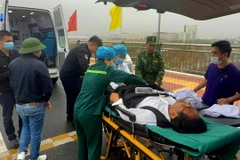
At around 16:20 the same day, the lane was activated at Bac Luan II Bridge area to allow an ambulance bearing license plate 15N-049.80 to transfer 63-year-old Chinese man Zhang Huizhong, who had suffered a cerebral infarction, to China for immediate treatment.
Aviation industry tightens round-the-clock health checks to prevent Nipah virus infections
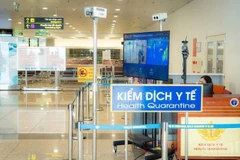
An airport representative said Noi Bai has tightened health controls around the clock, with close coordination between the International Health Quarantine unit and the airport’s emergency medical team helping detect abnormal signs early and ensuring the aviation gateway remains safe and smooth.
Vietnam tightens Nipah virus prevention at border gates
Local authorities have been instructed to strengthen disease prevention and control measures at border gates, medical facilities and in the community, stay updated with global disease information, and closely monitor inbound travellers.
Health sector steps up preparedness against Nipah virus disease
Nipah virus infection is designated a Group A infectious disease, with reported fatality rates of between 40 and 75%. At present, no vaccine or specific antiviral treatment is available. The virus is mainly transmitted from animals to humans or through contact with contaminated food and objects, and can also spread between people via direct contact with bodily fluids and secretions of infected patients.
Vietnam reports no Nipah virus cases, health sector on high alert
Vietnam has recorded no cases of Nipah virus infection as of January 26, according to the Ministry of Health (MoH), which has instructed localities to step up surveillance and preventive measures and remain ready to respond to any potential outbreak.
Health minister highlights comprehensive, people-centred healthcare orientation
Member of the Party Central Committee and Minister of Health Dao Hong Lan said the Politburo's Resolution No. 72 provides a breakthrough orientation for the protection, care and improvement of the people’s health. It places the people’s health at the centre of all healthcare policies and services, while aiming to address long-standing bottlenecks in the health sector that have yet to be fundamentally resolved.
14th National Party Congress: Hanoi’s health sector ready to respond to all situations
Ensuring medical security, disease prevention and control, food safety, environmental hygiene, and readiness to handle all medical contingencies is among the key tasks directly contributing to the success of the 14th National Party Congress.
Party leader attends groundbreaking ceremony for Hanoi Medical University elderly health care complex
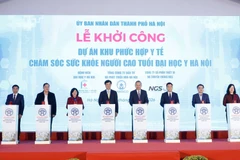
The Hanoi Medical University Elderly Health Care - Medical Complex is designed as a multi-functional integrated hub combining high-quality medical services, education and clinical training, scientific research, technology transfer and comprehensive elderly care, forming a synchronised healthcare–education–research ecosystem.
Strategic roadmap for healthier future
As Vietnam’s population ages rapidly, Dr Angela Pratt, WHO Representative in Vietnam, identified two strategic priorities: strengthening primary healthcare and developing a formal long-term care system. These measures are essential not only for healthy ageing, but also as long-term investments with wide-ranging socio-economic returns.
More than 300 medical staff assigned to serve 14th National Party Congress
Deputy Minister of Health Tran Van Thuan called on experts and healthcare workers to uphold a strong sense of responsibility, professionalism and expertise to ensure that medical services for the 14th National Party Congress are delivered safely, effectively and with the highest level of care.
Tu Du Hospital saves newborn in extremely rare twin pregnancy case
The eight-week delay far exceeded expectations and highlights the hospital’s high level of expertise and strong multidisciplinary coordination in managing rare, high-risk obstetric cases, giving fragile lives a precious chance from the very beginning.
Female health care worker donates organs, giving five lives a new lease on life
The 108 Military Central Hospital, on January 12, announced that it had successfully performed a multi-organ transplant from a brain-dead donor, a health care worker.
Drill held to ensure medical support for upcoming 14th National Party Congress
Medical teams will participate in a full rehearsal at the National Convention Centre on January 13 to finalise all preparations ahead of the 14th National Party Congress, which will take place from January 19 to 25.
Red Sunday blood donation campaign kicks off in Hanoi
The Red Sunday campaign has mobilised hundreds of thousands of blood units, making a significant contribution to reducing blood shortages during the Lunar New Year (Tet) Festival.
Leading medical experts review healthcare preparations for 14th National Party Congress
Participating experts underscored that smooth communication and close coordination among medical forces are a decisive factor in efficient emergency response.