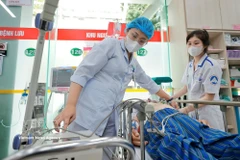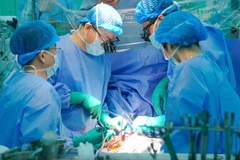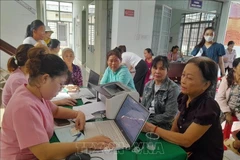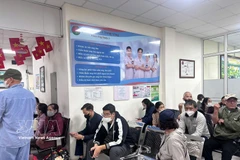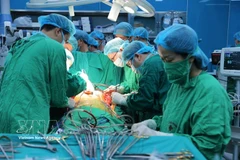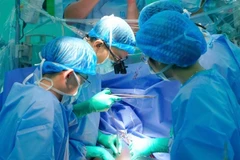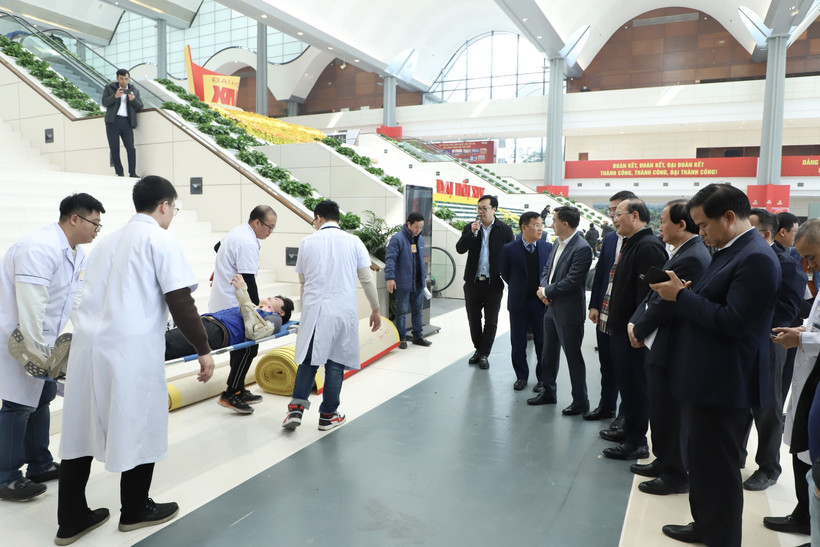
Hanoi (VNA) – The Ministry of Health on January 12 conducted a medical services drill at the National Convention Centre to ensure health and medical preparedness for the coming 14th National Congress of the Communist Party of Vietnam.
The exercise, chaired by Professor Dr Tran Van Thuan, Deputy Minister of Health, President of the Vietnam National Medical Council, and head of the medical subcommittee serving the congress, brought together more than 40 leading experts in various fields.
Addressing the event, Thuan underscored that the congress is a major political event of historic significance, marking a new phase of development for the country. Ensuring medical services, including disease prevention and control, food safety, emergency response, and medical examination and treatment for delegates and guests, is both an honour and a major responsibility for the health sector.
The ministry has issued emergency response guidelines for common medical conditions, developed contingency plans for disease prevention and control, and assigned specific responsibilities to its departments, affiliated hospitals and the Hanoi Department of Health.
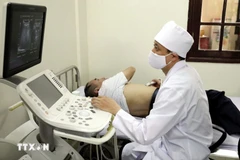
In terms of facilities, each hotel accommodating delegates has been equipped with an on-site emergency room. At the National Convention Centre, an intensive care area comparable to a modern hospital ICU has been set up, along with two emergency and treatment rooms. These are fully equipped with ambulances, automated CPR devices, defibrillators, ventilators, heart-lung machines, mobile digital X-ray systems, bedside ultrasound devices, rapid testing equipment, and essential medicines and supplies. The ICU is connected via teleconsultation with the medical subcommittee and leading hospitals, including Huu Nghi Hospital, Bach Mai Hospital, 108 Central Military Hospital and Viet Duc Hospital.
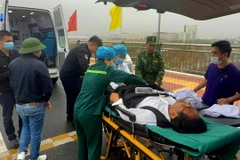
The drill marked the transition of the entire health sector into a full state of readiness. Four emergency scenarios were rehearsed, including cardiac arrest, myocardial infarction, stroke and multiple trauma, led by Bach Mai Hospital and Viet Duc Hospital, with coordination from other major hospitals.
Concluding the exercise, the Deputy Minister commended the thorough preparation of personnel, equipment and facilities, and urged continued review under the principle of “maximum preparedness, minimal use.” He emphasised seamless coordination, clear command and control, and uninterrupted communications to ensure the highest level of health safety for all delegates before, during and after the congress.
According to the plan, medical teams will participate in a full rehearsal at the National Convention Centre on January 13 to finalise all preparations ahead of the 14th National Party Congress, which will take place from January 19 to 25./.
See more
Red Sunday blood donation campaign kicks off in Hanoi
The Red Sunday campaign has mobilised hundreds of thousands of blood units, making a significant contribution to reducing blood shortages during the Lunar New Year (Tet) Festival.
Health ministry maps out three phases for hospital fee exemption
Health insurance participants from near-poor households and those aged 75 and above who are receiving social pension allowances will be entitled to 100% coverage of medical examination and treatment costs within the scope of health insurance benefits.
Hanoi aims for modern healthcare system
Hanoi's health sector will continue to expand the comprehensive use of digital technology in professional practices to improve management efficiency and service quality, aiming to develop a modern, transparent, and people-centred healthcare system.
Two brain-dead donors give new life to 13 patients through organ donation
Most recently, University Medical Centre HCM City successfully performed two simultaneous transplants, a heart and a liver, using organs donated from a brain-dead patient at People’s Hospital 115.
Duc Giang hospital, Vietnam Post pilot UAV application for medical transport
This is Vietnam’s first pilot initiative combining postal services with low-altitude aviation technology for healthcare purposes, highlighting Vietnam Post’s pioneering role in organising and operating innovative technological solutions in service of the community.
3.37 billion USD earmarked for public health care, population quality improvement
The programme’s overarching goal is to ensure that all people receive primary healthcare management and early, preventive care delivered close to home, thereby reducing disease burden; to increase the total fertility rate and strive for a balanced sex ratio at birth; to adapt to population ageing while improving population quality; to improve care for vulnerable groups; and to contribute to improvements in physical and mental health, stature, life expectancy and overall quality of life, towards building a healthier Vietnam.
Vietnam ranks 4th in health self-care readiness
Self-care is an essential component of primary healthcare, with WHO defining it as the ability of individuals, families, and communities to promote and maintain health, prevent disease, and cope with illness with or without the support of healthcare professionals.
Proton therapy, an alternative method for cancer patients
In recent years, Vietnam's Ministry of Health has held numerous meetings with relevant units to assess the progress in developing proton therapy centres in the country. The project for establishing proton therapy centres is set to commence preparations in 2025 and aims for completion between 2026 and 2030.
First hospital in Mekong Delta earns US AACI accreditation
Nam Can Tho University Hospital on December 15 hosted a ceremony to announce its accreditation by the American Accreditation Commission International (AACI), a US-based body, becoming the first facility in the Mekong Delta and among a select few in Vietnam to earn the distinction.
Vietnam proactively takes polio prevention measures amid outbreak in Laos
The meeting took place following an assessment by the World Health Organisation (WHO) warning that Vietnam is facing a very high risk of polio import and re-emergence. The risk arises after neighbouring Laos officially declared a polio outbreak on October 7, following the detection of circulating vaccine-derived poliovirus type 1 (cVDPV1).
National target programme on health prioritises most vulnerable groups
The National Assembly on December 11 adopted a resolution on the National Target Programme on Healthcare, Population, and Development for the 2026–2035 period, marking a significant step in Vietnam’s long-term commitment to improving public health and population quality.
WHO welcomes Vietnam’s strong stance on banned e-cigarettes, heated tobacco products
WHO Representative in Vietnam Dr Angela Pratt said, “WHO is delighted with the decision to include e-cigarettes and HTPs in the list of banned enterprises under the Investment Law, without exceptions. This is crucial for upholding the National Assembly’s ban on these products – Resolution 173.”
Nearly 100 international scientists attend molecular diagnostics conference in Vietnam
The conference features almost 80 presentations across plenary sessions, parallel sessions and poster sessions, focusing on leading research trends such as point-of-care diagnostics; predictive biomarkers used to anticipate individual responses to therapy; and the development of new tools and platforms for rapid molecular-level detection and diagnosis.
French NGO ADM Vietnam marks 33 years of medical aid, language bridge
The association was established with three core missions: medical assistance, social support, and promotion of medical French - sending volunteer doctors to Vietnam, donating equipment, and helping medical students master French to secure clinical internships in France.
AI and precision medicine: Emerging prospects for Vietnam-Canada cooperation
Canada has strong experience in compiling and analysing genomic data, while Vietnam has a large population with diverse genetic structures. This complementarity can help Vietnam narrow its technological gap and enhance its capacity to treat rare diseases — an area many countries are prioritising for development.
Vietnam on path to become a healthy nation
Resolution 72 not only focuses on health care but is also closely interlinked with other sectors, helping to build a solid foundation for sustainable national development and create momentum for Vietnam to “take off” and further integrate into the world.
Legislators seek breakthrough mechanisms to mobilise social resources for elderly care
Existing social protection facilities currently meet only about 30% of demand.
Health sector targets free hospital fee for all
The total value of medical expenses not covered by the health insurance fund is estimated at around 24.8 trillion VND (942 million USD) per year. Health insurance contributions remain low, at 4.5% of the salary or reference base used for calculation.
Vietnam rolls out comprehensive programmes to curb HIV/AIDS
In 2023, the World Health Organization (WHO) hailed Vietnam as a leading country in the Asia-Pacific region in HIV pre-exposure prophylaxis (PrEP) treatment.
Vietnam, Laos expand cooperation in military medicine
Over the past two decades, many Vietnamese experts have undertaken long-term missions at the Central Hospital 103 to provide training and technical assistance, contributing to the successful treatment of complex cases. The Central Military Hospital 108 has also trained 206 Lao doctors, six nurses and two engineers — a clear demonstration of substantive, long-standing cooperation.