Vietnam proactively takes polio prevention measures amid outbreak in Laos

The meeting took place following an assessment by the World Health Organisation (WHO) warning that Vietnam is facing a very high risk of polio import and re-emergence. The risk arises after neighbouring Laos officially declared a polio outbreak on October 7, following the detection of circulating vaccine-derived poliovirus type 1 (cVDPV1).

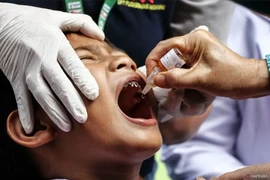
A health worker administer IPV polio vaccine to a child in Dong Thap province. (Photo: VNA)

Hanoi (VNA) - The Ministry of Health convened an urgent nationwide online conference on December 12 to discuss polio prevention and control measures amid rising risks of the disease being reintroduced into Vietnam.

The meeting took place following an assessment by the World Health Organisation (WHO) warning that Vietnam is facing a very high risk of polio import and re-emergence. The risk arises after neighbouring Laos officially declared a polio outbreak on October 7, following the detection of circulating vaccine-derived poliovirus type 1 (cVDPV1).

Deputy Minister of Health Nguyen Thi Lien Huong warned that the situation poses a serious threat to Vietnam’s hard-won polio eradication achievements, as well as those of the Western Pacific Region, which has been recognised as free of wild poliovirus since 2000.

Representatives from the WHO and the ministry’s Department of Disease Prevention analysed factors placing Vietnam at heightened risk, including epidemiological and geographical conditions.

One key concern is the high volume of population movement between Vietnam and Laos, particularly across border areas where the outbreak has occurred. In addition, immunity gaps remain due to polio vaccination coverage failing to meet targets in recent years, especially during the COVID-19 pandemic.

WHO representatives also highlighted that the measles outbreaks seen during the 2024–2025 period demonstrate how infectious diseases can spread rapidly from one country to others within a short time if preventive measures are not sufficiently strengthened.

In response, the Ministry of Health has issued a series of urgent directives to local authorities. Localities are required to promptly review vaccination records and organise catch-up and mop-up immunisation campaigns using polio vaccines, including IPV and bOPV, for individuals who have missed doses or have not completed the full vaccination schedule. These efforts are to prioritise high-risk areas, while routine immunisation activities must be reinforced to ensure both safety and effectiveness.

The ministry has also instructed localities bordering Laos to intensify leadership and supervision of polio prevention work, while strengthening coordination with Lao counterparts to monitor cross-border health risks. At the same time, local authorities are required to work closely with specialised institutes to develop detailed prevention and response plans. Risk assessments have now been completed in all 34 provinces and centrally-run cities nationwide.

The provincial/municipal People’s Committees are tasked with formulating and implementing plans to respond to the risk of polio importation and transmission during the 2025–2026 period. These plans must include stronger communication and public awareness efforts, as well as adequate preparation of vaccines, equipment and human resources for disease prevention and control, in line with the “four on-the-spot” principle.

The Ministry of Health stressed that vigilance, early detection and comprehensive vaccination coverage remain critical to preventing the re-emergence of polio in Vietnam./.
VNA

See more

A view of the International Conference on Molecular Diagnostics in Microbiology and Diseases, organised by Rencontres du Vietnam and the International Centre for Interdisciplinary Science and Education (ICISE) in the central province of Gia Lai on December 11. (Photo: VNA)

Nearly 100 international scientists attend molecular diagnostics conference in Vietnam

The conference features almost 80 presentations across plenary sessions, parallel sessions and poster sessions, focusing on leading research trends such as point-of-care diagnostics; predictive biomarkers used to anticipate individual responses to therapy; and the development of new tools and platforms for rapid molecular-level detection and diagnosis.

Digital transformation in healthcare is being strongly promoted. (Photo: Organising Committee of the 2024 “Technology with Heart” Award, co-hosted by Vietnam News Agency and Viettel)

AI and precision medicine: Emerging prospects for Vietnam-Canada cooperation

Canada has strong experience in compiling and analysing genomic data, while Vietnam has a large population with diverse genetic structures. This complementarity can help Vietnam narrow its technological gap and enhance its capacity to treat rare diseases — an area many countries are prioritising for development.

Maternal and child healthcare in Tuyen Quang province. (Photo: VNA)

Vietnam on path to become a healthy nation

Resolution 72 not only focuses on health care but is also closely interlinked with other sectors, helping to build a solid foundation for sustainable national development and create momentum for Vietnam to “take off” and further integrate into the world.

The emergency ward at Bach Mai Hospital, Hanoi. (Photo: VNA)

Health sector targets free hospital fee for all

The total value of medical expenses not covered by the health insurance fund is estimated at around 24.8 trillion VND (942 million USD) per year. Health insurance contributions remain low, at 4.5% of the salary or reference base used for calculation.

Sen. Lieut. Gen. Vongsone Inpanphim, Lao Deputy Minister of National Defence and Director of the General Department of Politics presents the Friendship Order of Laos to Vietnam’s Central Military Hospital 108. (Photo: VNA)

Vietnam, Laos expand cooperation in military medicine

Over the past two decades, many Vietnamese experts have undertaken long-term missions at the Central Hospital 103 to provide training and technical assistance, contributing to the successful treatment of complex cases. The Central Military Hospital 108 has also trained 206 Lao doctors, six nurses and two engineers — a clear demonstration of substantive, long-standing cooperation.

Deputy Minister Do Xuan Tuyen (left) and Alberto Anaya Gutiérrez, General Secretary of the Mexican Workers' Party (PT). (Photo: VNA)

Vietnam, Mexico boost medical cooperation

As both nations look to keep their long-standing partnership in good health, the health ministries of Vietnam and Mexico have been accelerating cooperation, especially in traditional medicines.

The opening of Vietnam Medi-Pharm 2025 and Vietmedicare Expo in Ho Chi Minh City on November 27, 2025. (Photo: VNA)

Major medical, pharmaceutical exhibitions kick off in HCM City

The 33rd Vietnam International Medical and Pharmaceutical Exhibition (Vietnam Medi-Pharm 2025) and the International Exhibition on Pharmaceuticals, Medical Devices and Healthcare (Vietmedicare Expo 2025) kicked off at the Saigon Exhibition and Convention Centre on November 27.

Doctors Do Thi Ngoc Linh (left) and Le Diep Linh at the RCS membership certificate award ceremony in London. (Photo: VNA)

Vietnamese surgeons honoured with prestigious Royal College Fellowship

The fact that the Vietnamese doctors have been awarded with FRCS certificate proves Vietnam’s surgical expertise has met international standards, contributing to improving the quality of treatment at home, expanding academic cooperation with world leading medical institutions and inspiring younger doctor to pursue higher standards.

Doctors from Military Hospital 175 perform surgery on a patient on Truong Sa Island. (Photo: Military Hospital 175)

First successful open-chest surgery performed at Truong Sa infirmary

The successful emergency operation on a patient with serious chest injuries in Truong Sa showed that Vietnam’s military medical forces are now capable of handling complex emergencies at sea, boosting the confidence of soldiers and fishermen living and working on remote islands.