Dien Bien Phu Victory

Dien Bien Phu Victory shows strength of intelligence, public consensus: Officer

The Dien Bien Phu Victory (May 7, 1954) was not only a victory of the strength of intelligence and public consensus but also contributed to the end of the resistance war against the French colonialists of the Vietnamese army and people, according to an officer.

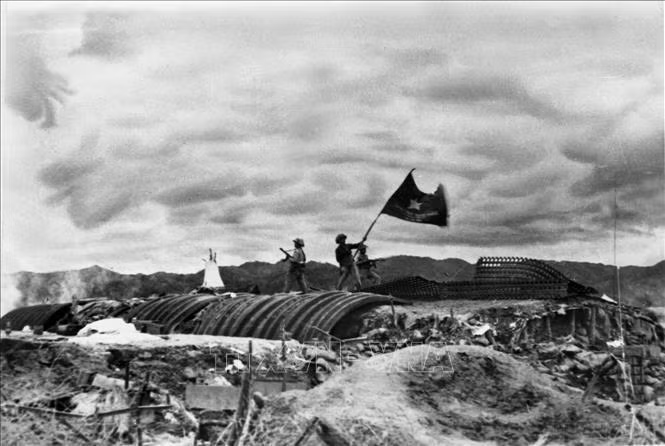
The flag “To fight, To win" on the roof of General De Castries’ bunker on the afternoon of May 7, 1954. (File Photo: VNA)

Hanoi (VNA) – The Dien Bien Phu Victory (May 7, 1954) was not only a victory of the strength of intelligence and public consensus but also contributed to the end of the resistance war against the French colonialists of the Vietnamese army and people, according to an officer.

Lieutenant General Associate Prof. Dr. Nguyen Hung Oanh, Principal of the Political Officer Training School under the Ministry of National Defence, said that the reality of the Dien Bien Phu campaign showed that the tradition and strength of great national unity, which was upheld and combined with the determination to fight and to win and the desire for peace, truly became an invincible source of spiritual strength transformed into material strength to triumph.

During the Dien Bien Phu campaign, the people's war posture was planned early and organised proactively by the general command of the campaign, with many creative measures used, suitable for each battlefield and each stage. The war posture was the combination of measures to organise, arrange, and deploy forces and means to create an advantageous position and maximise strength to win.

It was implemented widely in all the three Indochinese countries, dividing more than 80% of the French mobile force and creating a favourable position for Vietnam to destroy the enemy at the Dien Bien Phu battlefield, said Oanh.

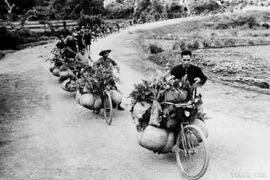
During the campaign, the Vietnamese people contributed 25,560 tonnes of rice, 226 tonnes of salt, 1,909 tonnes of food, 20,991 bicycles, 1,800 bamboo rafts, 756 rudimentary vehicles, 914 pack horses and 3,130 boats. Up to 26,453 individuals joined the campaign as frontline workers.

The figures demonstrated the extraordinary efforts and the mettle of Vietnam - a poor and backward country that was waging a long resistance war full of hardships and sacrifices.

In addition, the great help from the international community, first of all from the people of Laos, Cambodia and socialist countries, was both a material source and a source of political and spiritual strength, thus contributing to the victory of the Dien Bien Phu campaign.

Exactly 70 years after that historic day, the Dien Bien Phu Victory still leaves valuable lessons and invaluable experiences, including those on promoting the political and spiritual strength of the entire Party, army and people, combining the material with political and spiritual strength, and maximising the spiritual strength at difficult or turning point times to realise goals and bring the revolution to victory./.
VNA

See more

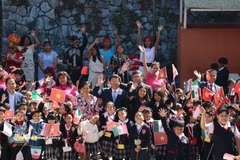
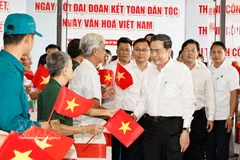
The Vietnamese delegation takes photo with students at the primary school named after the Socialist Republic of Vietnam (Photo: VNA)

CPV values traditional friendship with Mexican Labour Party

Deputy head of the CPV Central Committee’s Commission for Publicity Tran Thanh Lam proposed deeper theoretical exchanges and sharing of experience in Party building and national development; stronger cooperation in education, science, culture, external information, press, publishing and traditional medicine.

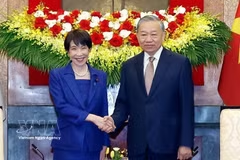
General Secretary of the Communist Party of Vietnam (CPV) Central Committee and President To Lam and Japanese Prime Minister Sanae Takaichi during her official visit to Vietnam in May, 2026. (Photo: VNA)

Top Vietnamese leader’s Japan visit to open up new space for bilateral cooperation

The visit is expected to further deepen ties through Party, State, parliamentary and people-to-people channels, while creating breakthroughs in economic, financial, scientific and technological cooperation, innovation, education and training, digital and green transformation, and supply chain diversification, thereby contributing to a peaceful and stable environment for development in both countries.

Politburo Member and Head of the Party Central Committee’s Commission for Publicity Trinh Van Quyet (R) meets with Jiri Mäntysalo, Vice Chairman of the Communist Party of Finland. (Photo: VNA)

Vietnam, Finland move to strengthen political trust, expand cooperation

Politburo Member and Head of the Party Central Committee’s Commission for Publicity Trinh Van suggested that Finland further promote its role as a bridge between Vietnam and the European Union (EU), while Vietnam could serve as a bridge between Finland and the Association of Southeast Asian Nations (ASEAN). He called for effective utilisation of the EU-Vietnam Free Trade Agreement (EVFTA) and urged Finland to encourage the remaining EU member states to ratify the EU-Vietnam Investment Protection Agreement (EVIPA) at an early date.

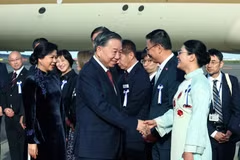
Representatives of the Japanese State and the Embassy of Vietnam in Japan welcome General Secretary of the Communist Party of Vietnam Central Committee and President To Lam and his spouse at Haneda International Airport in Tokyo. (Photo: VNA)

Top Vietnamese leader begins official visit to Japan

The visit is expected to further translate the potential and achievements of bilateral cooperation into concrete outcomes, strengthen the longstanding bonds between the two countries and ensure that the friendship nurtured across generations continues to deliver lasting benefits to both peoples.

General Secretary of the Communist Party of Vietnam Central Committee and President To Lam, his spouse Ngo Phuong Ly and a high-ranking Vietnamese delegation leave Hanoi on November 8 for a four-day official visit to Japan at the invitation of the Japanese State. (Photo: VNA)

Top leader and spouse depart for official visit to Japan

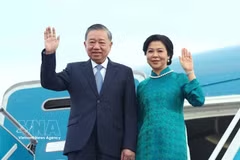
General Secretary of the Communist Party of Vietnam Central Committee and President To Lam, his spouse Ngo Phuong Ly and a high-ranking Vietnamese delegation left Hanoi on November 8 for a four-day official visit to Japan at the invitation of the Japanese State.

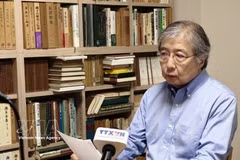
Toshiro Nishizawa, a Senior Fellow at Graduate School of Public Policy under the University of Tokyo in an interview with the Vietnam News Agency (VNA)'s correspondent in Japan (Photo: VNA)

Top leader’s visit to deepen Vietnam-Japan strategic cooperation: expert

The upcoming visit to Japan by General Secretary of the Communist Party of Vietnam Central Committee and President To Lam is expected to give fresh impetus to the Vietnam-Japan Comprehensive Strategic Partnership, reflecting the strategic priorities of both countries, according to a Japanese expert.

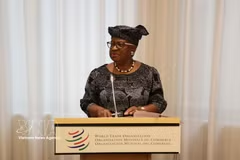
WTO Director-General Ngozi Okonjo-Iweala speaks at the event (Photo: VNA)

WTO hails Vietnam’s 20-year journey since accession

Joining the WTO was a strategic choice for Vietnam, closely associated with its Doi Moi (Renewal) process, opening-up policy and international economic integration. Over the past two decades, international economic integration has become a driving force for institutional reforms, trade expansion, foreign investment attraction and enhancement of the country's international standing.

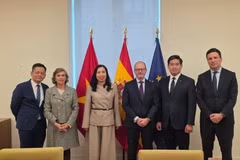
Vietnamese Deputy Minister of Foreign Affairs Le Thi Thu Hang (third, left) and other delegates at the political consultation (Photo: The Ministry of Foreign Affairs)

Vietnam, Spain seek to deepen Strategic Partnership

Vietnam asked Spain to continue voicing its support for and urging the European Commission (EC) to swiftly lift the IUU “yellow card” imposed on Vietnamese seafood, while actively encouraging EU member states to ratify the EU-Vietnam Investment Protection Agreement (EVIPA) at an early date.

Standing Deputy Minister of Foreign Affairs Nguyen Minh Vu (Photo: Ministry of Foreign Affairs)

Top leader's official visit to Japan carries three major strategic implications: Deputy FM

The visit, the first to Japan by the leader in his new capacity and the first visit to Japan by a General Secretary of the Communist Party of Vietnam in 11 years, will first set the overall strategic direction for bilateral relations in the new period, enabling leaders of the two countries to identify long-term cooperation orientations and priority areas that meet the development needs of both sides.