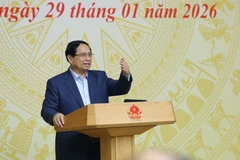
Dien Bien (VNA) - For border and remote areas, education is not only about raising public awareness and training human resources, but also a fundamental, long-term solution to safeguarding national sovereignty at its root — the people, Party General Secretary To Lam affirmed on January 31.
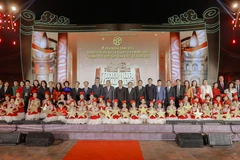
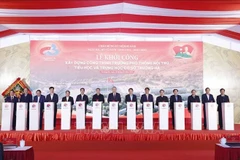
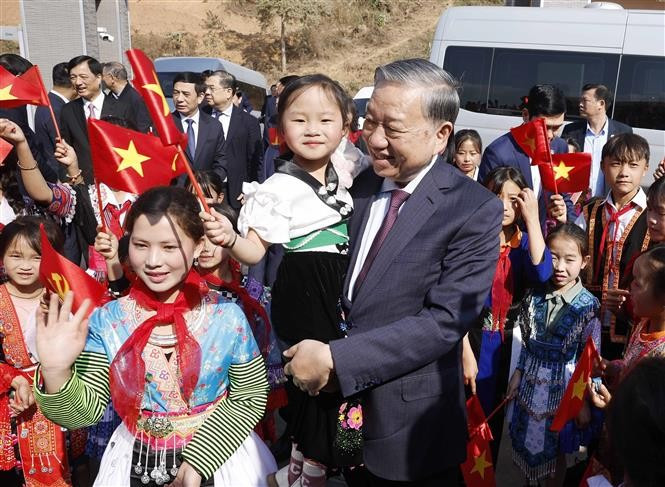
The leader made the remarks while attending the inauguration of Si Pa Phin Boarding Primary and Secondary School in Nam Chim 1 hamlet, Si Pa Phin commune, Dien Bien province.
This is among the first of the 248 inter-grade boarding schools to be built in 248 mainland border communes, in line with a Politburo directive.
The completion and commissioning of the project is of great significance, celebrating the success of the 14th National Party Congress and serving as vivid proof of the Party and State’s deep commitment to education and training, particularly in ethnic minority, mountainous and border areas.
General Secretary Lam commended efforts by local authorities, the responsible and heartfelt support from the Party organisation, administration and people of Hanoi, the close coordination of ministries and agencies, and the active engagement of businesses during the project implementation.
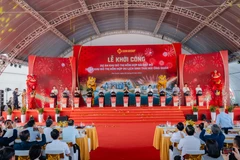
He stressed that to date, the first 100 schools under the programme have broken ground in border communes across 18 provinces and cities. Many are being implemented at a fast pace with assured quality, while most are on schedule and aiming for completion before August 30, 2026, in time for the 2026–2027 academic year.
At the inauguration ceremony, the Party chief officially launched the simultaneous construction of the remaining 148 schools.
He asked localities to prepare cleared sites, essential infrastructure and on-site implementation conditions. The leader said the Government would ensure adequate financial resources and promptly address bottlenecks in mechanisms and policies. The Ministry of Education and Training was tasked with ensuring teaching staff, curricula and education quality, while relevant ministries and agencies were urged to coordinate in refining boarding policies and benefits for teachers and students to enable schools to operate stably over the long term.

The Party and the State will continue to study and expand the inter-grade boarding school model to non-border areas that remain especially disadvantaged and have large ethnic minority populations, with the aim of gradually narrowing development gaps and ensuring equity in access to education across regions, he noted.
The General Secretary affirmed that the inauguration of the school is not only a source of pride for the local community, but also an important milestone in translating the Party’s education policy into reality, for the country’s future and the people’s well-being.
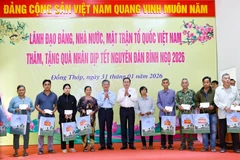
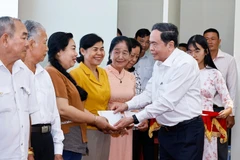
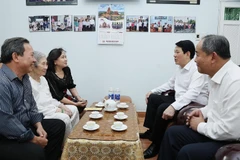
On this occasion, General Secretary Lam and officials presented gifts to the school’s teachers and students, and witnessed the signing of cooperation agreements between Nguyen Tri Phuong Secondary School in Hanoi and the Si Pa Phin Boarding Primary and Secondary School.
Located nearly 100 kilometres from Dien Bien’s centre, construction on the 6.88-hectare Si Pa Phin Boarding Primary and Lower Secondary School began in late July 2025. The project was carried out by the consortium of Sun Group and Construction and Trading Company No. 6, with funding from Hanoi and socialised capital.
The school is equipped with modern, integrated facilities and full amenities, meeting the learning and boarding needs of more than 1,000 students.
Accordingly, the academic complex includes 31 standard classrooms, 14 subject-specific rooms, music and STEM rooms, and a library system. There are also 120 dormitory rooms for students and 15 apartments for teachers./.