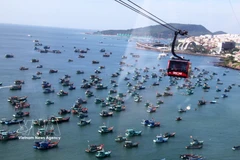
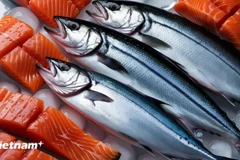
An Giang (VNA) - The Phu Quoc fish sauce craft, which has taken shape and developed for more than 200 years, was recognised a national intangible cultural heritage in 2021. Proud of their local traditional craft, local producers are devoted to preserving and developing it, bringing the brand further into the global market.
Determined to preserve the brand
Nguyen Huynh Anh Khoa (34 years old), Director of Huynh Khoa Fish Sauce Trading Co., Ltd., in Suoi Da hamlet, Phu Quoc special zone, in the southern province of An Giang, is one of the young, passionate, and successful individuals dedicated to preserving, developing, and elevating the Phu Quoc fish sauce brand in general, and the Huynh Khoa brand in particular.
After graduating from university with a degree in accounting, Khoa was hired to work in his field at a major corporation in Ho Chi Minh City with a high income. However, having been born into a family with three generations devoted to the craft, he always felt compelled to contribute to preserving and developing the family’s fish sauce brand. In 2016, he decided to return to the “pearl island” of Phu Quoc to take over and join his family in developing and elevating the Huynh Khoa fish sauce brand, not only in the domestic market but also internationally.
According to Khoa, Huynh Khoa fish sauce originated from his grandparents’ small barrels of fermented anchovies, used for family meals and bartering before 1980. By his parents’ generation (after the 1980s), the family’s craft gradually expanded and developed, and in 1995, Huynh Khoa private enterprise was established with 50 fermentation barrels, producing mainly unrefined fish sauce.
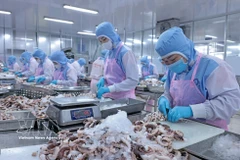
Since taking over in 2016, driven by a desire to expand the market and develop the brand, Khoa has not only increased the number of fermentation barrels from 50 to 120 but also allocated 30% of production to bottling and brand building. To ensure quality and reputation, Huynh Khoa fish sauce applies international standards such as HACCP, ISO, and HALAL, strictly controlling the production process from raw materials to finished products.
In addition, the facility focuses on developing products that meet OCOP (One Commune One Product) certification . By 2020, four of its products had achieved a 4-star OCOP rating. With the support of relevant agencies and local authorities in machinery and bottling lines, the facility continued to expand investment and gradually refine its standards. By 2023, three of its products had been recognised as national outstanding rural industrial products. At the end of June 2025, three of its products were awarded the national 5-star OCOP certification: Huynh Khoa Phu Quoc Fish Sauce 40°N, Huynh Khoa Phu Quoc Fish Sauce 43°N, and Huynh Khoa Phu Quoc Fish Sauce 45°N.
Currently, the facility has a total area of 4,000sq.m with more than 120 wooden fermentation barrels, supplying the market with 1 million litres per year. In June 2025, the first shipment was exported to the Australian market, where it received high praise from partners and consumers, creating favourable momentum for its journey to conquer international markets.
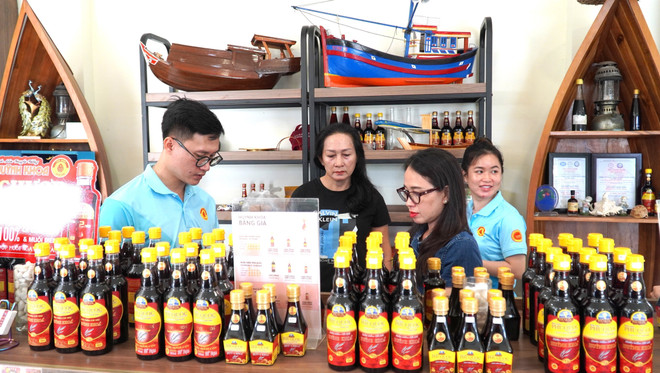
Next year, the facility will strengthen efforts to bring its products to markets with large Vietnamese communities and high demand for Vietnamese goods, such as the US and Europe. Along with domestic markets where its distribution network is focused in An Giang and other Mekong Delta provinces, the facility is now expanding to northern localities such as Hanoi, Hai Phong, and Nam Dinh.
Bringing Phu Quoc fish sauce to global stage
Khoa expressed his hope that in the coming time, authorities will strengthen the protection of geographical indications to prevent counterfeiting and imitation products that could damage the reputation of Phu Quoc fish sauce; support businesses in technological innovation and production standardisation to meet export requirements; and promote Vietnamese culture and cuisine associated with traditional fish sauce, so that the product is not only a seasoning but also a cultural ambassador.
Additionally, there needs to be a linked supply chain between anchovy suppliers, fish sauce producers, and distributors to ensure sustainable development together. In particular, fish sauce producers and business owners should collaborate closely with management agencies and the Phu Quoc Fish Sauce Association to preserve and enhance the traditional values, Khoa emphasised.
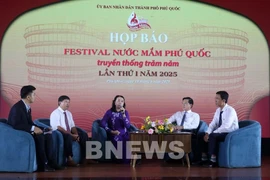
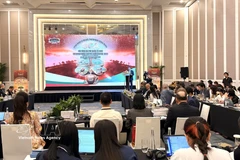
Pham Huynh Quoc Thanh, Vice President of the association, stated that the association currently has 50 members, including fermentation barrel owners and fish sauce production facilities, with over 7,000 wooden fermentation barrels producing nearly 30 million litres of fish sauce per year (with protein content of 25°N or higher).
Tran Minh Khoa, Chairman of the Phu Quoc Special Zone People’s Committee, stated that Phu Quoc recognises that the sustainable development of the fish sauce industry is an inseparable part of the local socio-economic development strategy.
Authorities will continue to accompany businesses and production facilities in implementing measures to protect intellectual property rights for geographical indications; promote trade and global marketing of the Phu Quoc fish sauce brand; and develop tourism linked to the traditional fish sauce craft, he added./.