Experts gather to chart course for Vietnam’s 2045 high-income status

Nearly 200 experts and scientists from universities and research institutes across Vietnam, Japan, and other regional countries gather at an international scientific workshop that opened in the central city of Da Nang on October 24 to strategise Vietnam's ascension to a high-income status by 2045.

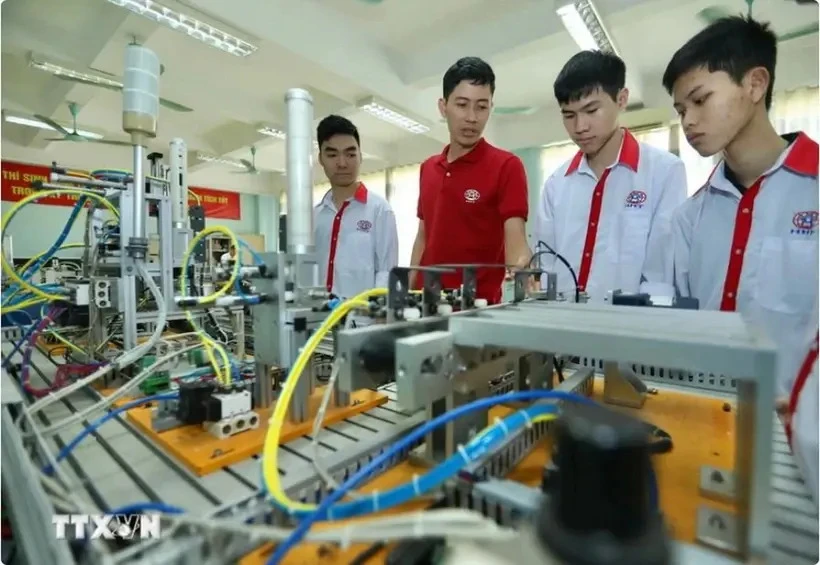
Illustrative image (Photo: VNA)

Da Nang (VNA) – Nearly 200 experts and scientists from universities and research institutes across Vietnam, Japan, and other regional countries gather at an international scientific workshop that opened in the central city of Da Nang on October 24 to strategise Vietnam's ascension to a high-income status by 2045.

Co-hosted by the Economic Research Institute for ASEAN and East Asia (ERIA) and Dong A University, the two-day event unveils key findings from the ERIA Report, a two-year research project titled "Vietnam 2045: Issues and Challenges for Development". This comprehensive study was submitted to leaders of both Vietnam and Japan in November 2023.

The workshop features four working sessions and a forum, bringing together 14 thematic reports offering insights into Vietnam's economic landscape.

The opening session set the tone with discussions on balanced development models, growth model transformation, and policies to avoid the middle-income trap. Speakers delve into the new wave of digital transformation, the fourth industrial revolution, the Internet of Things (IoT), and artificial intelligence (AI).

The subsequent sessions explore the impact of the external environment, drivers of industrial development, and emerging issues relevant to Vietnam's development goals until 2045.

Tran Van Tho, Emeritus Professor at Waseda University of Japan, stressed that escaping the middle-income trap and achieving sustained growth requires Vietnam to prioritise policies that foster industrialisation, support small- and medium-sized enterprises (SMEs), enhance manufacturing-driven markets, elevate education and training, and invest in research and development.

Prof. Yasuhiro Yamada, senior policy fellow at ERIA, underscored the necessity for Vietnam to achieve an annual growth rate of 5.4% to attain the status by the date. This goal necessitates productivity and industrial upgrades, and a shift from input-based growth to innovation-driven one, with key industries such as electronics, advanced agriculture, apparel, digital transformation sectors, automotive, health care, and energy poised to lead the charge toward a thriving circular economy.

Vice Chairwoman of the municipal People’s Committee Nguyen Thi Anh Thi called for ongoing reform and innovation to fuel economic growth. She highlighted the rapid advancement of the fourth industrial revolution, AI, and IoT as essential components of this transformative journey./.

VNA

See more

A production line for electrical wires at Bandai Vietnam Co., Ltd., in Bo Trai Industrial Park in Hoa Binh ward of Phu Tho province. (Photo: VNA)

High-quality FDI expected to drive new growth model

The resolution calls for a shift in development mindset, positioning FDI as a key driver of growth model transformation, with a focus on quality, value addition and continuous improvement of intrinsic capacity and self-reliance of the economy. Many experts and businesses believe the policy provides a timely strategic boost, helping Vietnam to capitalise on the ongoing global supply chain realignment.

Workers produce sportswear at AMPFIELD (Vietnam) Co., Ltd. in the Tan Binh Industrial Park, Ho Chi Minh City. (Photo: VNA)

Ho Chi Minh City shifts focus to new-generation FDI

Ho Chi Minh City is currently home to 20,259 FDI projects with total registered capital of nearly 142 billion USD from 152 countries and territories. In the first half of 2026, the city attracted more than 6.8 billion USD, fulfilling 62% of its annual target.

A shopper at a supermarket in Hanoi. (Photo: VNA)

Supermarkets expand promotion of OCOP, Vietnamese products

The campaign is expected to stimulate domestic consumption, boost retail sales, support economic growth, promote Vietnamese brands and encourage consumers to prioritise locally made products while attracting international visitors via shopping events.

Vietnamese Ambassador to Brazil Bui Van Nghi speaks at the seminar. (Photo: VNA)

Vietnam, Brazil seek ways to promote trade, investment cooperation

Vietnamese Ambassador to Brazil Bui Van Nghi informed that two-way trade reached 4.22 billion USD in the first six months of 2026, up 16.8% year-on-year. Brazil's exports to Vietnam exceeded 2 billion USD, rising 16.6%, while its imports from Vietnam totalled about 2.11 billion USD, an increase of 17%.

Wave Alpha, Honda Vietnam’s best-selling manual motorcycle model each month. (Photo: Bnews/VNA)

Honda Vietnam posts strong car sales growth, leads motorcycle market

The company sold 172,299 motorcycles in June, up 4.7% from the same month last year, highlighting steady consumer demand even as the market gradually shifts towards greener transport options. For the first six months of 2026, motorcycle sales reached 515,743 units, up 0.6% year-on-year.

Rice harvest in Xuan Giang commune, Ninh Binh province. (Photo: VNA)

Plan issued to develop agricultural logistics system

A key target is that by 2030, all concentrated agricultural, forestry and fisheries production areas will have access to essential services, including product traceability, quarantine, testing, quality certification, processing and market development. The move reflects growing international demand for stricter food safety, quality and traceability standards, which have become increasingly important for agricultural exports.