Firms advised to adapt to new EU standards to sustain exports

The move places stronger demands on Vietnamese exporters to ensure product quality and strict compliance if they wish to maintain stable market access.

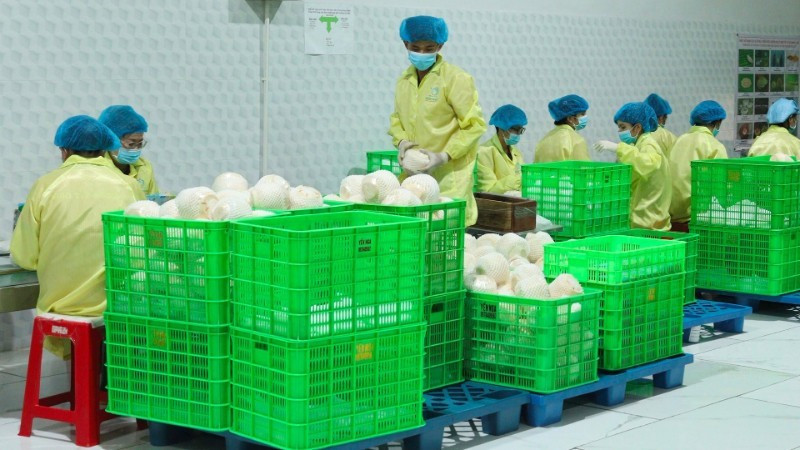
Workers package coconuts for export at an enterprise in Vinh Long province. (Photo: nhandan.vn)

Hanoi (VNA) – The European Union (EU) has announced it will increase food safety and sanitary and phytosanitary (SPS) inspections on imports from non-EU countries by 50%, while raising the number of audits at member states’ border control posts by 33%.

The move places stronger demands on Vietnamese exporters to ensure product quality and strict compliance if they wish to maintain stable market access.

According to Tran Ngoc Quan, Trade Counsellor at the Vietnam Trade Office in Belgium and the EU, Vietnam is currently the EU’s 17th largest trading partner. The country’s share of total EU imports has risen steadily, from 1.8% in 2023 to 2.28% in 2024, with a large proportion contributed by agricultural, forestry and aquatic products.

Entering its fifth year of implementation, the EU–Vietnam Free Trade Agreement (EVFTA) continues to reduce tariffs to 0% on many Vietnamese goods, enhancing price competitiveness. In the first 11 months of 2025, Vietnam’s coffee exports to almost all EU markets recorded strong growth, backed by ample supply. Exports to Germany exceeded 1 billion USD, up 97.5%, while shipments to Italy reached 615.8 million USD, up 52.9%. The EU also remains Vietnam’s fourth largest aquatic product export market.

However, the EU is now tightening requirements to ensure that imported products comply with the same strict food safety, environmental and animal welfare standards applied within the bloc. Alongside increased SPS checks, the EU is revising monitoring rules for pesticide residue, particularly for substances banned in Europe but potentially present in imported agricultural products. Substances recently reclassified by international organisations may also be incorporated into new EU law.

EU authorities are also intensifying efforts to combat trade fraud, so Vietnam must manage trade flows with both the EU and third countries more rigorously to prevent origin fraud that could undermine EVFTA benefits, Quan emphasised. He suggested Vietnam and the EU continue discussing trade-facilitation measures such as self-certification of origin, adding ST rice to tariff-rate quotas, and allowing exports of processed meat products to the bloc.

As one of Vietnam’s leading aquatic product exporters to the EU, Sao Ta Foods JSC (Fimex VN) invests heavily in global certifications for responsible aquaculture to meet strict hygiene and quality standards.

Its Chairman Ho Quoc Luc said the company is strengthening processed shrimp exports to the EU, focusing on high-value, deeply-processed products such as Nobashi shrimp and breaded and fried shrimp to enhance value and reduce competition pressures. With the EU increasingly prioritising traceability and sustainability, the company plans to expand its ASC-certified farming areas to secure stable raw material sources.

Vegetables and fruits are also under tighter scrutiny amidst ongoing EU warnings on certain Vietnamese products. To avoid rejection or destruction at EU borders, exporters must ensure compliance from cultivation to processing, strictly meeting SPS requirements.

Although the EU has adjusted some green transition policies, including delaying enforcement of the EU Deforestation Regulation (EUDR) to allow more preparation, Vietnamese enterprises are advised to stay updated, prepare early and proactively adapt.

At the same time, businesses are encouraged to rethink their market strategies, not only relying on import partners but also establishing a commercial presence in the EU to better connect with customers, manage logistics and ensure flexible, stable supply flows./.

VNA

See more

A nuclear reactor at the DaLat Nuclear Research Institute (Photo: VNA)

New decree sets roadmap for nuclear infrastructure and workforce development

The decree also covers simulation systems and databases for radiation safety, nuclear safety and nuclear security; specialised computational software for safety assessment; monitoring and command-and-control systems for responding to radiation and nuclear incidents; as well as design documentation, technical manuals, prototype products and other related facilities and equipment.

Hanoi's market surveillance team 2 inspects a shop in Hong Ha ward on July 14. (Photo: VNA)

Growing e-commerce market sees tougher fight against counterfeits

The local e-commerce market has surpassed 30 billion USD this year, recording growth of 25% and accounting for two-thirds of the value of the digital economy. However, this rapid growth has also brought about serious consequences, particularly the widespread proliferation of counterfeit and imitation goods and trade fraud.

The interest rate policy has been adjusted in line with market movements to ensure system liquidity and reduce capital costs. (Photo: VNA)

Banking sector anchors macroeconomic stability, setting stage for new growth cycle

Throughout 2025, the State Bank of Vietnam (SBV) has reaffirmed its role as the central regulatory authority in managing monetary policy, stabilising the financial market, and maintaining macroeconomic balance. Closely monitoring international and domestic economic trends, the SBV steered the monetary policy proactively while closely coordinating with the fiscal policy to achieve the dual objective of controlling inflation and supporting growth.

Professor Reena Marwah from the University of Delhi, and Secretary-General of the Association of Asia Scholars. (Photo: VNA)

Vietnam – A rising star in Asia: Indian professor

Vietnam’s projected GDP growth of around 8% in 2025 shows that its economy is on an impressive growth trajectory, driven by multiple reinforcing engines, said Professor Reena Marwah from the University of Delhi, and Secretary-General of the Association of Asia Scholars (AAS).

Harvesting jackfruit (Photo: VNA)

China to allow import of Vietnamese fresh jackfruits from June 1, 2026

To ensure smooth customs clearance, all orchards and packing facilities participating in exports must be registered and approved by competent authorities of both countries. The list of approved entities granted export codes will be published and regularly updated on the GACC website.

The fruit and vegetable sector is also set to hit a record, with exports projected at around 8.5 billion USD in 2025. (Photo: VNA)

Agro-forestry-fishery exports poised to hit record high in 2025

Agro-forestry-aquatic exports totalled 64.01 billion USD in the first 11 months of 2025. If performance in the final month matches that of recent months, the figure could approach 70 billion USD, far exceeding the 65-billion-USD target set for the year.

A view of Dinh Vu port in Hai Phong city. (Photo: VNA)

Circular on domestic maritime transport permits for foreign vessels issued

Under the circular, which will take effect from February 1 next year, the Minister of Construction will grant the permits for cases such as transporting oversized or overweight cargo or other types of goods using specialised vessels; clearing congested cargo, passengers, and luggage at ports when Vietnamese ships are unable to handle them; and conducting disaster relief, disease control, or emergency humanitarian aid.