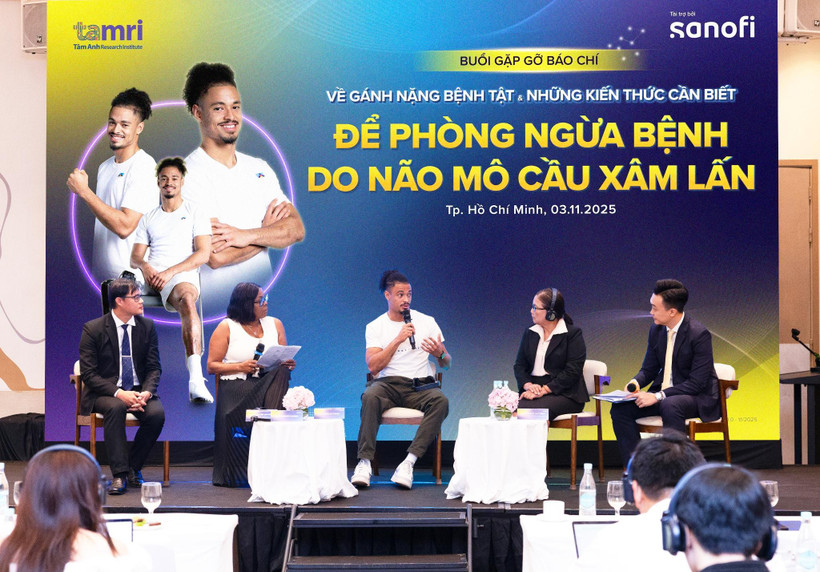
Hanoi (VNA) – “I had never even heard of meningococcal disease. The tragedy struck at a time when I believed I was in the prime of my youth,” mentioned Flavio Da Pozzo, who was forced to abandon his dream of becoming a professional footballer after undergoing a leg amputation at the age of 17 due to the illness.
Flavio and his mother, Catherine Nordey, shared their emotional journey of surviving the so-called “potentially 24-hour killer disease” during a press conference titled “The Burden of Disease and Essential Knowledge for the Prevention of Invasive Meningococcal Disease”, held on November 3 in Ho Chi Minh City.
The event was organised by the Tam Anh Medical Research Institute (TAMRI) with collaboration from Sanofi, as part of a global campaign to combat invasive meningococcal disease. The initiative aligns with the World Health Organisation’s (WHO) goal to eliminate meningitis by 2030.
During the discussion, 23-year-old French national Flavio recounted the life-altering moment that occurred just as he was on the verge of signing a professional football contract. Initially, he experienced what seemed like common flu symptoms—nasal congestion, fever, and a sore throat.
However, his condition rapidly deteriorated. He developed purpuric rashes on his heels, began vomiting, and became sensitive to light. Upon hospitalisation, doctors diagnosed him with meningococcal sepsis. His chance of survival was estimated at a mere 1%, and to save his life, one leg had to be amputated.
Catherine Nordey, Flavio’s mother, expressed profound grief upon learning that her previously healthy son had lost a limb to a disease that is preventable through vaccination. “Had I known earlier, I would have done everything in my power to prevent this. Protect your children before the disease strikes,” she implored.

Dr. Nguyen An Nghia, MD, PhD, Associate Head of the Department of Infectious Diseases and Neurology, Children's Hospital 1 in Ho Chi Minh City, explained that meningococcal disease is among the most dangerous acute infectious diseases. It is caused by the bacterium Neisseria meningitidis and can affect individuals of any age, often leading to death within 24 hours if left untreated.
“Without timely diagnosis and intervention, up to 50% of cases are fatal. Among survivors, approximately 20% suffer from severe complications such as limb amputation, hearing loss, neurological disorders, cognitive impairment, and long-term reduction in health and quality of life ,” Dr. Nghia emphasised.
Dr. Nghia noted that the bacterium spreads through respiratory droplets from infected individuals or asymptomatic carriers. Studies indicate that adolescents are twice as likely to contract meningococcal disease compared to the general population. This heightened risk is attributed to communal living environments such as dormitories, military barracks, and shared personal items, which facilitate transmission. Of particular concern is the incidence rate and mortality rate of serogroup W in adolescents.
In Vietnam, the dominant meningococcal serogroups vary over time, making epidemiological assessments and subsequent prevention challenging... This trend underscores the need for vigilant epidemiological surveillance and enhanced vaccination strategies.
Dr. Bach Thi Chinh, Medical Director of the VNVC Vaccination System, stated that Vietnam currently offers vaccines protecting against five major meningococcal serogroups: A, B, C, Y, and W-135.
“No single vaccine provides protection against all 5 serogroups in Vietnam. Therefore, a comprehensive immunisation strategy involving multiple types of meningococcal vaccines is essential. For e.g. many countries have already incorporated quadrivalent vaccines such as MenACYW into their routine immunisation schedules for adolescents”, Dr. Chinh advised.
In addition to vaccination, Dr. Chinh emphasised the importance of maintaining personal hygiene, ensuring well-ventilated living spaces, covering the mouth when coughing or sneezing, and avoiding close contact with infected or suspected individuals to minimise the risk of transmission./.