Vietnam affirms global standing in organ transplantation

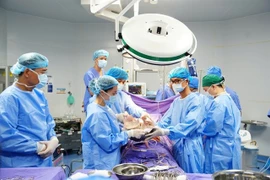
In mid-August, Viet Duc University Hospital announced that its doctors successfully performed Vietnam’s first-ever combined heart–lung transplant, marking a major step forward for the country’s medical field.

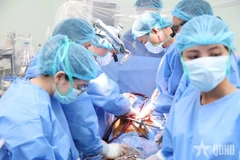
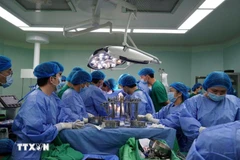
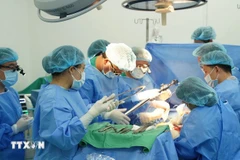
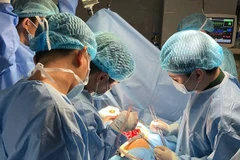
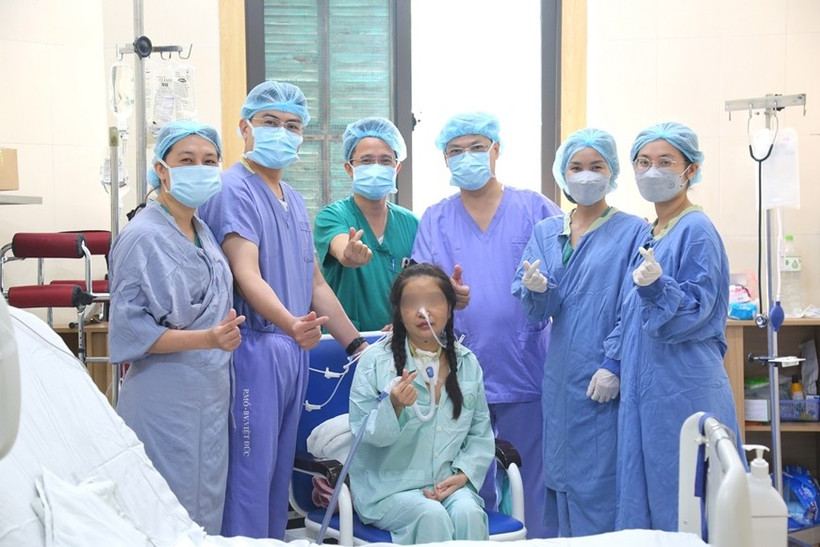
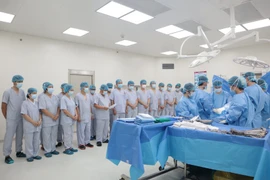
Doctors and nurses of Viet Duc University Hospital are with the patient who receives the first simultaneous heart-lung transplant in Vietnam. (Photo: Provided by the hospital)

Hanoi (VNA) – Vietnam’s achievements in organ transplantation have earned global recognition, placing the country among the few nations capable of performing the most complex multi-organ transplants in the world.

In mid-August, Viet Duc University Hospital announced that its doctors successfully performed Vietnam’s first-ever combined heart–lung transplant, marking a major step forward for the country’s medical field.

“With this success, we have proudly raised Vietnam’s red flag on the world’s map of multi-organ transplantation,” said the hospital's Director Professor Duong Duc Hung.

This represents a breakthrough in Vietnam’s medical capacity and opens new hope for patients with end-stage organ failure, he said.

The 38-year-old patient, Tran Nhu Q., was critically ill before surgery, with only days to live. She suffered from Eisenmenger syndrome, severe right heart failure, and serious tricuspid valve leakage. The donated organs also posed challenges. The lungs were infected with drug-resistant bacteria and were larger than the recipient’s chest cavity. Despite the odds, the medical team decided to operate, knowing that without surgery, there was no chance of survival.

Associate Professor Pham Huu Lu, Deputy Head of the Department of Cardiovascular and Thoracic Surgery, explained that the team used extracorporeal circulation to temporarily replace both the heart and lungs during the surgery, which lasted seven hours.

“We had to ensure the heart functioned well while preventing fluid overload that could cause pulmonary oedema,” he said. “We minimised anaesthesia and used advanced hemodynamic monitoring systems.”

To fit the new lungs into the chest cavity, surgeons carefully reduced their size and adjusted the connection technique, switching from the trachea to the two main bronchi, to improve blood circulation. Every step required absolute precision, with bronchoscopic checks conducted during surgery to inspect each connection.

Vietnam started organ transplantation much later than other countries, but has made remarkable progress over the past three decades.

The nation’s first kidney transplant was carried out in 1992 at the 103 Military Hospital, marking the beginning of its transplant journey. Early operations mainly involved kidney and liver transplants from living donors due to limited legal and community support for organ donation after brain death.

A turning point came in 2010, when Vietnamese doctors performed the first heart transplant from a brain-dead donor, a landmark achievement in the country’s medical history.

By 2020, Vietnam recorded two world-class medical milestones, the first limb transplant in Southeast Asia and the world’s first limb transplant from a living donor, conducted at the 108 Central Military Hospital.

The same year, the103 Military Hospital performed the first two intestinal transplants, completing Vietnam’s ability to transplant all six major organs, like kidney, liver, heart, pancreas-kidney, lung, and intestine. That success placed Vietnam among the 20 countries worldwide mastering these high-end techniques.

In 2024, Viet Duc University Hospital achieved another breakthrough with the simultaneous heart and liver transplant, a surgery previously performed only in a few advanced nations such as the US and those in Europe. And this year, the hospital again made history with the country’s first combined heart–lung transplant, one of the most complex operations in global medicine.

Globally, such surgeries are extremely rare - only around 100 cases per year - due to the scarcity of suitable organs and the high risk of complications. Survival rates, however, have improved significantly, at about 85% after 90 days and 72% after one year in the UK, and nearly 90% after one year in the US.

According to the Director of the Department of Medical Services Administration under the Ministry of Health, Dr Ha Anh Duc, these achievements are “a source of pride for Vietnam’s healthcare system and clear proof that our doctors can conquer challenges once thought impossible.”

“Although we began later than many countries, Vietnam has now reached the same level as global medical powers in organ transplantation,” Duc said. “The success comes from our doctors’ expertise, teamwork, and unwavering determination.”./.
VNA

See more

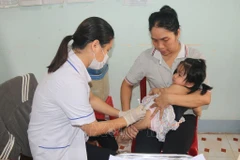
A health worker administer IPV polio vaccine to a child in Dong Thap province. (Photo: VNA)

Vietnam proactively takes polio prevention measures amid outbreak in Laos

The meeting took place following an assessment by the World Health Organisation (WHO) warning that Vietnam is facing a very high risk of polio import and re-emergence. The risk arises after neighbouring Laos officially declared a polio outbreak on October 7, following the detection of circulating vaccine-derived poliovirus type 1 (cVDPV1).

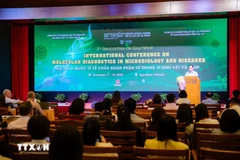
A view of the International Conference on Molecular Diagnostics in Microbiology and Diseases, organised by Rencontres du Vietnam and the International Centre for Interdisciplinary Science and Education (ICISE) in the central province of Gia Lai on December 11. (Photo: VNA)

Nearly 100 international scientists attend molecular diagnostics conference in Vietnam

The conference features almost 80 presentations across plenary sessions, parallel sessions and poster sessions, focusing on leading research trends such as point-of-care diagnostics; predictive biomarkers used to anticipate individual responses to therapy; and the development of new tools and platforms for rapid molecular-level detection and diagnosis.

Digital transformation in healthcare is being strongly promoted. (Photo: Organising Committee of the 2024 “Technology with Heart” Award, co-hosted by Vietnam News Agency and Viettel)

AI and precision medicine: Emerging prospects for Vietnam-Canada cooperation

Canada has strong experience in compiling and analysing genomic data, while Vietnam has a large population with diverse genetic structures. This complementarity can help Vietnam narrow its technological gap and enhance its capacity to treat rare diseases — an area many countries are prioritising for development.

Maternal and child healthcare in Tuyen Quang province. (Photo: VNA)

Vietnam on path to become a healthy nation

Resolution 72 not only focuses on health care but is also closely interlinked with other sectors, helping to build a solid foundation for sustainable national development and create momentum for Vietnam to “take off” and further integrate into the world.

The emergency ward at Bach Mai Hospital, Hanoi. (Photo: VNA)

Health sector targets free hospital fee for all

The total value of medical expenses not covered by the health insurance fund is estimated at around 24.8 trillion VND (942 million USD) per year. Health insurance contributions remain low, at 4.5% of the salary or reference base used for calculation.

Sen. Lieut. Gen. Vongsone Inpanphim, Lao Deputy Minister of National Defence and Director of the General Department of Politics presents the Friendship Order of Laos to Vietnam’s Central Military Hospital 108. (Photo: VNA)

Vietnam, Laos expand cooperation in military medicine

Over the past two decades, many Vietnamese experts have undertaken long-term missions at the Central Hospital 103 to provide training and technical assistance, contributing to the successful treatment of complex cases. The Central Military Hospital 108 has also trained 206 Lao doctors, six nurses and two engineers — a clear demonstration of substantive, long-standing cooperation.

Deputy Minister Do Xuan Tuyen (left) and Alberto Anaya Gutiérrez, General Secretary of the Mexican Workers' Party (PT). (Photo: VNA)

Vietnam, Mexico boost medical cooperation

As both nations look to keep their long-standing partnership in good health, the health ministries of Vietnam and Mexico have been accelerating cooperation, especially in traditional medicines.

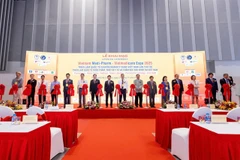
The opening of Vietnam Medi-Pharm 2025 and Vietmedicare Expo in Ho Chi Minh City on November 27, 2025. (Photo: VNA)

Major medical, pharmaceutical exhibitions kick off in HCM City

The 33rd Vietnam International Medical and Pharmaceutical Exhibition (Vietnam Medi-Pharm 2025) and the International Exhibition on Pharmaceuticals, Medical Devices and Healthcare (Vietmedicare Expo 2025) kicked off at the Saigon Exhibition and Convention Centre on November 27.

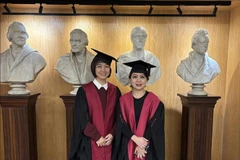
Doctors Do Thi Ngoc Linh (left) and Le Diep Linh at the RCS membership certificate award ceremony in London. (Photo: VNA)

Vietnamese surgeons honoured with prestigious Royal College Fellowship

The fact that the Vietnamese doctors have been awarded with FRCS certificate proves Vietnam’s surgical expertise has met international standards, contributing to improving the quality of treatment at home, expanding academic cooperation with world leading medical institutions and inspiring younger doctor to pursue higher standards.

Doctors from Military Hospital 175 perform surgery on a patient on Truong Sa Island. (Photo: Military Hospital 175)

First successful open-chest surgery performed at Truong Sa infirmary

The successful emergency operation on a patient with serious chest injuries in Truong Sa showed that Vietnam’s military medical forces are now capable of handling complex emergencies at sea, boosting the confidence of soldiers and fishermen living and working on remote islands.