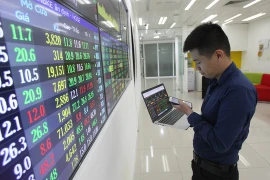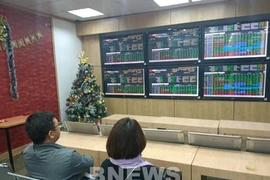
Hanoi (VNS/VNA) - The domestic stock market has seen an impressive performance of mid- and small-cap stocks, outperforming the market average.
However, experts warn investors to assess valuation levels against the growth potential of these companies for informed decisions.
Post-Lunar New Year, there has been a notable improvement in market liquidity, with funds spreading across various sectors, leading to an overall increase in stock prices.
The VN-Index has risen for five consecutive weeks, surpassing the significant 1,300-point threshold, a level it struggled to breach throughout 2024.
Average trading value since early February has reached approximately 17.5 trillion VND (684.5 million USD) per session, marking a 36% increase compared to January. In the most recent week, liquidity exceeded 20 trillion VND per session.
However, when compared to the same period last year, February's liquidity was down by 25%, and year-to-date figures show a 28% decrease.
During this period, mid- and small-cap stocks, particularly in sectors like mining, building materials, construction, rubber and chemicals, have experienced significant price increases.
The market surpassing the 1,300-point threshold, driven by mid- and small-cap stocks, is seen as a positive signal, especially amid global market volatility.
In February, the top ten best-performing stocks were dominated by the mining sector (Yen Bai Industry Mineral JSC, Fecon Mining, Becamex) and financial services sector (Icapital Investment JSC, APG Securities, Ocean Group JSC).
The recent surge in mineral stocks can largely be attributed to escalating trade tensions among major economies, said Lam Gia Khang, Head of Market Strategy at VietinBank Securities.
With China tightening export controls on key raw materials, particularly strategic metals and minerals, supply chain disruptions have driven investors toward these stocks.
However, after a strong rally, investors should be cautious. Despite the price surge, profits after tax in this sector have remained low in recent years, making valuations less attractive and raising the risk of short-term corrections.
Meanwhile, some non-life insurance stocks have been gaining momentum, partly due to a recovery in insurance demand after the crisis of confidence at the end of 2022.
Vietnam’s insurance market still has substantial growth potential. By the end of 2024, the insurance penetration rate (measured by premiums as a percentage of GDP) is expected to range from 2.3% to 2.8%, which is still lower than the ASEAN average of 3.35%, Asia’s 5.37% and the global average of 6.3%.
However, with many insurance stocks rising sharply and even reaching new highs, there is a risk of a market correction, especially as companies face pressure to cover claims from Typhoon Yagi, which struck in early September 2024.
Cautious approach
The stock market is expected to see strong divergence in 2025, creating opportunities for portfolio restructuring and new investments.
According to Khang, investors should focus on mid- and small-cap stocks in sectors benefiting from Government and Central bank policies aimed at achieving at least 8% GDP growth, such as civil construction, infrastructure and public investment.
Stocks like Tradico, which maintained over 110 billion VND in annual net profit (2022–2024) despite industry-wide losses, and PV Coating, which is set to gain from the Block B - O Mon project, are worth considering, he added.
The project could generate over 3.14 billion VND in revenue and 471 billion VND in profit after tax, a significant jump from previous years.
However, Le Duc Khanh, Head of Research at VPS Securities, notes that the recent rally in mid- and small-cap stocks is largely a recovery after prior declines.
For sustained market growth, blue-chip stocks must regain momentum. He expects capital to shift back to these larger stocks.
Bui Van Huy, Head of Investment Research at FIDT, agrees, arguing that large-cap stocks with stable price consolidation offer a more reasonable investment strategy than overheated smaller stocks.
The 2025 market will revolve around economic growth, public investment and market upgrades. Sectors with strong potential include banking, construction, building materials, retail and consumer goods.
Huy expects clearer opportunities in late 2025, as neither global nor Vietnamese markets have undergone significant corrections despite macroeconomic uncertainties. Recommended long-term picks include banking, steel and construction, attractive options if prices adjust, he said./.
See more
Can Tho city courts global investors to accelerate energy ambitions
Rising interest from major global players underscores Can Tho city’s growing appeal as an investment destination. Clean energy, particularly wind power, has been identified as a strategic pillar to drive socio-economic growth while strengthening energy security across the Mekong Delta.
Vietnam, US work to step up agricultural cooperation
Vietnam has strengths in tropical farm produce, seafood and wooden products, while the US is a major supplier of key inputs such as soybeans, corn, wheat and dairy products. This trade structure creates a balanced supply chain with little direct competition, delivering tangible benefits to businesses and consumers in both countries.
Vietbuild Hanoi 2026 International Exhibition opens
The five-day event, themed “Construction – Building Materials – Real Estate – Green Transport”, brings together more than 2,500 booths from domestic and international enterprises, reflecting the development momentum of Vietnam’s construction sector and the broader economy.
Vietnam reinforces role as key regional electronics manufacturing hub
Korean technology corporations are intensifying investment in Southeast Asia to diversify supply chains and leverage cost advantages, with Vietnam remaining a focal destination thanks to its strategic location and abundant labour force.
Global Coffee Alliance launched to drive sustainable, inclusive growth
The Global Coffee Alliance is envisioned as a public–private partnership that bridges diplomatic efforts with business operations. Looking ahead to 2040, it aims to develop a global coffee ecosystem that is inclusive, technology-driven, and aligned with net-zero emissions goals.
Vietnam races to restart idle ethanol plants to meet surging demand
Do Van Tuan, Chairman of the Vietnam Biofuels Association, said that monthly ethanol demand for the E10 blend is projected at 92,000–100,000 cu.m. The country’s six ethanol plants have a combined design capacity of roughly 41,000 cu. m per month, but only three are now running, churning out about 25,000 cu.m, or just 25–27% of demand. Even if every plant hits full tilt, local supply would cover only around 41% of national needs.
Sun PhuQuoc Airways partners with Korean GSA, set to launch two new routes in 2026
During the seminar, Sun PhuQuoc Airways announced the opening of ticket sales for its direct Seoul (ICN) – Phu Quoc (PQC) route, scheduled to commence on April 17, with an initial frequency of one flight per day, increasing to two daily flights in the next phase.
Ho Chi Minh City to pilot pork trading on Mercantile Exchange of Vietnam
Nguyen Nguyen Phuong, Deputy Director of the municipal Department of Industry and Trade, said listing pork on the MXV will finally give consumers and firms more stable prices, while slapping on stricter food safety rules and making it easier to track where the meat actually comes from. Farmers, meanwhile, stand to gain from more predictable margins and dodge fewer of the supply-demand imbalances that routinely distort prices.
Squid, octopus exports pick up early in 2026
In terms of product structure, squid has emerged as the main growth driver. Export turnover of squid exceeded 64 million USD, rising nearly 30%, while octopus exports brought in more than 47 million USD, up over 16%. The development indicates that demand for squid products is recovering faster in the short term.
An Giang steps up tourism development ahead of APEC 2027
Tourism in the province has recorded strong growth, affirming its position as one of the region’s leading destinations. Phu Quoc Island continues to attract the majority of international travellers, receiving more than 817,660 visitors, accounting for over 98.5% of total foreign arrivals to the province.
Reducing risks, removing logistics bottlenecks amid Middle East volatility
According to Truong Xuan Trung, Trade Counsellor of Vietnam in the UAE, the Middle East serves not only as a consumption market but also as a key global transhipment hub, meaning instability in the region creates ripple effects across intercontinental transport networks. Shipping route adjustments and airspace restrictions have lengthened transit times, increased costs and disrupted delivery schedules, with some Vietnamese shipments forced to reroute or seek alternative markets.
Senior housing emerges as high-potential segment in Vietnam
Major developers such as Vingroup, Sun Group and Tran Anh Group have already announced plans to enter the segment, signalling increasing investor interest in what is widely seen as an underdeveloped but promising market.
Businesses seek “survival momentum” amid global geopolitical turbulence
This is an urgent move as the challenges of 2026 differ markedly from previous ones, shaped by overlapping external shocks ranging from geopolitical tensions disrupting supply chains to surging logistics and raw material costs, exchange-rate pressures, and increasingly complex tariff barriers in global markets.
Reference exchange rate drops slightly on March 26
The State Bank of Vietnam set the daily reference exchange rate at 25,102 VND/USD on March 26, down 2 VND from the previous session.
Financial infrastructure - a critical enabler of sustainable cross-border e-commerce
Vietnam’s fast-growing e-commerce sector is increasingly viewed as a potential contributor to export growth. As the ecosystem matures, the focus is shifting from simply selling across borders to building the operational capacity required to run global businesses at scale.
Ho Chi Minh City gives boost to supporting industry firms
Supporting industry firms in Ho Chi Minh City are scrambling to embed themselves more deeply into both global and domestic supply chains, backed by a suite of local incentives that are speeding up their tech upgrades and market access.
Italian food firms eye opportunities in Vietnam
Italy’s exports of food and beverages to Vietnam reached 105.1 million EUR in 2025, up 4% year-on-year, positioning the country among the leading EU suppliers to the Vietnamese market.
German firms expand workforce cooperation with Vietnam’s labour market
BGWind GmbH, a member of the network of the German Association of Small and Medium-Sized Businesses (BVMW), intends to organise recruitment trips to Vietnam roughly once a month, with the next visit expected in late April 2026.
Quang Ninh promotes all-round cooperation with Guangxi Zhuang Autonomous Region
Quang Ninh encourages Guangxi enterprises to invest in high-tech marine aquaculture and expand aquatic product exports in China. At the same time, the province aims to develop livestock farming in line with international standards and attract investment in deep-processing plants for agricultural products such as cinnamon, star anise and tea, linked with traceability systems at border gates.
Vietnam becomes fastest growing market for Norwegian salmon in Southeast Asia
The Norwegian Seafood Council (NSC) reported at the “Norwegian seafood industry in Vietnam market 2026” event held in Ho Chi Minh City on March 25 that fresh Norwegian salmon exports to Vietnam jumped 16% in volume in the first two months of 2026 compared with a year earlier, while frozen salmon shipments surged about 37%.