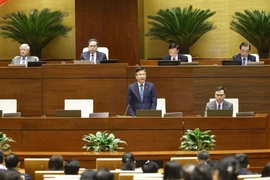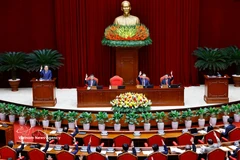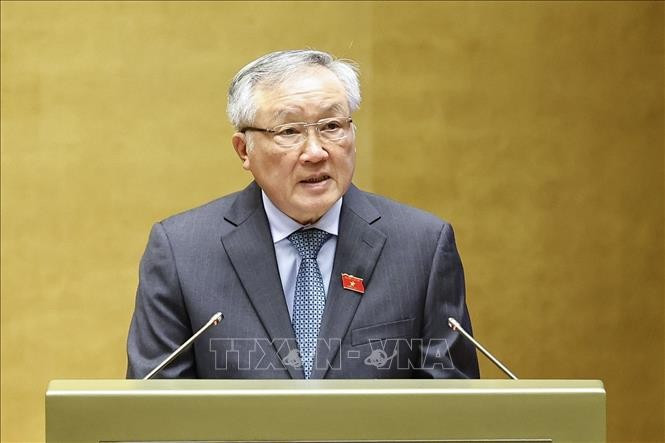
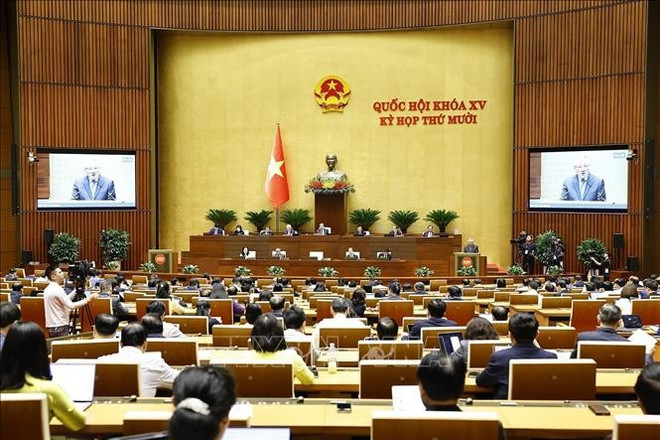
Hanoi (VNA) – Permanent Deputy Prime Minister Nguyen Hoa Binh on December 3 presented a government report on the implementation of 16 resolutions of the National Assembly (NA) in the 14th and 15th terms related to thematic supervision and questioning activities at the legislature's 10 session.
According to the Deputy PM, over the past period, the Government has taken strong and comprehensive actions, achieving significant progress in many areas. Numerous tasks have been completed with results described as “highly commendable,” while some issues have seen initial improvements and others require continued attention in the coming time.
Strengthening fiscal and legal foundations
In the financial sector, the Government and the Prime Minister have directed the review of 12 laws and submitted eight laws to the NA concerning the state budget, pricing, state capital management at enterprises and related taxation matters. Of 111 national master plans, 108 have been approved, with efforts ongoing to address bottlenecks in planning, administrative boundary adjustments and two-tier local administration organisation.
Budget estimate, allocation, management and use have been tightened. The Government has also focused on removing obstacles to long-delayed projects; improving the legal framework; implementing measures to revive the corporate bond market; maintaining a positive national credit rating; and effectively deploying fiscal and monetary policies under the Socio-Economic Recovery and Development Programme.
Monetary policy and banking system reforms
The Government has guided monetary policies in a proactive, flexible and timely manner, coordinated closely with a reasonably expansionary fiscal policy. This approach has supported macroeconomic stability, inflation control, growth promotion and maintenance of major economic balances.
Key actions include improving the legal framework governing banking activities; reducing risks; and implementing mandatory transfers for three zero-priced banks and Dong A Bank. As of October 2025, the on-balance-sheet non-performing loan ratio stood at 1.64%. Measures to stabilise the gold market have also been adopted.
Industry, trade and energy transition
The Government has issued decisions to adjust Power Development Plan VIII and its implementation roadmap; approved mechanisms for direct electricity sales between renewable energy producers and large consumers; and introduced incentives for rooftop solar development across residential, institutional and industrial facilities. The Quang Trach–Pho Noi 500-kV transmission line was completed ahead of schedule.
Market supervision, e-commerce management and anti-smuggling campaigns have been intensified, producing positive results.
Progress in agriculture, environment management
Significant progress has also been made in agriculture and environmental management. The Government has focused on resolving obstacles in the implementation of laws on land, minerals, geology and forestry; approved strategies for sustainable agriculture and rural development for 2021–2025; and adopted restructuring plans for the agricultural sector. It has also endorsed national master plans for the forestry, fisheries and environment sectors, and launched the one-million-hectare low-emission high-quality rice project. Data systems have been advanced, with cadastral data now covering nearly 57 million land plots in all 34 provinces and cities under the new administrative model. Digital transformation and technological adoption have been expanded, particularly in disaster response and the monitoring of offshore fishing vessels.
Infrastructure and social housing priorities
The Government has implemented synchronised measures under the programme to develop at least one million social housing units. Priority investment continues for strategic infrastructure projects such as the eastern North–South Expressway, ring roads in Hanoi and Ho Chi Minh City, and Long Thanh International Airport. Of the planned expressway network, 2,476 km has been completed, with a target of surpassing 3,000 km by the end of 2025. Approximately 1,397 km of coastal roads are now operational, with the aim of exceeding 1,700 km by late 2025. Electronic toll collection has been deployed at all BOT stations nationwide, while traffic accidents have decreased across all three key indicators.
Science, technology and national digital transformation
The Government has submitted to the Party Central Committee and the Politburo three key resolutions and conclusions on breakthroughs in science, technology, innovation and national digital transformation; biotechnology development; and national standards and quality infrastructure. Policies have been adopted to shift science and technology management to an output-based mechanism, encourage business investment in R&D, expand the corporate science and technology development fund, and create conditions for cooperation between enterprises and research institutions.
The Government has also rolled out national digital transformation strategies; developed a national digital infrastructure plan; completed the 2023 Telecommunications Law and related decrees; and promoted the development of a competitive and innovative telecommunications market.
Education reform for rapid, sustainable development
Major breakthroughs in education and training have been prioritised. The Government has submitted Resolution No. 71-NQ/TW on educational reform to the Politburo and presented the Law on Teachers and two resolutions to the NA on tuition exemption and support for preschool and general education students, and on universalising preschool education for children aged 3–5. Three draft laws amending the Laws on Education, Higher Education and Vocational Education have been submitted to the NA for consideration at this session.
Educational strategies and master plans have been issued, along with regulations on decentralisation aligned with the two-tier local administration model. Construction has begun on 100 new inter-level boarding schools in border communes, to be completed before August 30, 2026, with 148 additional schools to follow. The Government is reviewing public service units, preparing to implement a unified national textbook set for the 2026–2027 school year, and expanding AI training programmes and talent development centres. Vietnam strives to be among the world’s top 21 countries expected to meet the UN’s 2030 target for quality education./.