Green production, a game changer for the food industry

Adopting green production and consumption not only reduces negative environmental impacts but also secures long-term economic benefits, enhances the quality of people’s life and fosters a circular economy.

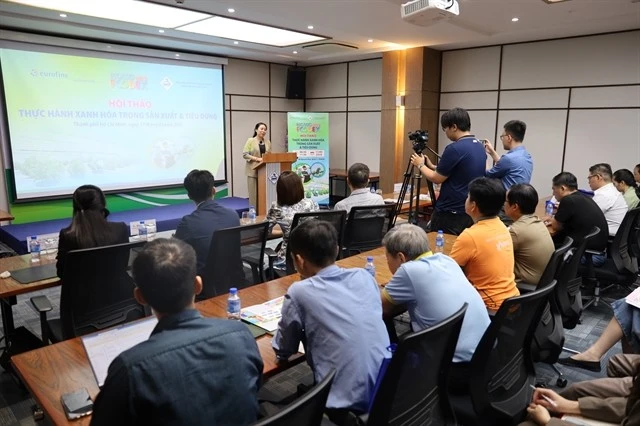
Ho Thi Quyen, deputy director of the Investment and Trade Promotion Centre of HCM City, speaks at a seminar titled “Green Practices in Production and Consumption” on March 11. (Photo courtesy of ITPC)

HCM City (VNS/VNA) - Adopting green production and consumption not only reduces negative environmental impacts but also secures long-term economic benefits, enhances the quality of people’s life and fosters a circular economy, a seminar heard in Ho Chi Minh City on March 11.

At “Green Practices in Production and Consumption,” organised by the Investment and Trade Promotion Centre of HCM City (ITPC) and Eurofins Sac Ky Hai Dang Co. Ltd, Ho Thi Quyen, the ITPC’s deputy director, said, given the severe environmental challenges, climate change and resource depletion the world is facing, fostering sustainable production and consumption is a collective societal duty.

She cited a report by the National Statistics Office stating that Vietnam’s industrial production grew by an estimated 8.4% in 2024, with the food processing industry growing by 7.4%.

But she said there are also challenges since Vietnam’s major export markets such as the US and EU are tightening food safety and environmental regulations.

In terms of consumption, she highlighted that HCM City residents are showing growing interest in environmentally friendly products. Around 59% of consumers intend to increase their use of green products in future, with 44% even willing to pay 5-10% extra to support sustainable consumption.

“But the green consumption rate remains low due to the high cost of green products and a lack of information about their benefits.”

She said adopting green production has become an inevitable trend across many industries, including food.

HCM City’s food and beverage industry is experiencing strong growth, catering to both domestic and export markets, and companies that embrace green practices would lead the way, she said.

“The development of green food products and the adoption of clean technology in production will help businesses enhance their competitiveness and meet international environmental standards.

“Companies implementing ESG (environmental, social, and governance) standards will gain better access to demanding export markets and strengthen their brand reputations.”

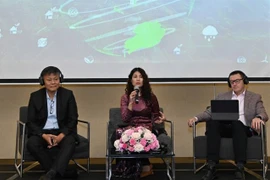
Speakers provided an overview of environmental initiatives and the landscape of sustainable development in agriculture and food production.

They also discussed ESG integration methods for food enterprises, greenhouse gas emissions and the decarbonisation process and sustainability standards such as the EU Regulation on Deforestation-free Products, and highlighted opportunities and challenges for businesses and consumers in adopting green production and consumption.

Dr Dang Thanh Tu, head of sustainable development services at Eurofins Sac Ky Hai Dang, quoted the 2024 report on ESG adoption in Vietnam as saying the concept is relatively new to many businesses.

Of more than 1,000 companies surveyed, 39%, primarily small and micro-enterprises, had never heard of ESG, and 62% were unaware of related regulations, he said.

This underscores the need for improved policy communication, ensuring guidelines are accessible and easy to implement, he said.

Providing green loans to companies investing in sustainable practices and tax incentives for ESG-driven businesses could encourage wider ESG adoption, he added.

Eurofins also presented case studies demonstrating how companies have successfully implemented ESG practices across the food supply chain.

Sharing the efforts made for sustainable development by Tam Nong Vietnam Cooperative – which makes fermented chilli sauce and freeze-dried fruits for export in HCM City’s Cu Chi district – Nguyen Thi Van Anh, its chairwoman, said all raw materials are cultivated in dedicated zones.

As part of its commitment to sustainability and innovation, the cooperative continually seeks advanced packaging solutions to meet Japan’s stringent market requirements, she said.

It has opted for aluminium trays for packaging fermented chilli sauce and deep-processed frozen products due to three key benefits – better preservation of product quality, improved consumer safety as aluminium does not contain harmful chemicals and alignment with eco-friendly trends, as all aluminium trays are recyclable, reducing waste and promoting sustainability, she added.

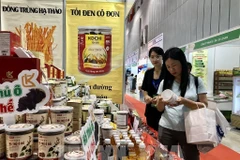
The seminar, part of a series of activities under the HCM City International Exhibition of Food and Beverages (HCMC FOODEX 2025), set to be held in HCM City next month, attracted a large number of delegates and enterprises, reflecting the community’s strong interest in sustainable development, particularly in the food industry./.

VNA
See more

Party General Secretary To Lam (C) and Prime Minister Pham Minh Chinh (third from left) and other delegates break ground Vietnam’s first semiconductor chip manufacturing plant (Photo: VNA)

Vietnam launches first semiconductor chip manufacturing plant

The plant, developed by Viettel Group in line with the mission assigned by the Ministry of Defence and based on the government’s resolution, is located on a 27-hectare site within the Hoa Lac High-Tech Park and is expected to serve national industries such as aerospace, telecommunications, Internet of Things (IoT), automotive manufacturing, medical equipment, and automation.

Vietnam’s cashew exports in 2025 are estimated at 766,600 tonnes, generating more than 5.2 billion USD (Photo: VNA)

Cashew sector faces economic efficiency challenge despite high export revenue

Vietnam’s cashew industry has faced a pressing challenge despite an export revenue of over 5 billion USD for the first time in 2025, as this impressive figure has yet to translate into commensurate economic efficiency for exporting enterprises, especially when the industry seeks to ensure that its position as the world’s leading cashew exporter is matched by sustainable profitability.

Deputy Director General of Vietnam National Authority of Tourism Nguyen Thi Hoa Mai (centre) chairs an online meeting on the organisation of ITE HCMC 2026. (Photo: TITC)

International Travel Expo HCM City 2026 set for August

The expo will feature key activities including on-site and online exhibition booths; a digital business-to-business (B2B) buyer–seller matching programme; Vietnam Night; the opening ceremony; programmes for international buyers and media representatives; forums and thematic seminars introducing key source markets and emerging tourism trends; and a tourism consumer festival.

An illustrative image showing a Crystal Bay Airlines plane. (Photo: dantri.com.vn)

New Vietnamese airline takes off with charter capital of 11.4 million USD

According to the company's registration documents, Crystal Bay Airlines Joint Stock Company was established on November 6, 2025, with a charter capital of 300 billion VND (11.4 million USD). The firm operates in 51 business sectors, with its main focus being air passenger transportation.

Garment production for export at the Thai Nguyen Garment Company. (Photo: VNA)

Spring Fair 2026 strengthens Vietnam – India cooperation

The seminar aimed to help the Indian business community gain a clearer understanding of the scale, role and potential of the Spring Fair 2026 one of Vietnam’s major trade promotion events hosted by the Government and the Ministry of Industry and Trade.

VinFast Evo battery-swap electric motorbike (Photo: VNA)

VinFast rolls out four new electric motorbike models

The automaker introduced three battery-swappable models, Evo, Feliz II and Viper, designed for different customer segments. It also launched the Amio, a compact pedal-assisted model that does not require a driving licence, aimed primarily at students and short-distance urban commuters.

Handling export cargo at Lach Huyen Port, Hai Phong city. (Photo: hanoimoi.vn)

Internal strength crucial for building export resilience

In the new era, strengthening domestic capacity will be crucial to ensuring that Vietnam’s exports grow not only rapidly, but also sustainably, contributing meaningfully to the country’s development aspirations in the new era.

Production activities at a centrifugal concrete pillar manufacturing plant (Photo: VNA)

Rising FDI, investor optimism reinforce Vietnam’s appeal for inflows

Commenting on Vietnam’s FDI performance in 2025, Dr. Nguyen Quoc Viet, a public policy expert at the University of Economics under the Vietnam National University, Hanoi, said that the strong growth in disbursed capital, particularly additional funding for ongoing projects, reflects sustained confidence among international investors.

An illustration of the North-South high-speed railway project (Image created by AI)

Vietnam fast-tracks key national railway projects

With the completion of a key legal framework, Vietnam's major national railway projects have kicked off the new year of 2026 with an accelerated implementation phase, notably the North-South high-speed railway and the Lao Cai-Hanoi-Hai Phong railway line