Hanoi customs seize suspected gold smuggled by four passengers at Noi Bai airport

The inspection revealed that passenger P.T.H. had concealed 10 pieces of the metal, weighing about 5 kg, inside her bra and underwear. Passenger V.T.M. hid five pieces totalking roughly 1.1 kg beneath underwear. Passenger N.V.L. concealed nine pieces amounting to around 3.5 kg, while passenger C.S.M.H. hid seven pieces weighing some 2.7 kg under underwear and on the wrist.

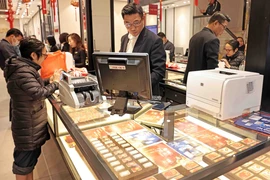
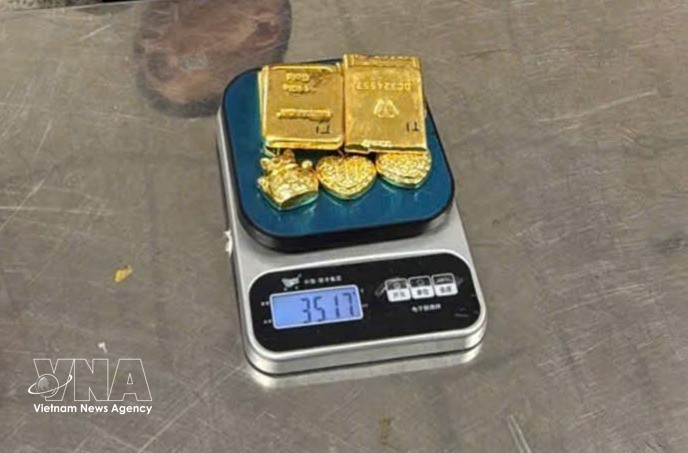
Yellow metal suspected to be gold is confiscated (Photo: VNA)

Hanoi (VNA) – Vietnam Customs announced on March 4 that officers at Hanoi's Noi Bai International Airport have uncovered four inbound passengers from Taiwan (China) allegedly attempting to smuggle a total of 12.3 kg of yellow metal suspected to be gold into Vietnam.

At about 9:40 on March 3 in the arrival area of Terminal T2, customs officers identified four passengers showing suspicious behaviour and failing to file required customs declarations.

Noi Bai airport customs, in coordination with Team 1 under Vietnam Customs’ Anti-Smuggling Investigation Department, airport border police, and Division 6 of the Hanoi Police Department’s Economic, Corruption, Smuggling and Environmental Crime Investigation Division (PC03), inspected the passengers and their luggage.

The inspection revealed that passenger P.T.H. had concealed 10 pieces of the metal, weighing about 5 kg, inside her bra and underwear. Passenger V.T.M. hid five pieces totalking roughly 1.1 kg beneath underwear. Passenger N.V.L. concealed nine pieces amounting to around 3.5 kg, while passenger C.S.M.H. hid seven pieces weighing some 2.7 kg under underwear and on the wrist.

Given signs of criminal conduct, all the four individuals, along with the seized items and related documentation, have been transferred to the PC03 for further investigation in accordance with the law.

In total, authorities confiscated 31 pieces of yellow metal with a combined weight of roughly 12.3 kg suspected to be gold bars.

The items are undergoing expert appraisal to confirm their composition as gold and determine their value. Further information will be released once the assessment is completed./.


VNA

See more

Defendants at the court (Photo: VNA)

Ho Chi Minh City court opens trial over Agribank lending scandal

The investigation revealed that multiple credit files were incomplete or riddled with inaccurate information, while some pledged assets lacked proper legal standing yet were accepted and grossly overvalued. As a result, the loans became high-risk and largely unrecoverable, leading to losses surpassing 1 trillion VND.

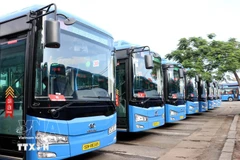
Hanoi introduces 53 electric buses from April 18 (Photo: VNA)

Hanoi to add 53 electric buses from April 18

According to the plan, all buses operating within Ring Road 1 will use green energy by July 1, 2026. The requirement will expand to Ring Road 2 by January 1, 2028, and to Ring Road 3 by 2030.

Illustrative image (Photo: VNA)

National, local traffic safety committees to be dissolved from June 1

Under the dicision, ministries and ministerial-level agencies will assume responsibility for tasks previously performed by the committee, in line with their mandates under the Law on Government Organisation, the Law on Road Traffic Order and Safety, the Law on Roads and other relevant legal frameworks, ensuring that traffic safety and order are maintained without disrupiton.

Visitors explore technology showcases at the exhibition held during the Da Nang Startup and Innovation Festival (SURF 2025). (Photo: VNA)

About 10,000 students expected at National Startup Day 2026

This year marks the rollout of the “Student Startup Support Programme for 2026 – 2035”, approved under Decision No. 336/QD-TTg, which places emphasis on practical outcomes, real products, real testing, real partnerships, and measurable impact.

Hong Quang High School pilots teaching mathematics in English starting from the 2025–2026 academic year. (Photo: VNA)

National foreign language proficiency framework issued

The circular establishes a unified benchmark for foreign language proficiency across the national education system, providing a foundation for curriculum design, teaching, testing, assessment, and certification. It is expected to help learners better map out their language development pathways while enabling educational institutions to improve training quality and strengthen articulation between different levels of education.