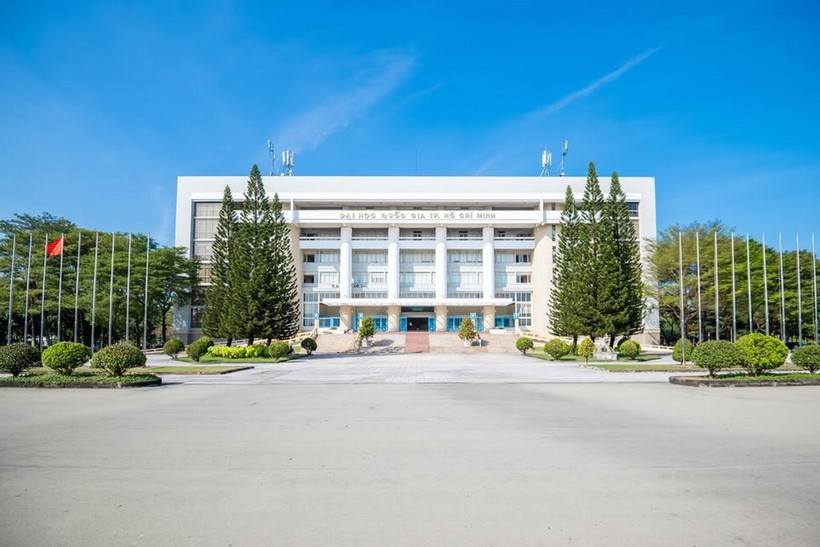
Ho Chi Minh City (VNA) – As Vietnam presses ahead with comprehensive education reforms, the Vietnam National University, Ho Chi Minh City (VNU-HCM) has been at the forefront of efforts to renew curricula and diversify training methods through digital transformation, helping improve teaching quality and expand access to higher education.
High school students begin earning university credits
In July 2024, the VNU-HCM’s High School for the Gifted launched a pilot programme allowing students to take a number of university-level credit courses. About 600 students from grades 10 to 12 – roughly one-third of the school’s total – registered for the pilot phase under the university’s MOOC (Massive Open Online Course) project.
Four university courses – Linear Algebra, General Chemistry, Computer Architecture and Physics 1 – were offered. Lectures were uploaded to VNU-HCM’s online platform, enabling students to study anytime while also attending in-person sessions with lecturers and sitting for end-of-term exams on campus.
Credits from these courses will be recognised once students are admitted to any member university of VNU-HCM, creating a direct academic bridge between secondary and higher education.
According to Tran Vu, Vice Principal of the High School for the Gifted, about 60 students passed the first round of exams, accounting for 10% of participants. The result is considered promising given that the courses were delivered online and open to all grade levels, not just final-year students. The programme will continue in the 2025–2026 school year with expanded registration at the start of the academic term.
Beyond credit recognition, the MOOC initiative is designed to leverage the strengths of VNU-HCM’s member institutions in interdisciplinary and distance training, as well as short-term certificate programmes. Since 2023, the university has developed 21 MOOC courses and 71 blended learning subjects, and issued regulations on training and credit recognition for four of them.
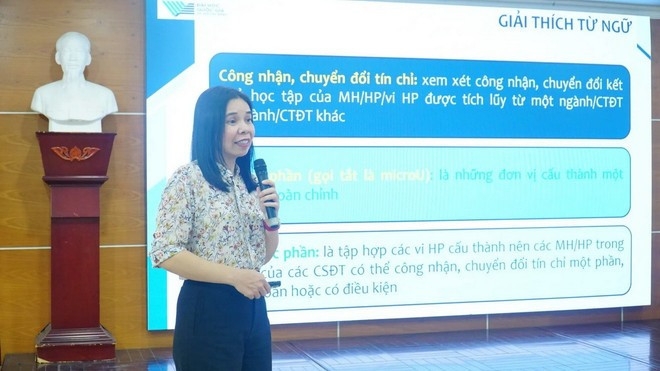
Interdisciplinary, cross-university programmes
Interdisciplinary education has become an essential trend in Vietnam’s higher education landscape, aligning with global shifts toward integrated learning and digital innovation.
In 2024, VNU-HCM launched its first cross-university and interdisciplinary bachelor’s programme - Korean Business and Commerce - jointly implemented by the University of Social Sciences and Humanities and the University of Economics and Law.
The course combines training in Korean Studies and Business Management, with subjects such as Korean for Business, Human Resource Management, and Digital Business Models. The inaugural cohort admitted 58 students.
Building on this model, the university will introduce three additional cross-university programmes in 2025 to maximise its academic resources and system-wide strengths.
Among them, the Land Economics programme, led by the University of Natural Sciences in collaboration with the University of Economics and Law, will enrol 90 students in its first year. This pioneering programme integrates land management, real estate, economics, and public policy, catering to Vietnam’s growing demand for sustainable land resources management amid the digital transformation era.
The Digital Agricultural Technology programme, co-organised by An Giang University and the University of Information Technology, equips students with skills in data management, automation and digital systems for smart farming. Graduates are expected to enhance agricultural productivity, add value to farm products, and strengthen Vietnam’s competitiveness in global markets.
Meanwhile, the Digital Agricultural Business programme, jointly conducted by An Giang University and the University of Economics and Law, focuses on management, commercialisation, and digital-based agribusiness operations. The programme aligns with Vietnam’s National Digital Transformation Strategy, the New Rural Development Programme, and the goal of sustainable agricultural growth.
Under its 2021–2030 development strategy, with a vision toward 2045, VNU-HCM targets establishing 20 joint degree programmes between its member universities, prioritising fields such as social sciences, economics, law, and education, reaffirming its pioneering role in innovation and digital transformation in higher education./.