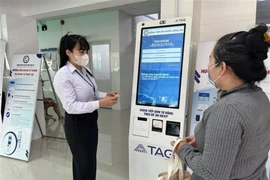
Hanoi (VNA) - Making digital transformation the foundation of national development in the new era is not only an urgent requirement but also a strategic choice for Vietnam to make breakthroughs, narrow the development gap, deepen integration, and enhance competitiveness.
The Party and the State have identified digital transformation as one of the three strategic breakthroughs for the new era, as set out in the Politburo's Resolution No. 57-NQ/TW on breakthroughs in science and technology development, innovation, and national digital transformation.
A strong lever for two-tier administration operations
According to Vice Chairman of the Hanoi People’s Committee Truong Viet Dung, the city has issued concrete action programmes implemented consistently at all levels, built on three core elements: synchronisation, data, and proactivity. Hanoi has established numerous community digital technology groups, drawing on feedback from officials and residents to continuously improve content and processes. Within just three weeks of official operation, the city processed 66,000 administrative dossiers, with the two-tier local administration system operating smoothly and effectively, thanks in large part to digital technology.
The Ministry of Science and Technology, in coordination with the Ho Chi Minh City People’s Committee and digital enterprises, has piloted the upgrading of five information systems. The city was selected for the pilot given its merger with the former provinces of Binh Duong and Ba Ria-Vung Tau, creating a mega-urban area with a complex information system. The pilot results served as the basis for the ministry to issue detailed guidelines for other localities.
The ministry also requested ministries and sectors to make administrative procedures public in accordance with 28 decrees on decentralisation and delegation of authority, and to implement them on the National Public Service Portal.
More than 12,000 personnel from digital enterprises have been deployed to accompany 3,219 communes during the restructuring process, alongside police, military forces, and student volunteers. As a result, by June 30 the digital systems of more than 3,200 communes were operating smoothly and meeting requirements.

A strategic breakthrough for the nation
Le Anh Tuan, Deputy Director of the National Authority of Digital Transformation under the Ministry of Science and Technology, said since the issuance of the Politburo's Resolution No. 52-NQ/TW on proactive policies for the Fourth Industrial Revolution, followed by Resolution No. 57, the Party has consistently defined digital transformation as a strategic breakthrough for national development. Resolution 57 sets clear strategic targets: by 2030, the digital economy must account for at least 30% of GDP; by 2045, at least 50% of GDP, positioning Vietnam among the world’s top 30 countries in innovation and digital transformation.
To realise these goals, the Government has introduced a series of key strategies and schemes, including: Decision No. 749/QD-TTg (2020) approving the national digital transformation programme to 2025, with orientations to 2030; Decision No. 942/QD-TTg (2021) approving the E-government development strategy towards digital government for 2021–2025, orientation to 2030; and Decision No. 411/QD-TTg (2022) approving the national strategy for the development of the digital economy and digital society to 2025, with orientations to 2030.
By the second quarter of 2025, Vietnam’s digital government ranking had advanced 15 places to 71st among 193 countries and territories. As of July 2025, the rate of fully online administrative procedures reached 39.85%, up 4.24% from 2024. The IT sector's revenues stood at over 2.77 quadrillion VND (109.8 billion USD), a 24% increase, achieving 65% of the annual plan. Hardware and electronics exports hit 2.48 quadrillion VND, up 29%, meeting 60% of the plan.
On the digital society front, 17.5 million citizen ID cards and 64 million VNeID accounts with 48 utilities have been issued, recording 1.5 million daily uses. Digital infrastructure has made major strides, with 99.3% of villages covered by mobile broadband; mobile internet speed at 146.64 Mbps (top 20 globally); fixed broadband speed at 203.89 Mbps (top 26 globally); 5G coverage reaching 26% of the population; and 21.8 million digital signature certificates issued, equivalent to 35.18% of the adult population.
Tuan affirmed that a complete institutional foundation for digital transformation serves as a launchpad for shaping Vietnam in the digital era. The vision is concretised through three pillars: building a creative, smart, and inclusive state that operates on the principle of “digital by default”; ensuring management decisions are based on real-time data and artificial intelligence, with end-to-end, paperless, and personalised public services; and establishing a unified, service-oriented administration that eliminates administrative boundaries.
Efforts are being made to build a dynamic, competitive, and self-reliant digital economy that unlocks resources and creates a level playing field. Small and medium-sized enterprises are supported through shared digital platforms and open data, while “Make in Vietnam” businesses are encouraged to expand globally. The development of the platform economy and data economy is promoted, alongside the widespread application of AI, to boost productivity and improve the quality of Vietnamese products.
In parallel, a human-centered digital society is being developed, with people placed at the core. Every citizen is connected, equipped with digital skills, and comprehensively protected. National culture spreads vibrantly in the digital environment, helping to build a lifelong learning society that adapts to new technologies.
These are not only long-term goals but also strategic orientations, underscoring the strong political will of the Party and the State to make digital transformation the foundation of development and a driving force for Vietnam’s powerful rise in the new era./.