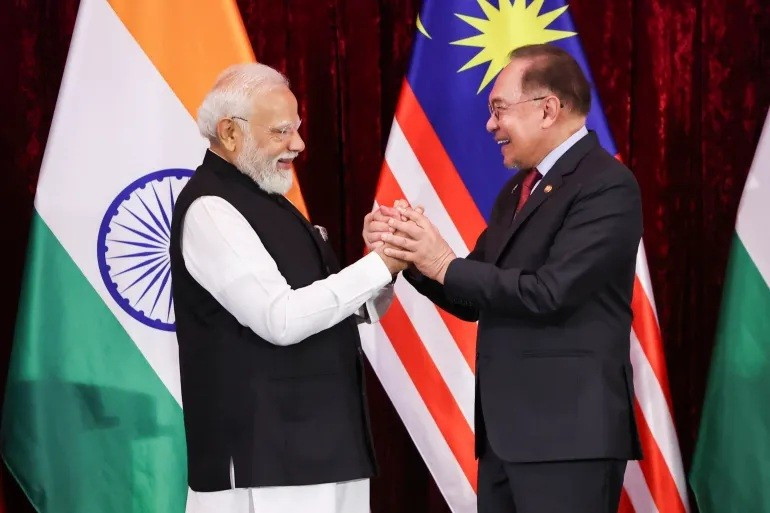
New Delhi (VNA) – India and Malaysia have strengthened their Comprehensive Strategic Partnership following the signing of multiple cooperation agreements during Indian Prime Minister Narendra Modi’s official visit to Malaysia on February 7-8.
Prime Minister Modi and Malaysian Prime Minister Anwar Ibrahim witnessed the signing and exchange of 11 memoranda of understanding and cooperation documents, providing fresh momentum for the Comprehensive Strategic Partnership, established in August 2024.
The agreements reflect expanded collaboration beyond traditional trade into key areas such as defence and security, counterterrorism, intelligence sharing, maritime security, energy, semiconductors, artificial intelligence, the digital economy, cross-border digital payments, healthcare, food security, education and people-to-people exchanges.
In defence and security, the two sides agreed to enhance practical cooperation through existing mechanisms, including the Malaysia–India Defence Cooperation Committee, the Strategic Affairs Working Group and the Su-30 Forum, while expanding joint exercises, naval exchanges, training and defence industry collaboration. Both countries also reaffirmed close coordination within the ASEAN Defence Ministers’ Meeting-Plus (ADMM+) framework and their co-chairmanship of the Counterterrorism Working Group for 2024–2027.
Prime Minister Modi congratulated Malaysia on its successful ASEAN chairmanship in 2025. Both leaders reiterated strong support for ASEAN unity and centrality and pledged to further strengthen the ASEAN–India Comprehensive Strategic Partnership.
In their joint statement, the two sides underscored their commitment to a free, open, rules-based, peaceful and prosperous Indo-Pacific region. They welcomed enhanced alignment between the ASEAN Outlook on the Indo-Pacific (AOIP) and India’s Indo-Pacific Oceans Initiative (IPOI).
They also reaffirmed respect for freedom of navigation and overflight and emphasised the peaceful settlement of disputes in accordance with international law, including the 1982 United Nations Convention on the Law of the Sea (UNCLOS).
Economic and technology cooperation will focus on semiconductors as a new strategic pillar, linking India’s strengths in design and human resources with Malaysia’s capabilities in manufacturing, assembly and packaging, while promoting innovation, workforce development and supply chain resilience.
Energy cooperation will prioritise renewable energy, solar power and green hydrogen, with both sides reaffirming their commitment to net-zero targets and recognising Malaysia’s role in clean energy projects in India as well as highly valuing India’s International Solar Alliance initiative.
Additional agreements on anti-corruption, disaster management, social security, media cooperation, technical and vocational education, and academic collaboration are expected to further align bilateral ties with the practical interests of businesses and citizens./.