Indonesia boosts solar power development

Indonesia's Institute for Essential Services Reform (IESR) announced on October 21 that the country’s installed solar power capacity has surpassed 700 MW. However, further acceleration is needed to meet global climate targets.

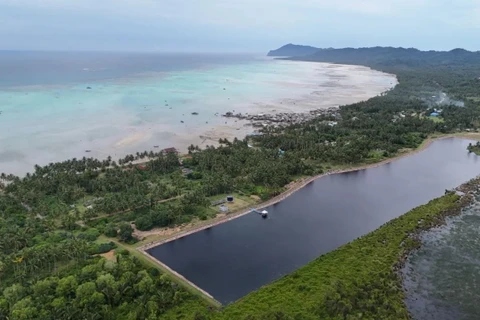
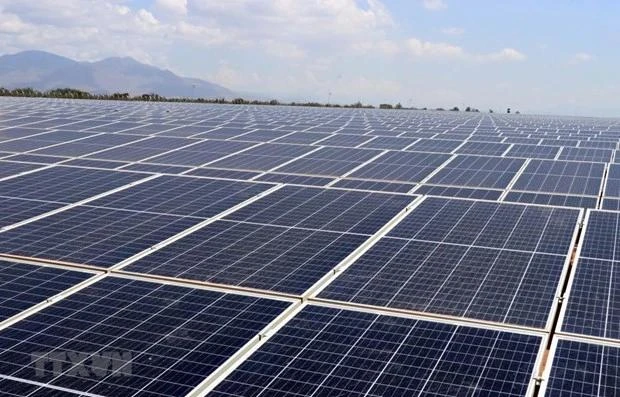
Indonesia’s installed solar power capacity reached 717.71 MW as of August 2024. (Illustrative photo: VNA)

Jakarta (VNA) – Indonesia's Institute for Essential Services Reform (IESR) announced on October 21 that the country’s installed solar power capacity has surpassed 700 MW. However, further acceleration is needed to meet global climate targets.

As of August 2024, Indonesia’s installed solar power capacity reached 717.71 MW. The Cirata solar power project, installed in November 2023, had to nearly triple its capacity to 145 MW to meet demand.

Indonesia currently has around 17 GW of solar power under development, with state utility PLN planning to add 3.2 GW by 2030. Offshore solar energy development is also being prioritised to address electricity transmission challenges in remote areas. Floating solar panels are seen as more efficient, helping reduce evaporation and maintain water levels for irrigation.

Solar power installation costs have decreased by 19% over the past five years, mainly due to cheaper photovoltaic modules. PLN is working with affiliates to further reduce prices, and Indonesia encourages household-scale solar development to promote green energy products. In 2024, the Indonesian Government allocated 112 million USD for solar energy transmission projects.

Additionally, Indonesia sees solar development as an opportunity to export green energy, particularly to Singapore. With limited land for renewable energy, Singapore depends on cross-border energy from countries like Indonesia and Malaysia.

Recently, Vena Energy and Shell Eastern Trading signed an agreement to export 400 MW of solar power from Indonesia’s Riau Islands to Singapore./.
VNA

See more

Indonesia eyes trade breakthrough with EAEU via FTA

Indonesia eyes trade breakthrough with EAEU via FTA

Indonesia seeks to develop relations with all countries and sees itself as a bridge between different regions of the world. Against a backdrop of growing geopolitical and global economic uncertainty, strengthening international cooperation and building reliable supply chains have become more important than ever.

Thai Prime Minister Anutin Charnvirakul (R) at Nation TV’s 26th anniversary event on June 4, 2026. (Photo: nationthailand.com)

Thailand prioritises OECD accession

Thai Prime Minister Anutin Charnvirakul the country’s bid to join the Organisation for Economic Co-operation and Development, or OECD, is central to the government’s economic agenda.

ASEAN aims to become global digital economy hub

ASEAN aims to become global digital economy hub

Studies indicate that the ASEAN Digital Economy Framework Agreement (DEFA) could help raise ASEAN’s digital economy value to 2 trillion USD by 2030 while transforming the region into a connected, comprehensive and sustainable digital economy hub on the global stage.

Malaysian Deputy Prime Minister and Minister of Energy Transition and Water Transformation Seri Fadillah Yusof speaks at the Energy Transition Conference 2026 (ETCon26) in Kuala Lumpur on June 3. (Photo: VNA)

Malaysia accelerates energy transition

Malaysian Deputy Prime Minister and Minister of Energy Transition and Water Transformation Seri Fadillah Yusof noted that for both Malaysia and ASEAN, the transition is not only an environmental imperative but also an economic necessity and a strategic priority.

A pregnant woman receives a routine pregnancy check-up at a hospital. (Photo: VNA)

ILO report highlights gaps in maternity benefits across ASEAN

The report calls for extending maternity protection to all women, including workers in the informal economy; strengthening financing mechanisms to ensure sustainability and adequacy of benefits; and aligning maternity protection policies with broader social protection, health and care policies.

President of Timor-Leste José Ramos-Horta (L) at the leadership lecture in Jakarta on June 2 hosted by the ERIA School of Government under the Economic Research Institute for ASEAN and East Asia (ERIA). (Photo: ERIA)

Timor-Leste President shares vision for peacebuilding, ASEAN integration

Drawing on his experience as a diplomat and Nobel Peace Prize laureate, Ramos-Horta cited the reconciliation process between Timor-Leste and Indonesia as a model for peacebuilding. He paid tribute to former Indonesian leaders for their contributions to normalising bilateral ties, stressing that friendship and cooperation ultimately prevailed over past divisions and laid the foundation for Southeast Asia's stability today.

Southeast Asia tourism sustains rebound

Southeast Asia tourism sustains rebound

Indonesia welcomed 4.68 million foreigners in the first four months, an 8.24% hike from a year earlier and the highest tally for the period since the COVID-19 outbreak, its Central Bureau of Statistics said on June 3.

 Indonesia replaces free school meal programme chief after food poisoning scandals

Indonesia replaces free school meal programme chief after food poisoning scandals

The free meal initiative forms part of Indonesia’s broader effort to tackle chronic malnutrition, with more than 20% of children in the country still affected by stunting caused by inadequate nutrition. Jakarta’s long-term goal is to provide meals to around 82.9 million children, pregnant women and breastfeeding mothers, equivalent to more than 30% of the national population.

SAANSOOK application supports holistic health management and promotes workplace wellness to help reduce non-communicable diseases among working-age people. (Photo: SAANSOOK)

Thailand launches AI-powered tool to combat non-communicable diseases

Developed under the “DOPA” strategy – Data, Outcomes, Partners and AI-driven, the SAANSOOK application tracks four key health behaviours: eating, sleeping, exercising and relaxation. It encourages users to adopt healthier lifestyles through challenges and rewards aimed at sustaining long-term behavioural change.