Indonesia faces massive financing gap to meet climate goals

On December 2, the Indonesian government officially launched the Innovation and Technology Fund (ITF) a financing mechanism designed to support low-carbon development programmes at the provincial level.

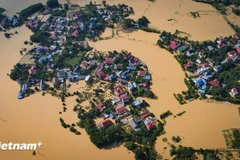
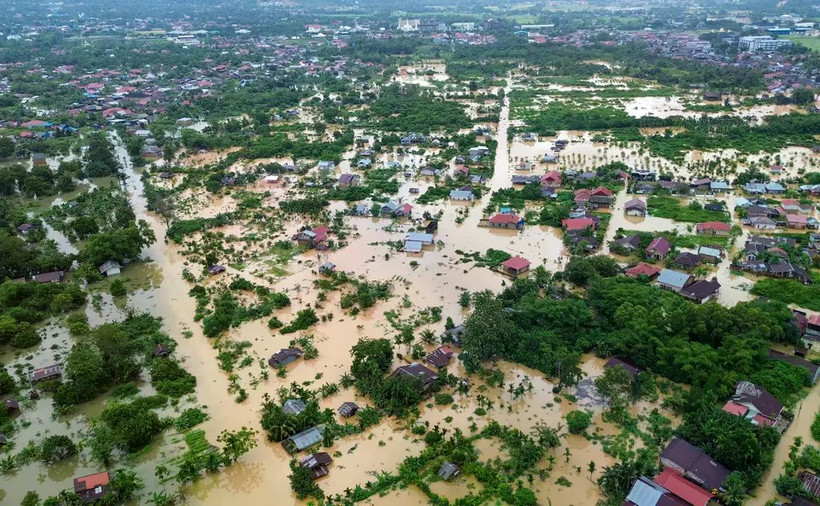
This aerial photo shows residential areas submerged by floods in Padang, West Sumatra on November 25, 2025. (Photo: Antara)

Jakarta (VNA) - Indonesia will require 757.6 billion USD in climate financing by 2035 to meet its climate-action commitments under the Enhanced and Secondary Nationally Determined Contribution (NDC), highlighting a major funding gap as current climate spending accounts for only 3% of the state budget.

National Development Planning Minister Rachmat Pambudy presented the figure during an event in Jakarta, noting that climate-related allocations remain modest compared with the magnitude of the country’s decarbonisation and adaptation objectives.

He said that on average, government climate expenditure between 2016 and 2024 stood at 4.4 billion USD per year, or about 3% of the state budget. This means there is still a very large climate-financing gap.

He stressed that to close the gap, Indonesia must improve governance readiness and accelerate programmes and projects capable of mobilising large-scale investment. Investment is crucial to advancing technology, innovation and knowledge, foundations that will allow Indonesia to fast-track its low-carbon transition and climate resilience.

On December 2, the government officially launched the Innovation and Technology Fund (ITF) a financing mechanism designed to support low-carbon development programmes at the provincial level.

Rachmat said the ITF will function as a financing bridge to spur climate innovation, strengthen technological solutions and support projects that deliver multiple long-term benefits for mitigation and adaptation.

The ITF will be distributed through the Innovative Development Fund, which is expected to contribute to broader national development targets./.

VNA

See more

Angkor Wat temple in Cambodia (Photo: AFP)

Cambodia to pilot visa waiver for Chinese tourists

The exemption allows a 14-day stay during the four-month pilot, without requiring any application or fees. The completion of an e-arrival card upon entry is still required. During the pilot period, Chinese tourists can enter Cambodia multiple times.

Chief Economist at IQI Global Shan Saeed (Photo: VNA)

Five economies seen powering ASEAN’s next growth cycle

The MIT-PV economies are quickly becoming the mainstay of ASEAN’s next growth supercycle, supported by booming populations, rising wealth, structural reforms, and stategic convergence of human resources development, infrastructure modernisation, and resources.

Tourists inside a beer shop in Thailand. (Photo: AFP)

Thailand eases alcohol sales restrictions

Thailand ranked 16th out of nearly 200 countries for the most road traffic deaths per capita in 2021, WHO data shows. Nearly 33,000 people were killed in drunk driving incidents in the country from 2019 to 2023, according to public health ministry figures.

Illustrative image (Photo: tribune.net.ph)

Philippines dismisses over 9,000 police personnel

Data from the PNP Directorate for Personnel and Records Management released on December 3 showed that from July 2016 to November 26, 2025, a total of 32,698 police personnel were found guilty of various administrative offenses.

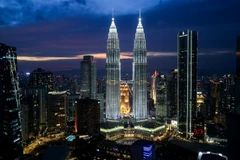
Intel to invest additional 208 million USD in Malaysia (Photo: invezz.com)

Intel to boost investment in Malaysia

The US is Malaysia’s third-largest market for semiconductor exports. In 2024, Malaysia exported 120 billion MYR (28 billion USD) in electrical and electronic products to the US, with around half related to chips.

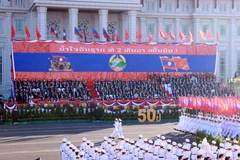
A military parade and march held to celebrate the 50th National Day of the Lao People’s Democratic Republic. (Photo: VNA)

Laos marks 50th National Day with solemn ceremony

In his address, General Secretary and President Thongloun recalled that 50 years ago, the site hosted a mass mobilisation of revolutionary forces and patriotic Lao people to seize power in Vientiane, paving the way for the National Congress to abolish colonial and feudal rule and proclaim the establishment of the Lao PDR on December 2, 1975. He stressed that the historic victory profoundly changed the nation’s destiny, ushering in a new era of independence, unity and development, and ensuring a peaceful, prosperous and happy life for all ethnic groups in Laos.