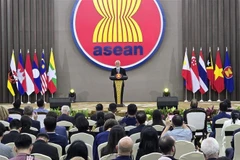
Hanoi (VNA) – Dr. Kao Kim Hourn, Secretary-General of ASEAN, affirmed ASEAN’s commitment to leading the charge in digital transformation. “Digital interconnectedness has become a vital economic and social infrastructure. The UBIN initiative reflects this vision, addressing longstanding barriers to cross-border trade and fostering trust among businesses to thrive in a seamlessly connected and competitive global economy.”
Imagine a digitally interconnected ASEAN—where businesses seamlessly trade across borders, leveraging an interoperable digital infrastructure that recognises and validates their business identities in real-time, facilitating frictionless trade. This promise will be materialised following the adoption of the Implementation Roadmap of the Unique Business Identification Number of ASEAN (UBIN) in early 2025. With UBIN, businesses, both big and small, can operate with greater confidence and agility, unlocking ASEAN’s full economic potential. Nadhir Ashafiq, co-founder of The Lorry, highlighted the importance of creating a unified business environment in ASEAN. "From (a) young entrepreneur’s lens, we want easier business approval, set up, and harmonisation of procedures across all ASEAN," he said. UBIN embodies this vision, paving the way for an ASEAN where trade knows no barriers and opportunity is within reach for all.
Driving ASEAN’s Digital Transformation
ASEAN recognises the massive potential of a digitally enabled trade. Catalysed by the endorsement of the Bandar Seri Begawan Roadmap: An ASEAN Digital Transformation Agenda to Accelerate ASEAN’s Economic Recovery and Digital Economy Integration in 2021 , ASEAN is on track to leapfrog its digital economy transformation through the ASEAN Digital Economy Framework Agreement (DEFA) – the first regionwide agreement of its kind – launched in September 2023 . In the same year, with the support of the Government of Australia through the Aus4ASEAN Futures Initiative, ASEAN embarked on the journey to explore an ASEAN vision of a regionally interoperable and recognisable digital business identity, which led to the endorsement of the “Benchmarking Guidelines on Unique Business Identification Number (UBIN) in ASEAN” by the ASEAN Economic Ministers during their 55th Meeting in August 2023, boosted with the mandate to implement the UBIN initiative across AMS . With this mandate, ASEAN has taken the next step to an ASEAN UBIN vision through an Implementation Roadmap to guide individual ASEAN Member States in establishing a regionally interoperable digital business identification system.
Dr. Kao Kim Hourn, Secretary-General of ASEAN, affirmed ASEAN’s commitment to leading the charge in digital transformation. “Digital interconnectedness has become a vital economic and social infrastructure. The UBIN initiative reflects this vision, addressing longstanding barriers to cross-border trade and fostering trust among businesses to thrive in a seamlessly connected and competitive global economy.”
Introduction to ASEAN Unique Business Identification System
The ASEAN UBIN is a framework that will enable interoperability between countries in ASEAN, essential for establishing a reliable and interoperable business ID system across ASEAN to support cross-border business operations. The framework consists of five core components: Data, ensuring the accurate and secure exposure of information between business registries; Technology, focusing on building a decentralised and interoperable system that allows real-time verification and secure cross-border transactions; Governance, establishing a common management framework to operation the UBIN system regionally and nationally; Regulations, aligning UBIN with existing legal frameworks such as data protection and privacy laws across AMS; and finally, Enablers, which include capability-building programmes to ensure smooth implementation and sustainable growth of the system.
An analysis conducted by the Boston Consulting Group projected that the economic impact of UBIN’s full implementation is monumental, with estimates suggesting that it could unlock between 110 billion USD and 300 billion USD in economic value – an estimated of between 10–25% contribution to the overall DEFA value-add to ASEAN’s digital economy. Driven regionally by cross-border trade value, trade cost, and FDI inflows, this growth is expected to strengthen national economies and spur regional prosperity, cementing ASEAN’s position as a global economic powerhouse .

Driving Equal Opportunities for Economic Growth in ASEAN
Inclusive growth is at the heart of ASEAN’s vision for regional integration. By addressing systemic barriers and fostering equitable access to opportunities, UBIN has the potential to empower businesses, including micro, small and medium enterprises (MSMEs) and those enterprises led by women who are motivated by growth and innovation, to participate in global trade, transforming it into a driver of inclusive economic progress across the region.
MSMEs is the backbone of ASEAN’s economy, represent 97–99% of businesses, contributing approximately 45% to ASEAN’s GDP. And yet, only 18% are exporting, contributed partly due to the obstacles faced in accessing international markets, such as complex customs procedures, varying foreign regulations and a general lack of trust in cross-border business transactions and partners. UBIN aims to address these challenges through use cases that would help streamline complex processes and enable MSMEs to fully leverage the opportunities offered by ASEAN's thriving digital economy.
Women-owned businesses are disproportionately affected by complex bureaucratic processes, with 31% more likely to remain informal due to regulatory challenges.
While informal businesses are often excluded from traditional cross-border trade, the rise of e-commerce has provided new opportunities for them to reach international markets. However, these businesses still face significant hurdles, such as limited trust from foreign buyers, inconsistent regulations, and difficulties in scaling their operations. UBIN could potentially address this issue by simplifying business formalisation and cross-border compliance, making it easier for women-led enterprises to participate in regional and global markets.
One of UBIN’s standout features is the introduction of recognised digital business ID designed to enhance trust and credibility. In ASEAN, 70% of women-owned businesses struggle to access credit and financing, while the gender gap in financial services remains at 9% . One of UBIN’s potential use cases aims to close this gap by improving financial inclusion by strengthening the credibility of businesses, including MSMEs and women-owned enterprises, making them more visible and trustworthy to financial institutions. Streamlined digital processes simplify compliance and documentation, reducing barriers to accessing formal financial services.
An Implementation Roadmap for a Unified Digital Trade
ASEAN is built on mutual respect and shared commitment . Building on these principles, the ASEAN UBIN vision is guided by five key principles: Sovereignty & Inclusivity, enabling each AMS to control its data and regulatory discretion; Security & Resilience, with scalable, open-source technology; Interoperability for seamless information exchange; Lean, Practical & Non-Intrusive design with minimal investment and regulatory changes; and MSME Trade-Focus to boost MSME cross-border participation, linking ASEAN businesses to regional and global markets. In other words, no country will be left behind and every ASEAN Member State would have the tools and flexibility needed to participate fully in this regional initiative.
The Implementation Roadmap to establish the ASEAN UBIN is a step-by-step guide with five key milestones. “Basecamp Established” focuses on setting up the governance model and stakeholder training. “Ascent Commenced” initiates technical implementation by selecting a technical partner and securing funding. “Momentum Gained” involves launching the “enable first” use cases. “High Altitudes Reached” covers the phased rollout of advanced use cases, such as e-contracts. Finally, “Summit Achieved” completes the full implementation with UBIN established as the regional trust anchor.
In the near term, ASEAN envisions to implement high-impact, easy-to-adopt use cases aimed at transforming business operations across the region. Among the identified implement-first use cases are "Company Search" and "Data as a Service," which promise to simplify the verification process for registered companies. These use cases will introduce a region-wide search function, providing standardised business information such as company names, national business IDs, and registered addresses. The move aims to offer businesses a time-efficient and user-friendly solution for verifying potential partners, fostering greater trust in cross-border trade and bolstering confidence in ASEAN company credentials.
In the long run, UBIN would support the secure verification of essential documents frequently used in daily operations, especially for cross-border transactions. ASEAN UBIN will be a critical digital regional infrastructure to enable the exchange of digital documents such as invoices, trade licenses, and customs permits, ensuring that they are not tampered with and have been securely authenticated. This innovation is expected to deliver significant time and cost savings for MSMEs and create a safer business environment for MSMEs.
The development of the UBIN Implementation roadmap is only the beginning – nevertheless a significant milestone for ASEAN toward enhancing regional integration and economic growth. Through UBIN, ASEAN envisions new opportunities for enterprises of all sizes across ASEAN – a future where businesses can thrive in a truly interconnected ASEAN Community./.
By Dr. Le Quang Lan, Director, Market Integration Directorate, ASEAN Secretariat