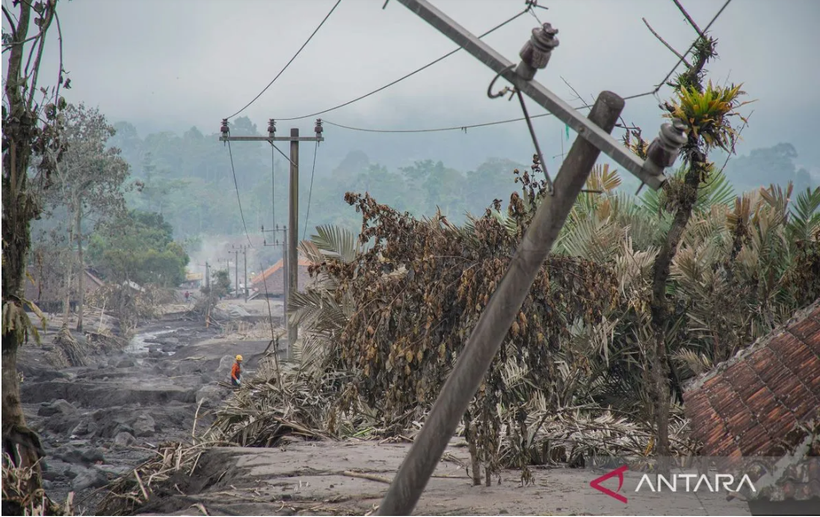
Jakarta (VNA) – Indonesia’s Disaster Data, Information, and Communication Center of the The National Disaster Mitigation Agency (BNPB) on November 24 reported that the eruption of Mount Semeru in Lumajang, East Java caused severe injuries to three people and displaced more than 500 residents.
The three injured victims are currently receiving treatment at hospital while the residents from three villages of Supiturang, Oro-Oro Ombo and Penanggal are evacuated to two schools.
The Geological Agency of the Ministry of Energy and Mineral Resources (ESDM) previously reported that Mount Semeru erupted on November 19 with the eruption column reaching approximately 2,000 metres above the summit.
During the eruption, Mount Semeru produced a pyroclastic flow - a fast-moving current of hot gas and ash that traveled up to 7 kilometers from the summit.
This was accompanied by a thick, gray ash column observed drifting toward the north and northwest.
The event, recorded on a seismogram at the Lumajang volcano monitoring post, showed a maximum amplitude of 40 mm and lasted for approximately 16 minutes and 40 seconds.
To date, the local government and the Geological Agency have maintained Mount Semeru's status at Level IV (Alert), the highest warning level, in anticipation of potential further activity.
This status also served as the basis for the Lumajang District Government's declaration of a Natural Disaster Emergency Response Status, which remains in effect until November 26.
The eruption damaged 204.63 ha of agricultural land, 21 houses, an educational facility, one health facility, and one electricity substation.
BNPB said that multiple aid packages have been delivered to meet the needs of the evacuees.
This aid included 300 mattresses, 300 tarpaulins, 300 blankets, 200 boxes of medical masks, 200 plastic trash bags, and 150 hygiene kits.
Food aid provided consists of 1,000 ready-to-eat meals and 200 basic food packages./.

Indonesia declares end of type-2 polio outbreak
The Indonesian government responded with two rounds of nationwide vaccination using the novel OPV-2 (nOPV2) vaccine between late 2022 and the third quarter of 2024. Routine immunisation coverage also improved, with the second dose of inactivated polio vaccine (IPV) increasing from 63% in 2023 to 73% in 2024.