Indonesia plans stunting interventions for 8.6 million at-risk families

The interventions range from nutritional fulfillment, clean water and sanitation provision, and child marriage prevention.

Jakarta (VNA) – About 8.6 million Indonesian families that are at risk of stunting have become the focus of intervention efforts, said Indonesian Population and Family Development Minister Wihaji.

The interventions range from nutritional fulfillment, clean water and sanitation provision, and child marriage prevention.

During a meeting with Commission IX of the House of Representatives (DPR) in Jakarta on July 1, Wihaji informed that several ministries and agencies are participating in stunting interventions. However, their efforts have not been effective so far since they did not target the root of the problem.

He noted the country is now focusing on the upstream factors, namely clean water, nutritional intake, sanitation, and child marriage.

According to the minister, the monitoring and evaluation of the stunting reduction programme must also be made clear and emphasise handling during the first 1,000 days of a child’s life, or until the child turns two years old.

He cited his ministry’s data as showing that among the 8.6 million at-risk families, 3.7 million families do not have proper toilets, while 1.9 million do not have access to proper drinking water. In addition, 4.3 million at-risk families comprise couples of reproductive age who are either too young, too old, have too-short birth spacing, have too many children, or do not use contraceptives.

Wihaji added that his ministry has more than 18,000 family planning counsellors and 600,000 family assistant teams who will support stunting reduction efforts.

The Nutritional Status Survey, the main reference for accelerating stunting reduction efforts, pegged stunting prevalence in Indonesia at 19.8% in 2024, down from 21.5% in 2023./.


VNA

See more

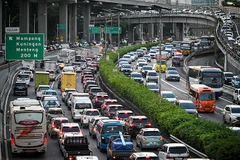
Jakarta grapples with mounting traffic pressure (Photo: thejakartapost.com)

Jakarta faces mounting traffic pressure

Data released by the Metro Jaya Police on December 31 showed that by the end of 2025, the total number of vehicles in Jakarta and its satellite cities of Depok, Tangerang and Bekasi reached 25.07 million, up 2.93% year-on-year. Of this figure, nearly 735,000 were newly registered vehicles, including more than 93,600 cars.

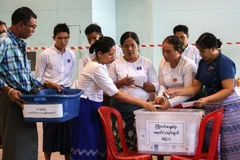
Election Commission officials count ballots at a polling station during Myanmar's general election in Yangon, Myanmar, on December 28, 2025. (Photo: Reuters)

Myanmar completes first phase of general election

Across Myanmar, more than 24.26 million people were eligible to vote in the 2025 general election. For the first phase, over 11.69 million voters were registered, and more than 6.09 million cast their ballots.

Indonesia's Minister of Energy and Mineral Resources Bahlil Lahadalia. (Photo: www.petromindo.com)

Indonesia targets diesel self-sufficiency in 2026

The Indonesian government is pressing ahead with its plan to end diesel imports in 2026, banking on the start-up of the Balikpapan Refinery Development Master Plan (RDMP) and the expansion of the biodiesel mandate to achieve fuel self-sufficiency.

A worker inspects a waste-to-energy generator at the Putri Cempo power plant in Solo, Central Java. (Photo: ANTARA)

Indonesia promotes waste-to-energy conversion

Under the programme, the national strategic investment management agency (Danantara) will provide investment capital, while state-owned electricity utility Perusahaan Listrik Negara (PLN) will be responsible for purchasing and distributing the electricity generated.

Passengers line up for check-in procedures at Kuala Lumpur International Airport (Photo: VNA)

Malaysia expands international air routes to boost tourism

Malaysian Minister of Tourism, Arts and Culture Tiong King Sing said that the new services comprise 16 scheduled flights and five charter flights to be operated by 10 airlines, linking Malaysia with destinations across ASEAN, East Asia, Uzbekistan and Sri Lanka.