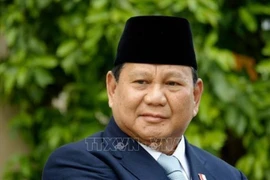
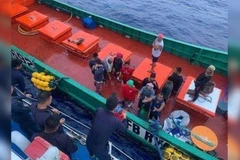
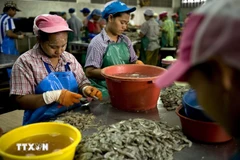
Jakarta (VNA) – Indonesian President Prabowo Subianto pledged to distribute fishing vessels ranging from five to 30 gross tonnes to coastal communities, aiming to boost catches and enable longer voyages as part of a national push to modernise fishing villages.
The vessel distribution is part of the Kampung Nelayan Merah Putih programme, which targets the modernisation of 12 million fishing villages across Indonesia, according to the President.
He said that one of the country’s most strategic programmes is Kampung Nelayan, each village will receive jetties, ice plants, cold storage and fishing boats.
Under the plan, villages will be allocated several 5-GT boats and, eventually, larger vessels of up to 30 GT, with the goal of providing at least one larger boat per fishing village.
He said the government has launched a pilot fishing village project in Biak Numfor, Papua, which has demonstrated strong results.
He said the country already has a pilot project in Biak that has proven to increase fishermen’s output by nearly 60%.
The Marine Affairs and Fisheries Ministry has begun upgrading fishing villages in recent months, with 19 Kampung Nelayan Merah Putih operating as of early 2026.
Modernised villages include sites in Tolitoli in Central Sulawesi, Bumiharjo in Central Java, Pujiharjo in East Java, Lebetawi in Maluku, Gebang Mekar in West Java and Karang Duwur in Central Java.
Other upgraded villages are located in Poncosari, Yogyakarta, and Bulukumba in South Sulawesi, according to the ministry.
From the Bulukumba fishing village, nearly one metric tonne of fresh fish was exported for the first time to Saudi Arabia on January 9, marking an early commercial milestone.
To support vessel procurement, President Prabowo travelled to the UK last month to meet leaders of the Babcock International Group in London. The two sides discussed the possibility of cooperating on building 1,500 fishing vessels to for Indonesia's modernisation programme.
According to Prabowo, the broader initiative is designed to raise fishermen’s incomes, strengthen cold-chain infrastructure and integrate coastal communities into export-oriented seafood supply chains./.