Indonesia to launch wage subsidy for low-income workers

The subsidy will be distributed over a two-month period to help sustain public purchasing power amid global economic headwinds and in anticipation of increased household spending during the school holiday season.

Jakarta (VNA) – The Indonesian Government is finalising a new wage subsidy programme that will provide 150,000 IDR (9.23 USD) per month to workers earning less than 3.5 million IDR. The scheme is part of a broader economic stimulus package set for rollout in the second quarter of 2025.

Chief Economic Affairs Minister Airlangga Hartarto said on May 26 that the proposal is still under discussion with relevant ministries and is scheduled to take effect on June 5.

The subsidy will be distributed over a two-month period to help sustain public purchasing power amid global economic headwinds and in anticipation of increased household spending during the school holiday season. The programme was previously discussed during the National Coordination Meeting on May 23. It is part of a wider stimulus plan, known as the Incentive Package, which also includes electricity tariff discounts, food aid, airline ticket subsidies, and other social protection programmes.

The Indonesian Government is set to reintroduce electricity bill discounts for low-power households starting June 5.

In the first two months of 2025, the government allocated 13.6 trillion IDR to provide a 50% discount on electricity bills for customers with power usage ranging from 450 volt-amperes (VA) to 2,200 VA. The subsidies benefited around 81.4 million customers, including 24.6 million with 450 VA, 38 million with 900 VA, 14.1 million with 1,300 VA, and 4.6 million with 2,200 VA./.

VNA

See more

Thailand enters technical deflation: Expert

Thailand enters technical deflation: Expert

Associate Professor Thanavath Phonvichai, President of the University of the Thai Chamber of Commerce and Chairman of the Centre for Economic and Business Forecasting, attributed the current bout mainly to lower production costs, particularly cheaper fuel and persistently low agricultural prices.

Indonesia spots four Sumatran tigers at national park

Indonesia spots four Sumatran tigers at national park

Camera traps installed in Bukit Tigapuluh National Park of Indonesia have recorded four individual Sumatran tigers (Panthera tigris sumatrae), providing strong evidence that the conservation area's ecosystem remains well preserved.

Deputy Prime Minister and Agriculture Minister of Thailand Thammanat Prompao (Photo: The Nation)

Agricultural envoys ordered to boost Thai crop exports

Deputy Prime Minister and Agriculture Minister of Thailand Thammanat Prompao said that the ministry is prioritising a “market-led, innovation-supported, higher income” strategy, built on three key pillars: strengthening confidence in core, established markets to protect Thailand’s market share; targeting high-potential products to open new opportunities, including dried seahorses, dried geckos, live crocodiles for consumption, and breeding crocodile parent stock for farming; and expanding networks by deepening cooperation with key trading partners, including China, and widening sales channels, such as digital platforms, so Thai products can reach consumers more directly.

Illustrative image (Photo: Internet)

Thailand maps out national semiconductor strategy

Under the strategy, Thailand will prioritise power, sensor, photonics, discrete and analog semiconductors, which are closely linked to the country’s established electronics manufacturing base and supply chains serving the automotive, energy, data centre and industrial sectors.

MDEC headquarters (Photo: nabalunews.com)

Malaysia’s digital exports surge

Malaysia's digital exports recorded 6.8 billion RM (1.67 billion USD) between 2024 and the first half of 2025, marking a milestone in the country’s development journey of digital economy.

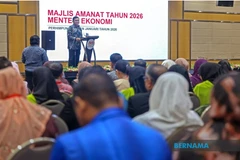
Malaysian Minister of Economy Akmal Nasrullah Nasir speaks at the Economy Minister Mandate 2026 on January 8. (Photo: Bernama)

Malaysia seeks to translate economic policies into practice

Malaysia enters the preparatory phase for the 13MP on the back of encouraging economic indicators in 2025. Gross domestic product (GDP) expanded by 5.2% in the third quarter of 2025, bringing average growth for the first nine months of the year to 4.7%.