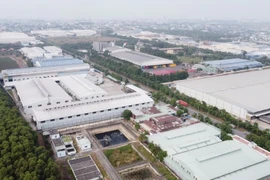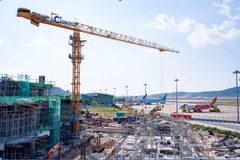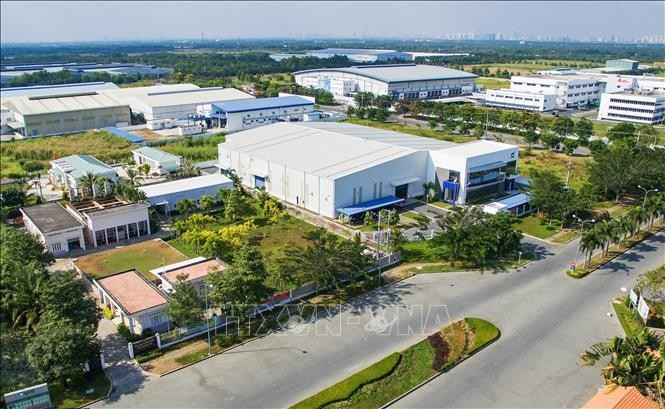
Hanoi (VNA) - The delegation of licensing authority to localities along with newly planned and expanded industrial zones is driving the growth of the industrial real estate segment, providing a major boost for investors.
According to the approved planning schemes of 63 localities, by 2030, Vietnam will have 221 newly planned industrial zones, while 76 existing zones will be expanded and 22 have their planning adjusted.
The acceleration of legal obstacles removal in recent industrial real estate projects is creating growth opportunities for many businesses participating in this segment. Notably, this is also one of the key factors contributing to attracting investment and boosting growth for real estate in 2025.
In November 2024, the National Assembly adopted the Law on amendments and supplements to a number of articles of the Law on Planning, the Law on Investment, the Law on Investment under Public-Private Partnership (PPP), and the Law on Bidding. Notably, the amended Law on Investment requires the delegation of investment certification for industrial zones to the provincial People's Committees, instead of the Prime Minister. This decentralisation of industrial land management will accelerate the establishment of new industrial zones.
According to experts, the licensing procedures for the establishment of new industrial zones will be sped up this year.
For example, in January, the Kinh Bac Urban Development Corporation (KBC) made significant legal progress in key projects, such as receiving approval for the investment policy of the 687-hectare Trang Due 3 Industrial Park, the 585-hectare Trang Cat Urban Area, and Phase 1 of the Kim Thanh 2 Industrial Park covering 235 hectares. As a result, the company's total industrial land fund has increased to 6,402 hectares, accounting for 5.1% of the national industrial land area.
Nguyen Van Dinh, Chairman of the Vietnam Association of Real Estate Brokers, stated that industrial real estate remains a "star" of the market, and is predicted to continue "carrying" the overall market's recovery at the top tier.
Notably, not only large, well-known developers such as Kinh Bac (KBC), Viglacera (VGC), Becamex (BCM), Idico (IDC), and others who dominate the industrial real estate market, but many other companies are also being drawn into the "race" by the segment's appeal.
Recently, Saigon Thuong Tin Real Estate Joint Stock Company (TTC Land) has announced its upcoming strategy to expand into the industrial and logistics real estate sectors in the southern market. Meanwhile, DIC Holdings, a member of DIC Corp, has also partnered with Van Thuong Industrial Park Infrastructure Development Co., Ltd. to be prioritised as the general contractor for the 400-hectare infrastructure project in Phu My township in Ba Ria-Vung Tau province.
Thomas Rooney, senior expert at Savills Hanoi, assessed that although the potential is "huge," most industrial park projects in Vietnam are currently being developed using the traditional model.
Converting a conventional industrial park into an environmentally friendly zone is necessary. However, this is not a simple task, as it involves high costs and requires time, as well as careful consideration from the Government regarding the legal framework and incentive policies. Additionally, credit support for investors is needed to help reduce the initial cost burden.
For industrial real estate to maintain its appeal and continue to grow strongly in the future, the expert stated that infrastructure and transport systems must continue to be developed and planned in a synchronised and efficient manner. At the same time, developers and investors need to pay attention to the general trends of the industry.
In 2025, experts forecast that the growth potential of this segment will stem from the trend of shifting FDI capital into Vietnam, along with support from land rental prices and policies from the Government./.
VNA