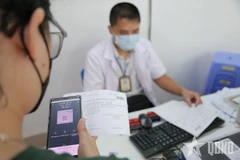
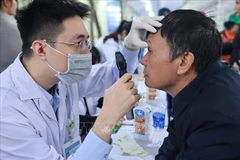
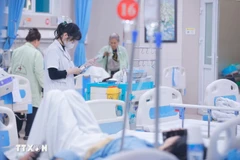
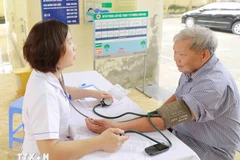
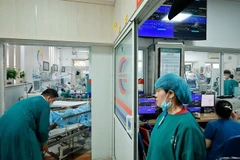
Quick SARS-CoV-2 tests conducted in Hanoi's Cau Giay district (Photo: VNA)
Hanoi (VNA) - Justone new COVID-19 infection case was reported on April 4 afternoon, bringing thetotal number in the country to 240.
The 240th patient is a 29-year-old Vietnamesewoman from Luc Nam district in the northernprovince of Bac Giangwho lived andworked inBangkok, Thailand.
On March 19, she joined a partyin Thailand with the family of the 166thpatient – a 25-year-old woman also from Bac Giang province.
On March 20, she returned to Hanoi on flightVN618, seat 28B from Bangkok and was sent to a concentrated quarantine camp in Nho Quan district, Ninh Binh province upon arrival.
She developed a fever on March 31 and testedpositive to SARS-CoV-2 on April 1 at Ninh Binh province’s General Hospital.
Her six roommates at the quarantine camp alltested negative for the virus on the same day.
On March 30, health officials in the centralprovince of Quang Binhisolated eight people who had been in close contact with the 166th patient whenthey were in Thailand.
As of April 4 afternoon, Vietnam hassuccessfully treated 90 COVID-19 patients.
The number of suspected infections was 3,736,down 935 cases compared to April 3.
The healthcare sector also urged localities totrace all people who had come in contact with the 237th patient – a Swedish manwho was confirmed infected with COVID-19 on April 1 afterbeing hospitalised following an accident./.
Permanent Deputy Foreign Minister Bui Thanh Son emphasised the importance of international cooperation in the COVID-19 fight during the third phone talks with leaders of the ministries of foreign affairs of the US, Japan, the Republic of Korea (RoK), India, Australia and New Zealand on April 3.
The Ministry of Foreign Affairs has urged Vietnamese representative agencies abroad to raise the sense of responsibility and keep staying in the host countries to fulfill all assigned tasks amid the complicated developments of the COVID-19 pandemic.
Two new COVID-19 infection cases, including one relating to Hanoi-based Bach Mai Hospital, were confirmed by the Ministry of Health on April 4 morning, raising the total number of patients nationwide to 239.
The Ministry of Health (MoH) has issued an urgent notice to trace all people in close contact with the 237th COVID-19 patient, a 64-year-old Swedish man, who was reported infected with the coronavirus on April 1 after being hospitalised for a accident.
The Government Office on late April 3 issued a document detailing the instructions on the implementation of the Prime Minister’s Directive 16 regarding a 14-day nationwide stay-at-home order and social distancing measures starting April 1 to deal with the COVID-19 pandemic.
Five more COVID-19 patients have recovered and were discharged from Cu Chi acute respiratory hospital in Ho Chi Minh City and Da Nang Hospital on April 4, bringing the total number of patients given the all-clear in Vietnam to 90.
Vietnamese Ambassador to Kuwait Trinh Minh Manh said on April 3 that the embassy gives the top priority to supporting Vietnamese citizens, with the aim of protecting their health and lives, legitimate rights and interests, amid the complicated developments of the COVID-19 pandemic.
President of the Vietnam Red Cross Society (VRCS) Central Committee Nguyen Thi Xuan Thu has sent a letter to call for the community's greater efforts to effectively prevent the spread of the COVID-19 pandemic and ensure enough blood for emergencies and medical treatment.
The novel coronavirus SARS-CoV-2-caused acute respiratory disease (COVID -19) pandemic has cost many real estate firms trillions of VND from their market capitalisation value.
Chairman of the Ho Chi Minh City People’s Committee Nguyen Thanh Phong has signed a decision to set up 62 posts and stations for COVID-19 prevention and control throughout the city.
The Red Sunday campaign has mobilised hundreds of thousands of blood units, making a significant contribution to reducing blood shortages during the Lunar New Year (Tet) Festival.
Participating experts underscored that smooth communication and close coordination among medical forces are a decisive factor in efficient emergency response.
Health insurance participants from near-poor households and those aged 75 and above who are receiving social pension allowances will be entitled to 100% coverage of medical examination and treatment costs within the scope of health insurance benefits.
Hanoi's health sector will continue to expand the comprehensive use of digital technology in professional practices to improve management efficiency and service quality, aiming to develop a modern, transparent, and people-centred healthcare system.
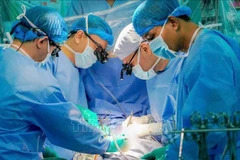
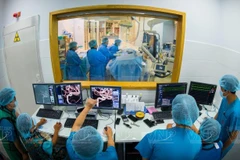
Most recently, University Medical Centre HCM City successfully performed two simultaneous transplants, a heart and a liver, using organs donated from a brain-dead patient at People’s Hospital 115.
This is Vietnam’s first pilot initiative combining postal services with low-altitude aviation technology for healthcare purposes, highlighting Vietnam Post’s pioneering role in organising and operating innovative technological solutions in service of the community.
The programme’s overarching goal is to ensure that all people receive primary healthcare management and early, preventive care delivered close to home, thereby reducing disease burden; to increase the total fertility rate and strive for a balanced sex ratio at birth; to adapt to population ageing while improving population quality; to improve care for vulnerable groups; and to contribute to improvements in physical and mental health, stature, life expectancy and overall quality of life, towards building a healthier Vietnam.
Self-care is an essential component of primary healthcare, with WHO defining it as the ability of individuals, families, and communities to promote and maintain health, prevent disease, and cope with illness with or without the support of healthcare professionals.
In recent years, Vietnam's Ministry of Health has held numerous meetings with relevant units to assess the progress in developing proton therapy centres in the country. The project for establishing proton therapy centres is set to commence preparations in 2025 and aims for completion between 2026 and 2030.
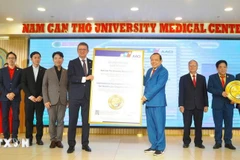
Nam Can Tho University Hospital on December 15 hosted a ceremony to announce its accreditation by the American Accreditation Commission International (AACI), a US-based body, becoming the first facility in the Mekong Delta and among a select few in Vietnam to earn the distinction.
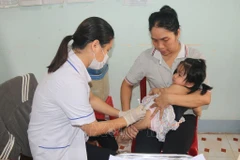
The meeting took place following an assessment by the World Health Organisation (WHO) warning that Vietnam is facing a very high risk of polio import and re-emergence. The risk arises after neighbouring Laos officially declared a polio outbreak on October 7, following the detection of circulating vaccine-derived poliovirus type 1 (cVDPV1).
The National Assembly on December 11 adopted a resolution on the National Target Programme on Healthcare, Population, and Development for the 2026–2035 period, marking a significant step in Vietnam’s long-term commitment to improving public health and population quality.
WHO Representative in Vietnam Dr Angela Pratt said, “WHO is delighted with the decision to include e-cigarettes and HTPs in the list of banned enterprises under the Investment Law, without exceptions. This is crucial for upholding the National Assembly’s ban on these products – Resolution 173.”
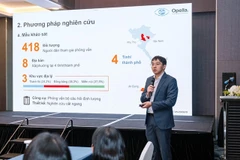
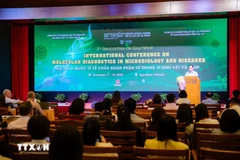
The conference features almost 80 presentations across plenary sessions, parallel sessions and poster sessions, focusing on leading research trends such as point-of-care diagnostics; predictive biomarkers used to anticipate individual responses to therapy; and the development of new tools and platforms for rapid molecular-level detection and diagnosis.
The association was established with three core missions: medical assistance, social support, and promotion of medical French - sending volunteer doctors to Vietnam, donating equipment, and helping medical students master French to secure clinical internships in France.
Canada has strong experience in compiling and analysing genomic data, while Vietnam has a large population with diverse genetic structures. This complementarity can help Vietnam narrow its technological gap and enhance its capacity to treat rare diseases — an area many countries are prioritising for development.
Resolution 72 not only focuses on health care but is also closely interlinked with other sectors, helping to build a solid foundation for sustainable national development and create momentum for Vietnam to “take off” and further integrate into the world.
The total value of medical expenses not covered by the health insurance fund is estimated at around 24.8 trillion VND (942 million USD) per year. Health insurance contributions remain low, at 4.5% of the salary or reference base used for calculation.
In 2023, the World Health Organization (WHO) hailed Vietnam as a leading country in the Asia-Pacific region in HIV pre-exposure prophylaxis (PrEP) treatment.