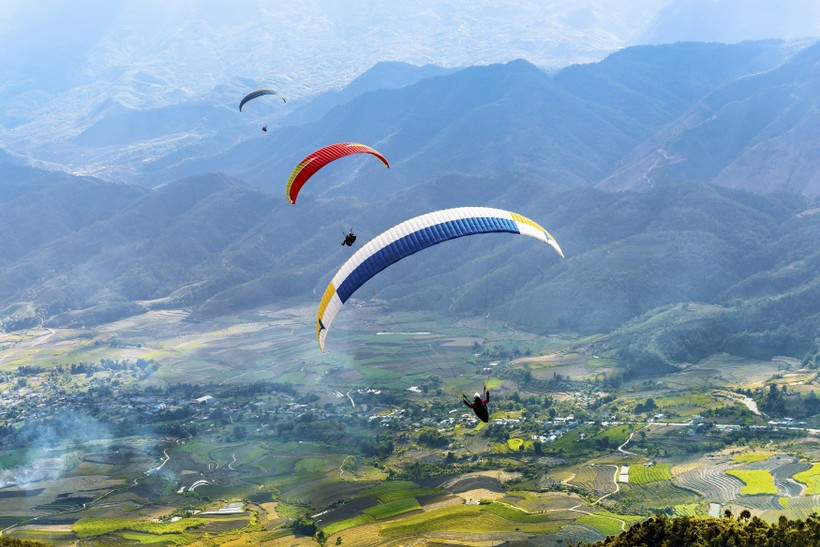
Hanoi (VNA) - As the nation enters a new era of development, the northern province of Lai Chau stands at the threshold of a fresh development phase, intertwined with opportunities and challenges. Its tourism is poised to “spread its wings and take off,” positioning itself as a promising destination amid the majestic Northwestern highlands.
Awakening potential, affirming position
Lai Chau is endowed with abundant natural tourism assets, including the Hoang Lien Son Mountain Range, home to seven of Vietnam’s highest peaks, including the Pusilung, Putaleng, Ta Lien Sơn, and Bach Moc Luong Tu. The province also boasts unique wonders of the O Quy Ho Pass, Pusamcap and Chin Chu Chai caves, Tac Tinh and Nam Luc waterfalls, alongside a mild climate and diverse landscapes.
With 20 ethnic groups, Lai Chau is a treasure trove of cultural heritage. It hosts distinctive festivals such as Then Kin Pang, Kin Lau Khau Mau, Gau Tao, Xoe Chieng, and Nang Han, alongside folk songs, handicrafts, rich ethnic cuisine, and 32 ranked historical sites (5 national-level, 27 provincial). These values create fertile ground for community-based, eco-resort, adventure, and culture-linked experiential tourism.
The province has set strategic directions and enacted policies to develop tourism as a key economic sector. Since the province’s re-establishment, tourism strategies have been regularly updated, along with projects to develop new-style rural areas and rural tourism, and preserve and promote the cultural identity of local ethnic minority groups.
Thanks to the concerted efforts of political bodies, businesses, and communities, Lai Chau’s tourism has advanced significantly. Infrastructure has improved, transport connectivity expanded, and tourism products steadily developed, establishing the province’s brand.
Promotion efforts through large-scale provincial and national programmes have helped portray Lai Chau as a dynamic, friendly, and hospitable destination for domestic and international visitors.
In 2024, the province welcomed 1.4 million visitors, a 30% increase over the previous year. This surge in tourism generated over 1.08 trillion VND (approximately 40.88 million USD). Notable destinations such as Sin Ho Plateau and O Quy Ho Pass have been designated as National Tourism Sites by the Prime Minister, as part of the 2021–2030 plan with a vision extending to 2045. These developments highlight the province’s positive growth trajectory.
Future path
However, challenges remain. Infrastructure and facilities are uneven, high-quality tourism products are scarce, and large investors have yet to arrive. Promotional efforts, though increased, lack full systematisation and fail to reach all potential markets. Revenue falls short of the province’s full potential.
To make tourism a key pillar of the provincial economy by 2030, a strategic vision, innovation, decisive action, and broad consensus from the political system, businesses, and people are essential. Priorities include completing sub-zone and construction plans for national and provincial tourism areas, reviewing preferential policies to attract investment from large corporations for modern shopping and entertainment centres.
Experts advised the locality to continue implementation policies on preserving ethnic cultural identity linked with tourism, along with national target programmes through 2030, while prioritising breakthrough infrastructure projects, attracting investment in key tourism projects. Master planning for Sin Ho Plateau and O Quy Ho Pass should be finalised to develop new products and attract enterprises.
Tourism products must be diversified and elevated in quality, they said, adding that promotion and marketing require modernisation and professionalism through stronger regional ties, international cooperation, national campaigns targeting global markets, large-scale cultural and tourism events, fam trips, film crews, digital applications, and building intelligent tourism ecosystems integrating infrastructure and services.
Developing a skilled tourism workforce, especially in community and ethnic minority tourism, is critical, combining theoretical and practical training./.