Vientiane (VNA) - On the eve of Party General Secretary To Lam’s state visit to Laos and his attendance at ceremonies marking the 50th National Day of Laos, the 105th birth anniversary of President Kaysone Phomvihane, and the high-level meeting between the Communist Party of Vietnam (CPV) and the Lao People’s Revolutionary Party (LPRP) from December 1-2, the Lao media has published a series of articles praising the exceptional, enduring and sacred relationship between the two neighbours.
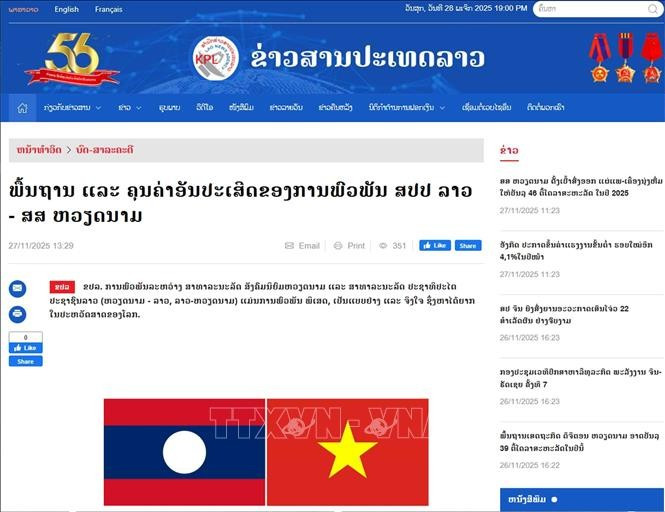
From November 27-28, major Lao outlets ran articles reaffirming that the great friendship, special solidarity and comprehensive cooperation between Vietnam and Laos constitute a priceless historical legacy.
Pasaxon, the official newspaper of the LPRP, published three articles emphasise that this unique bond, forged during the most challenging periods of each country’s revolutionary struggle and nurtured by successive generations, goes far beyond a traditional neighbourly relationship. It is a profound, loyal partnership built over nearly a century.
The Pasaxon series retraces the origin of the relationship, rooted in the shared revolutionary ideals of President Ho Chi Minh, President Kaysone Phomvihane and President Souphanouvong. The founding of the Indochinese Communist Party in 1930 marked a historic turning point, laying the ideological and organisational foundation for the two nations to fight side by side. This common path defined decades of joint struggle during some of the most difficult yet glorious chapters of their histories.
The articles highlight the brutal wartime years, during which the people and revolutionary forces of Vietnam and Laos stood shoulder to shoulder against common enemies. The presence of Vietnamese volunteer soldiers and experts in Laos symbolised pure internationalist solidarity, playing a vital role in the Lao people’s struggle for national liberation. In return, the Lao people generously supported and protected Vietnamese forces, reinforcing a combat alliance of exceptional strength. The legendary Truong Son Trail stands as a historic testament to the inseparable unity of the two nations and their shared victories.
Building on this shared struggle, the bilateral relations were formally set up with the establishment of diplomatic ties on September 5, 1962. The signing of the Vietnam–Laos Treaty of Amity and Cooperation on July 18, 1977 provided a solid legal and political framework for comprehensive collaboration in the post-war era. These documents retain their full value today and continue to guide the deepening and effective development of the special Vietnam–Laos relationship.
In the era of peace and development, the relationship has expanded significantly across all fields. Regular high-level visits and exchanges between the two Parties, States, National Assemblies and Governments have strengthened political trust — the foundation for all bilateral cooperation. Defence and security cooperation remain a priority, with both countries working closely to protect their shared border, maintain social order and combat transnational crimes. Effective bilateral mechanisms have contributed to safeguarding political stability and territorial integrity for both sides.
Economic cooperation has grown markedly over the past two decades. Vietnam is now among the top three foreign investors in Laos, with major projects in energy, agriculture, mining, finance and services. These investments not only drive Laos’s economic growth but also enhance linkages between the two countries' enterprises. Infrastructure connectivity has become a new highlight, with several major transport projects being promoted vigorously. Vietnam’s permission for Laos to use Vung Ang Port is viewed as a strategically significant step, helping the landlocked country strengthen its access to international trade and advance its ambition of becoming a regional logistics hub.
Education and training cooperation remains a long-term priority. Each year, Vietnam provides thousands of scholarships for Lao students and officials, contributing to the development of high-quality human resources. Many Lao leaders and senior officials studied in Vietnam, forming a generation of dedicated "bridge-builders" for the bilateral ties. Cultural, sports and tourism exchanges have also flourished, deepening people-to-people bonds, especially among young generations. These activities have not only enhanced mutual understanding but also preserved and carried forward the shared historical traditions of the two nations.
The Pasaxon articles conclude that the Vietnam–Laos relationship is the result of persistent efforts grounded in trust, sincerity and shared interests. In a world characterised by unpredictable geopolitical changes, the special solidarity between Vietnam and Laos remains a strategic pillar of stability and development for both countries and a valuable contribution to regional peace and cooperation.
Meanwhile, Pathetlao, another major Lao news outlet, published a parallel trilogy of articles titled “The Historical Legacy and Sacred Value of the Special Laos–Vietnam Relationship.” The series reiterates that the Laos–Vietnam bond is a rare, exemplary and sincere relationship in world history — one forged “mountain to mountain, river to river,” strengthened through sweat, blood and enormous sacrifices by generations of revolutionary cadres and citizens. Through time and hardship, this great friendship and special solidarity have become a treasured legacy and a fundamental stabilising force for both nations.
According to Pathetlao, the establishment of diplomatic relations 63 years ago marked a milestone of immense significance, reflecting the shared political and diplomatic achievements of both revolutions. Since then, the relationship has continued to grow, not only on the battlefield in earlier decades but also in the recognition and support of the international community during peacetime, national construction and development.
Today, the Parties, States and people of Laos and Vietnam continue to inherit and promote this precious legacy. They consistently strengthen political trust and expand cooperation across all sectors, with defence–security collaboration identified as a “crucial pillar” contributing to national independence, sovereignty, social stability and territorial integrity. The two countries have worked closely in foreign affairs, regularly supporting one another at regional and international forums, enhancing each nation’s global standing and contributing to shared peace and development.
Cultural and educational cooperation, human resource development and people-to-people exchanges remain vibrant. Border provinces have maintained active cross-border friendship programmes, turning the Laos–Vietnam borderline from a geographic boundary into a corridor of peace, friendship and development.
Both Pasaxon and Pathetlao stress that the great friendship, special solidarity and comprehensive cooperation between Laos and Vietnam constitute a sacred and invaluable asset of both nations. Preserving and promoting this legacy is a shared responsibility and honour of the two Parties, States and people of Vietnam and Laos, especially the younger generations, who are expected to carry forward the torch of solidarity into the future./.