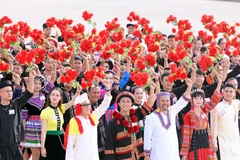
Vietnam ready for national election day
This political event carries special significance as an expression of the people’ right to mastery to choose worthy representatives.
The deployment and development of 5G networks in Vietnam not only bring technological benefits but also drive sustainable economic growth, enhance national competitiveness, and support industrialisation and modernisation.
Vietnamese women have long been an indispensable force in the country’s socio-economic development. Today, they are present across a wide spectrum of economic activities, from production, trade and small-scale services to innovative start-ups, collective economic development, the digital economy, green growth, the circular economy and financial inclusion.
Each election took place under different historical circumstances, yet all vividly reflected the People's will, aspirations and trust in the Party and the State, while affirming the NA's central role within the political system and in the process of building a socialist rule-of-law State of Vietnam.
Restoring and developing forests as part of the 2026–2030 coastal forest protection and development project is still a big job. The plan aims to plant 5,088 hectares — including 3,236 hectares of mangroves and 1,852 hectares on soil and sandy land — and to enrich, restore, and improve 1,514 hectares of existing forests, with 683 hectares of mangroves and 831 hectares on soil and sand.
In the course of Doi moi (Renewal) and international integration, infrastructure has been identified as the “lifeblood” of the economy, playing a pivotal role in driving growth and expanding development space.
In recent years, alongside the tradition of family reunions during the Lunar New Year (Tet), travelling during the holiday has become increasingly popular. Early spring travel is not merely about sightseeing; it also carries the meaning of seeking good fortune, peace and cultural experiences across different regions of the country.
Each dish embodies not only taste but also memories and cultural values nurtured over generations. Sustaining this heritage ensures that Vietnamese cuisine is not eroded by time, but continues to be cherished, renewed and shared with care and respect.
In a January interview with the Vietnam News Agency shortly after the congress, Party General Secretary To Lam emphasised the determination of the entire political system to turn its resolution into tangible outcomes, bringing clear benefits to the people as quickly as possible.
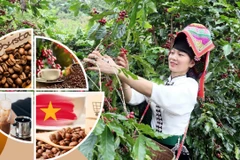
After more than a century of formation and development, the coffee industry has made Vietnam one of the world’s leading coffee producers
As the country enters a new era marked by extensive global integration, digital transformation and global competition, culture has ascended to its rightful place as soft power.
The term of the 14th National Congress of the Communist Party of Vietnam is an extremely important and pivotal period, carrying decisive significance for the country’s two strategic centennial goals. The Resolution of the 14th National Party Congress clearly sets the major objectives, orientations and measures for the new term and the subsequent stages.
After one year of implementing the Politburo’s Resolution No. 57-NQ/TW on breakthroughs in science, technology, innovation, and national digital transformation, numerous digital models and knowledge-based initiatives have been rolled out, bringing digital transformation to communities and contributing to the fulfilment of socio-economic development targets.
With total import-export revenue reaching 920 billion USD in 2025, Vietnam has officially entered the world’s top 15 economies in terms of international trade, marking a significant milestone in national development after decades of global economic integration and 40 years of Doi moi (Renewal). International trade has become a key driver of Vietnam’s economic growth.
Over three continuous decades, from 1945 to 1975, the Party organised and led two protracted wars of resistance to resounding victory, creating events of international significance and profound historical impact.
The National Assembly (NA) on December 11, 2025 passed Resolution No. 257/2025/QH15, greenlighting investment policy for a sweeping National Target Programme on new-style rural development, sustainable poverty reduction, and socio-economic development in ethnic minority and mountainous areas through 2035.
Vietnam has obtained historic achievements in foreign affairs over 40 years of "Doi moi" (renewal) under the leadership of the Communist Party of Vietnam (CPV), which is set to continue to build on these successes to proactively seize opportunities and surmount challenges to further strengthen diplomatic efforts, thereby safeguarding national interests and affirming Vietnam’s role as a responsible and active member of the international community in an ever-changing world.
Vietnam’s Logistics Services Development Strategy for the 2025–2035 period, with a vision to 2050, for the first time outlines a long-term and comprehensive roadmap clearly defining logistics as the “backbone” of the national economy.
Dong Thap province’s fishing fleet operates mainly in the Ba Dong, Vung Tau and South Con Son fishing grounds, with about 60% of vessels having large capacity sufficient to venture into deep-sea areas. To date, 1,291 vehicles have been licensed, equipped with vessel monitoring systems (VMS), and had their data fully updated on the national fisheries database (Vnfishbase).
In the richly diverse tapestry of Vietnam’s 54 ethnic groups, there are small communities – like precious gems hidden deep in the mountains – that quietly enrich the nation’s cultural identity. These are the very small ethnic minority groups, with populations of fewer than 10,000 people, and in some cases only a few hundred.
With the governmetn's determination, coordinated efforts of sectors, dynamic local implementation and active engagement from businesses, Vietnam's tourism is poised to accelerate, make breakthroughs and grow sustainably, moving toward becoming a a key economic pillar and enhancing the country’s position on the global tourism map
The digital economy is establishing itself as a pillar of Vietnam’s development process as it is expected to reach about 39 billion USD in 2025 and boasts one of the fastest growth rates in Southeast Asia.
Vietnam currently has 17 intangible cultural heritage elements inscribed by UNESCO, contributing to enhancing the country’s image on the global tourism map.
Vietnam has once again been honoured as the World’s Leading Heritage Destination in 2025 by the World Travel Awards (WTA), marking its sixth recognition after the wins in 2019, 2020, 2022, 2023, and 2024 and reaffirming its foothold in the global tourism industry.
As Ho Chi Minh City’s tourism sector continues to sustain growth momentum, it is shifting strongly from post-merger recovery to development acceleration, with a focus on restructuring destination spaces to offer diverse tourism models and attract more domestic and international visitors.