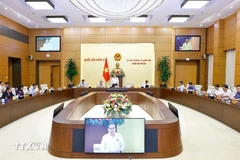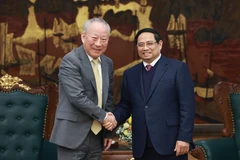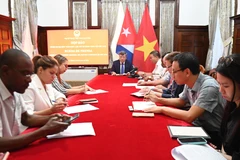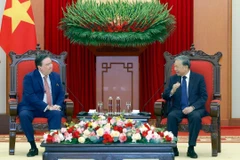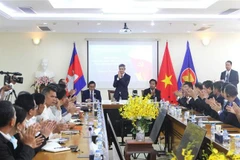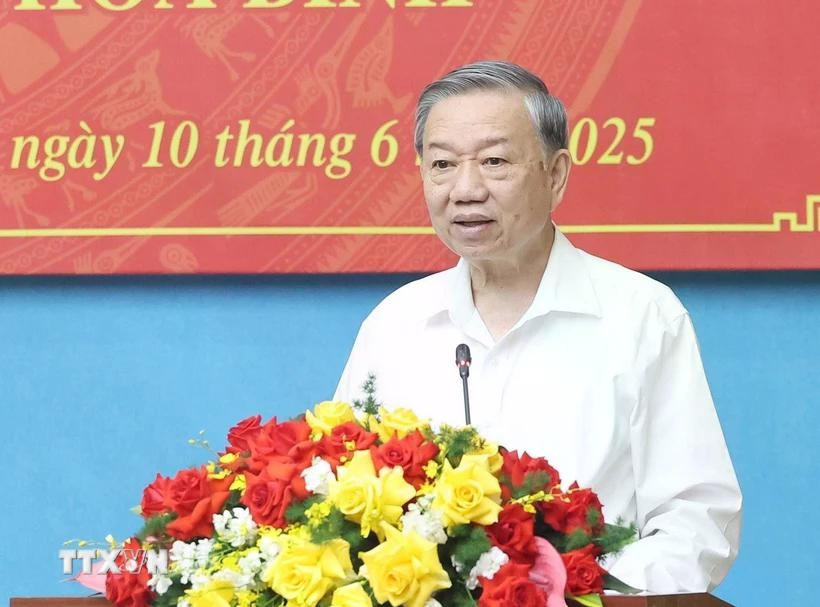
Phu Tho (VNA) – The merger of the three northern provinces of Phu Tho, Vinh Phuc and Hoa Binh to form a single Phu Tho province is expected to create favourable conditions for the development of economic corridors across plains, midlands, and mountainous regions, stated Party General Secretary To Lam at a working session with the Standing Boards of the three localities' Party Committees on June 10.
General Secretary Lam emphasised that the merger of the three provinces marks a strategic turning point for the broader northern midland and mountainous region.
Geographically, it would create a contiguous and integrated area linking Hanoi with the vast Northwest and serving as a gateway to the North Central region via National Highways 6 and 32, and the Ho Chi Minh Road. Removing rigid administrative boundaries would enable unified planning for infrastructure, urban development, industry, and agriculture. This integration would support seamless economic corridors from lowland to highland, unlocking interregional potential in trade, tourism, and logistics.
Highlighting the unique economic structure of each locality, the General Secretary noted that their complementary strengths form a complete value chain. In terms of human capital, the merger would allow a more balanced and diverse labour force, enhancing productivity and narrowing development disparities between regions.
The provinces showcase diverse northern cultural traditions, offering strong potential for cultural tourism, local education, and regional heritage branding, making the area both historically rich and attractive today. Additionally, plans to reorganise urban, industrial, and transport systems into a multi-centre model with distinct functional zones aim to support more efficient growth management, said the Party chief.
Phu Tho, Vinh Phuc, and Hoa Binh provinces have leveraged their cultural heritage and strong political commitment to achieve significant, coordinated progress across various sectors. In 2024, all the three provinces experienced robust economic growth - Phu Tho 9.53%, Hoa Binh 9%, Vinh Phuc 7.52% - with key indicators meeting or exceeding targets. Improvements were made in economic restructuring, poverty reduction, ethnic minority support, social welfare, culture, education, healthcare, environmental protection, and political stability.
Currently, six of 14 tasks on the re-organisation of administrative units have been completed, including a 69.1% reduction in commune-level units from 479 to 148. The restructuring process has been inclusive and widely supported, with over 95% public approval, aiming to boost administrative efficiency and socio-economic development.
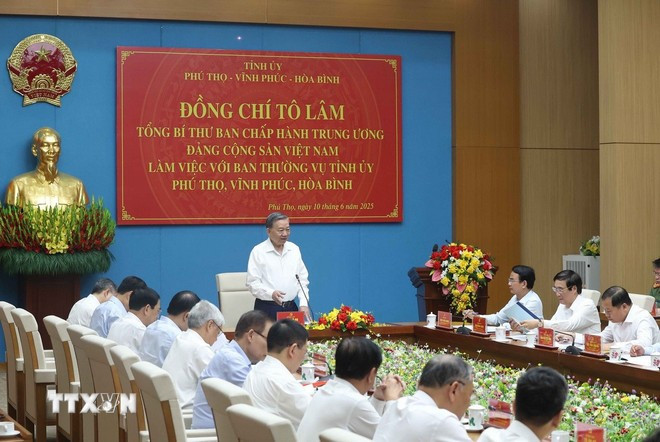
To fully realise the merged province’s potential, General Secretary Lam outlined key priorities, including swift and orderly implementation of the new two-level local governance model, ensuring transparency, objectivity, and alignment with central resolutions and guidelines; proper personnel policies, especially for those retiring, being reassigned, or working in remote areas, alongside preparing a forward-thinking leadership pipeline; and comprehensive review of existing economic, demographic, urban, and sectoral landscapes to define appropriate regional roles and functions.
He suggested that Vinh Phuc serve as a hub for industry, logistics, and modern urban development, driving revenue, job creation, and manufacturing, while Phu Tho act as a central services corridor, cultural tourism gateway, and agricultural specialist, linking lowlands with mountainous areas, and Hoa Binh focus on green economy, eco-tourism, forestry, hydropower, and ethnic heritage, balancing conservation and high-end resort development.
On this foundation, regional value chains should be developed, supported by a tiered urban network centred on Vinh Yen, Viet Tri, and Hoa Binh, with satellite hubs like Phuc Yen, Thanh Thuy, Luong Son, Yen Lac, and Tan Lac.
The newly merged province is tasked with completing a comprehensive master plan to 2030 with a vision to 2050, aligned with broader integration strategies linking the Northwest, Hanoi, the North Central region, and the Laos–Vietnam economic corridor. Environmental sustainability, cultural preservation, and social welfare must not be compromised for mere growth targets, he stressed.
He also reminded the three localities to ensure good preparations for the Party congresses at all levels with high quality amid the transitional period.
The Party leader underscored that the newly merged province should propose special mechanisms, ranging from infrastructure investment and digital transition to fiscal decentralisation and cultural heritage protection, to fully leverage its new scale, diversity, and strategic position./.