NA adopts resolution on Vietnam’s International Financial Centre

It outlines the framework for the establishment, operation, governance, oversight, and implementation of special mechanisms and policies applicable to Vietnam’s IFCs. It is applicable to all centre participants, investors, relevant authorities, organisations, and individuals involved in the operation of the IFC as defined in the resolution.

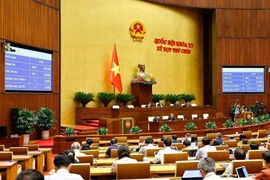
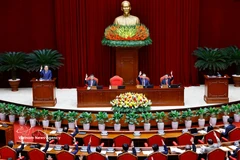
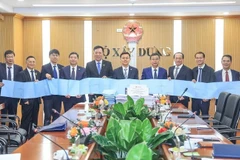
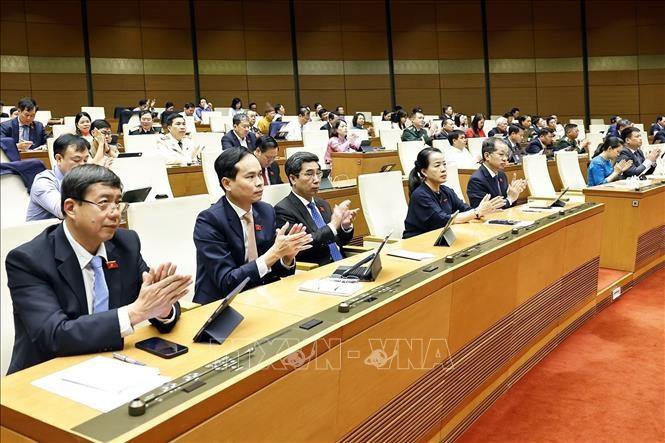
The National Assembly adopts the resolution on the International Financial Centre (IFC) in Vietnam, with 438 out of 447 legislators voting in favour, (Photo: VNA)

Hanoi (VNA) – The National Assembly (NA) on June 27 adopted the resolution on the International Financial Centre (IFC) in Vietnam, with 438 out of 447 legislators voting in favour, representing 91.63% of all NA deputies.

The resolution, comprising six chapters and 35 articles, will come into effect on September 1, 2025.

It outlines the framework for the establishment, operation, governance, oversight, and implementation of special mechanisms and policies applicable to Vietnam’s IFCs. It is applicable to all centre participants, investors, relevant authorities, organisations, and individuals involved in the operation of the IFC as defined in the resolution.

According to the resolution, the IFC will be based in Ho Chi Minh City and Da Nang, developed on a unified model of operation, supervision, and governance. Each city will have tailored financial product strategies that leverage their respective strengths while maintaining fairness and mutual complementarity. The aim is to elevate Vietnam’s position in the global financial network and foster economic growth drivers.

The IFC will also serve as a platform to promote sustainable finance, encourage the development of green financial products, and mobilise resources for energy transition and green transformation projects, contributing to sustainable socio-economic development. It will operate in accordance with advanced international standards, linking with major global financial markets and facilitating integration between domestic and international exchanges. It is designed to attract capital flows and foster innovation in financial services, especially in financial technology.

The centre will develop a highly skilled workforce by attracting both domestic and international financial professionals, while creating a business-friendly and liveable environment for global investors and experts.

The development of the IFC must strike a balance between the interests of the State, investors, and the public, and safeguard financial security, economic stability, political order, and social safety.

Entities that meet the criteria set forth in this resolution and associated legal documents will be entitled to benefit from the special mechanisms and policies outlined.

These special policies will apply within the administrative boundaries of the IFC as specified by a Government Decree on the centre's establishment, as referenced in Article 8 of the resolution.

IFC members must operate with efficiency, transparency, integrity, and professionalism, adhering to international standards in both financial and supporting services.

The IFC will maintain operational independence from state management functions. The State affirms its recognition and protection of the ownership of assets, investments, income, and all lawful rights and interests of IFC members.

To attract investment, technology, modern management methods, and high-quality human resources, the Government will introduce superior and tailored mechanisms and incentives. These include creating favourable environment conducive to free movement of international capital; promoting the development of the stock market, insurance, banking, digital assets, fintech, and e-commerce to support green, sustainable projects and innovation-driven financial services; and drawing and developing high-quality human resources in Vietnam.

Regulatory and supervisory agencies within the IFC will be streamlined, empowered, and responsive to investors and market participants. They will follow special administrative procedures aligned with both international practices and Vietnam’s legal context.

Special mechanisms and policies will cover key areas including foreign exchange and banking activities; capital markets and tax incentives; immigration, residency, and labour for experts and investors; social security and employment; land use, construction, and environment; controlled pilot frameworks for fintech and innovation; strategic investor incentives and infrastructure development; trade and service regulations, including import/export, distribution, and fees; and dispute resolution in investment and business activities.

In transactions involving at least one foreign party, the parties may agree to apply foreign law, provided it does not contravene the fundamental principles of Vietnamese law. If no governing law is agreed upon, the law of the jurisdiction most closely connected to the transaction shall apply. For property-related transactions such as ownership, leasing, or collateral involving real estate, the law of the jurisdiction where the property is located will apply.

The official working language of the IFC is English, or English accompanied by a Vietnamese translation. All regulations and internal rules will be published in both English and Vietnamese. Financial, technical, and statistical documents must be stored in English or in bilingual format. Administrative procedures, transactions among IFC members and with foreign parties, and dispute resolution will all be conducted in English or in English with a Vietnamese translation./.

VNA
See more

☕ Afternoon briefing on January 8

☕ Afternoon briefing on January 8

The Government's conference reviewing its 2025 performance and set tasks for 2026, Vietnam – Japan trade exceeding 50 billion USD for the first time, and five cultural practices listed as national intangible cultural heritage are among news highlights on January 8.

Overview of the January 8 conference reviewing the Government and localities’ 2025 performance and launching 2026 tasks (Photo: VNA)

Achieving double-digit growth requires new growth model: PM

High economic growth must be anchored in macroeconomic stability and major economic balances, the PM said, adding that fast growth must be sustainable and tied to social progress and equity, environment protection and higher living standards.

Party General Secretary To Lam speaks at the national conference reviewing the Government’s performance in 2025 and outlining tasks for 2026 (Photo: VNA)

Party leader calls for decisive mindset shift from administration to development creation

Party General Secretary To Lam commended the Government, ministries, local authorities, the business community, and the people at home and abroad for their concerted efforts and achievements in 2025 and throughout the 2021–2025 period. At the same time, he stressed the need to frankly acknowledge persistent shortcomings and newly emerging challenges, many of which reflect deep-rooted structural bottlenecks in the development model and national governance system.

Zhu Chenming, Honorary Director of the institute of South and Southeast Asian studies under China’s Yunnan Academy of Social Sciences, gives an interview to the VNA. (Photo: VNA)

Chinese scholar commends Vietnam’s active, balanced foreign diplomacy

Vietnam’s foreign activities in recent years have produced many positive and noteworthy results. The country has consistently pursued a foreign policy of independence, self-reliance, multilateralisation and diversification of international relations, while proactively advancing comprehensive and in-depth international integration.

Prime Minister Pham Minh Chinh speaks at the meeting (Photo: VNA)

Government conference sets socio-economic agenda for 2026

Vietnam fulfilled its socio-economic development tasks for 2025 and the 2021-2025 period amid rising complex global changes. The country's 2025 economic growth expanded by 8.02%, ranking among the top performers in the region and the world.Vietnam’s economic growth expanded by 8.02%, ranking among the top performers in the region and the world.

Prime Minister Pham Minh Chinh, his spouse, Vietnamese officials and Dominican friends at a memorial dedicated to President Ho Chi Minh in Santo Domingo, the Dominican Republic, on November 21, 2024. (Photo: VNA)

Vietnam asserts increasingly high standing on int’l stage: Dominican leader

Secretary General of the United Left Movement (MIU) of the Dominican Republic Miguel Mejía said that Vietnam’s Doi Moi (renewal) process over the past four decades has enabled the country to sustain strong economic growth, laying a core foundation for its modernisation and establishing a strong position on the global stage.

☀️ Morning digest on January 8

☀️ Morning digest on January 8

The 4th meeting of the Steering Committee for Nuclear Power Plant Construction, a meeting of the Party Central Committee Office and relevant agencies to review preparations for the 14th National Party Congress, and retail sales statistics in 2025 are among news highlights on January 7 evening.

Politburo member and Standing Member of the Party Central Committee’s Secretariat Tran Cam Tu chairs a working session with the Party Central Committee Office and relevant agencies to review preparations for the 14th National Party Congress. (Photo: VNA)

Major tasks for 14th National Party Congress on track

Chairing a working session with the Party Central Committee Office and relevant agencies on January 7 to review preparations for the Congress, Politburo member and Standing Member of the Party Central Committee’s Secretariat Tran Cam Tu commended agencies and units for their strong sense of responsibility and efforts in fulfilling assigned tasks in line with the plan.

A corner of Hanoi (Photo: VNA)

Overcoming headwinds, Vietnam lays cornerstone to break through into new era: PM

In 2025 and since the beginning of the current term, one of the most prominent bright spots in the leadership, direction and governance by the Government and the Prime Minister, as well as all-level authorities, sectors and localities, has been the strong focus on closely grasping situation developments, staying grounded in reality, and adopting proactive, timely, flexible and effective policy responses.

State President Luong Cuong (middle) hands over appointment decisions to new Deputy Chief Justices Le Tien (left) and Nguyen Bien Thuy on January 7. (Photo: VNA)

State President appoints two deputy chief justices

President Luong Cuong described the appointees as highly trained legal experts with strong qualifications who have advanced through the ranks while accumulating substantial hands-on experience in the judicial system.