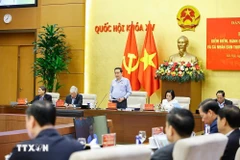
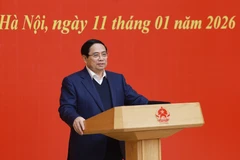
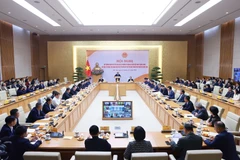
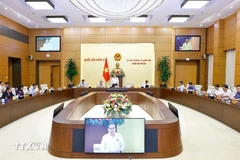
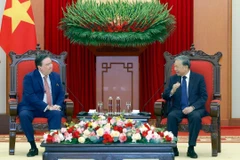
Minister of Planning and Investment Nguyen Chi Dung presents the report on the draft law on public-private partnership (PPP) at the National Assembly's Standing Committee meeting on September 16 (Photo: VNA)
 Hanoi (VNA) - The National Assembly Standing Committee discussed a draftlaw on public-private partnership (PPP) projects, composed by the Ministryof Planning and Investment (MPI), during its 37th session inHanoi on September 16.
The draftproposes PPP projects be unavailable in sectors that have so far seen noPPP projects, those with ineffective PPP projects, or those lacking appeal toinvestors, and others where other kinds of investment would be more fitting.
Under thedraft, tourism; culture and sports; telecommunications infrastructure;infrastructure for science and technology development; infrastructureat industrial parks, economic zones, industrial clusters, and high-tech parks;and infrastructure for rural areas and agriculture would be banned from runningPPP projects.
There arealso changes in the draft law regarding Government guarantees and risk-sharing.Specifically, the draft proposes Government guarantees of foreign exchangebalance for PPP projects be determined by the NA and the Prime Minister, with amaximum of 30 percent of project revenue paid to private investors inVND.
Therisk-sharing mechanism for revenue is also proposed in the draft lawto be extended to key projects decided by the NA and the PM.
Ministerof Planning and Investment Nguyen Chi Dung said implementation of PPPprojects in the past showed the investment in this model of PPP in Vietnamstill had many risks.
Amongthem, there are market risks, but there are also many risks stemming from theGovernment's decisions, such as decisions to abandon fee collection tools or towaive road fee adjustment of planning and pricing mechanisms, orchanges in foreign currency policy. Such risks wouldaffect project revenue.
TheMinister of Planning and Investment said a risk-sharing mechanism is necessary.
Accordingto Dung, the draft law's revenue risk-sharing mechanism lets investorsshare a part of the risk when a project has a revenue deficit. On theother hand, the Government will receive back the shares when the projecthas revenue higher than the initial targets.
Specifically,the Government would have to commit to sharing withinvestors not more than half of the deficit between actualrevenue and committed revenue in the contract, while investors have toshare with the Government not less than half of the increase in revenuebetween actual revenue and committed revenue in the contract.
Head ofthe NA Judiciary Committee Le Thi Nga said the proposal wasnot rational.
When theGovernment signs a contract with investors, it should ensure the contractis feasible, she said.
Forinstance, when building a build-operate-transfer toll booth, the Government andthe investor should make sure the location is rational. It would not be rightif the toll booth is set up at a location where people would objectto pay, and then the Government has to share risk costs, she said.
Phan ThanhBinh, head of the National Assembly's Committee for Culture, Education, Youth,Adolescents and Children, proposed re-considering the risk-sharing mechanism inthe draft law.
“We arean agricultural country, but for farmers, do we have a policy to share risk? Whydo we raise the problem of risk-sharing when it comes to PPPprojects? Every year, when farmers face consumption problems, we say theyhave to deal with it because it’s a market problem!” he said.
Vietnamhas so far attracted 336 PPP projects in transport, technical infrastructure,energy, water supply and drainage, environment, culture, sports, and educationand training, among other fields.
The draftLaw on PPP is expected be completed this month before being submittedto the National Assembly for discussion in October 2019 and approval inMay 2020./.
VNA