Resolution No. 66-NQ/TW and “renewal” of legal thinking

Party General Secretary To Lam has stressed that high-quality institutions and laws, aligned with practical development needs and the aspirations of the people, are the foremost factors determining a nation’s success.

Resolution No. 66 is not merely a technical legal directive but a revolution in legal thinking and national governance. (Illustrative image: baochinhphu.vn)

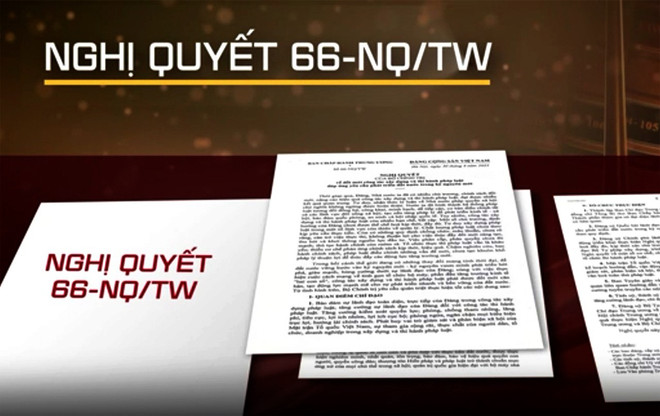
​Hanoi (VNA) – The Politburo's Resolution No. 66-NQ/TW on reforming the building and enforcement of laws to meet the requirements of national development in the new era has so far demonstrated its effectiveness, creating an institutional breakthrough for sustainable development in the time to come.

Party General Secretary To Lam has stressed that high-quality institutions and laws, aligned with practical development needs and the aspirations of the people, are the foremost factors determining a nation’s success. Therefore, for the country to rise and develop strongly, it is imperative to firmly say “no” to any limitations in institutions and laws, and not to compromise with any weaknesses in policy design, law drafting, or implementation.

This viewpoint affirms that institutions and laws are the core foundation for the country’s groundbreaking development in the new era, which is also the fundamental reason for the Politburo’s issuance of Resolution 66-NQ/TW on April 30, 2025 to remove existing institutional bottlenecks.

Within the State administrative system, the Ministry of Justice plays a central role in advising on and organising the implementation of the resolution. The ministry is also key to reforming law-making methods, improving the quality of draft laws, and strengthening management of the law-making process, from policy research and proposal to law enforcement.

Statistics from ministries and sectors show that all 1,295 comments and recommendations have been responded to and publicly posted on the ministries’ portal and the national legal portal. Preliminary figures indicate that by the end of 2025, 462 out of 470 comments and recommendations (98.3%) had been addressed, while only eight cases (1.7%) remained unresolved.

Thus, the goal set by the resolution – to complete the removal of “bottlenecks” caused by legal regulations in 2025 – has been achieved. Notably, many difficulties and obstacles in the fields of finance, investment, science and technology, innovation and digital transformation, justice, and public security have been resolved.
nghi-quyet-66-01012026-01.jpg

Minister of Justice Nguyen Hai Ninh affirmed that Resolution No. 66 is not merely a technical legal directive but a revolution in legal thinking and national governance. Its implementation is not a narrow task of the justice sector alone, but a strategic mission of the entire political system, aimed at building a legal system that effectively serves social development and modern governance.

Assessing the resolution’s impact, Ngo Quynh Hoa, Deputy Director of the Department of Legal Dissemination and Education under the Ministry of Justice, said that after a period of implementation, the resolution has brought about clear and fundamental changes in law-making and enforcement. The most notable shift is the strong transformation in mindset, from a management-oriented approach to one focused on development facilitation, and from passively improving laws to proactively designing forward-looking legal policies that pave the way for socio-economic development.

According to Hoa, the resolution has created an important political and legal framework that closely links law-making with law enforcement, overcoming the situation of “laws being made and then left unused.” Policy communication, legal dissemination and education have been identified as key stages, implemented more systematically, earlier, and closer to reality, thereby raising awareness and building social consensus from the policy building stage./.


VNA

See more

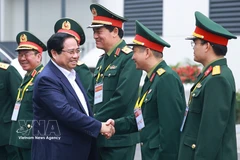
Prime Minister Pham Minh Chinh presents Certificates of merit from the Government’s Party Committee to individuals with outstanding achievements. (Photo: VNA)

Prime Minister outlines five specific strategies for Government’s Party Committee

PM Chinh noted that the Government’s Party Committee exercised comprehensive leadership over the Government's operations, proactively and effectively responded to emerging issues, with a particular focus on socio-economic development. As a result, 2025 witnessed high economic growth, sustained macroeconomic stability and ensured major balances.

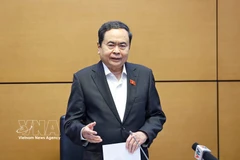
Politburo member, Standing member of the Party Central Committee’s Secretariat Tran Cam Tu attends the rehearsal. (Photo: VNA)

Security forces stage rehearsal for 14th National Party Congress

The People’s Public Security forces have been praised for their core role in closely working with the army and relevant ministries and agencies, with success in thwarting hostile plots at an early stage, drastically combating fake news and disinformation surrounding the 14th National Party Congress.

Senior Lieutenant General Le Quoc Hung (L), member of the Communist Party of Vietnam (CPV) Central Committee and Deputy Minister of Public Security, and General Vilay Lakhamfong, Politburo member and permanent member of the Secretariat of the Lao People’s Revolutionary Party (LPRP) Central Committee. (Photo: VNA)

Deputy Minister of Public Security congratulates Lao officials following succesful 12th National Party Congress

Deputy Minister of Public Security Senior Lieutenant General Le Quoc Hungconveyed the warmest congratulations of the Central Public Security Party Committee, the Ministry of Public Security leadership, and the Vietnamese People’s Public Security Forces to Lakhamfong and other Lao public security leaders on the congress’s success and their election to key leadership positions for the new term.

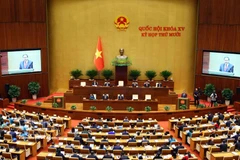
A session of the National Assembly Standing Committee. (Photo: VNA)

NA Standing Committee's key work agenda for 2026 approved

A major focus will be preparations for the election of deputies to the 16th NA and to People’s Councils at all levels for the 2026–2031 term. The NASC will coordinate with the National Election Council, the Government, the Vietnam Fatherland Front Central Committee, and relevant agencies and organisations to continue implementing the election plan, organise oversight of the electoral process, and carry out its duties and powers as prescribed.

Party General Secretary To Lam receives US Ambassador Marc Evans Knapper in Hanoi on January 9, 2026. (Photo: VNA)

Party leader receives outgoing US Ambassador

Vietnam always values its relationship with the US and looks forward to continuing close cooperation with the US government to deepen bilateral relations based on mutual respect for each other’s independence, sovereignty, territorial integrity, and political institutions, contributing positively to peace, stability, cooperation, and development regionally and globally.