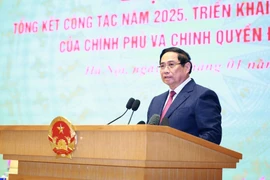
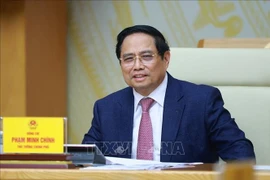
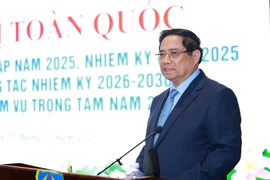
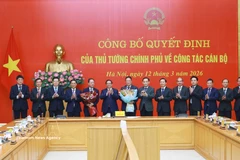
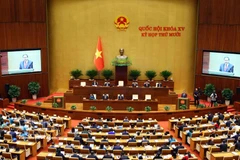
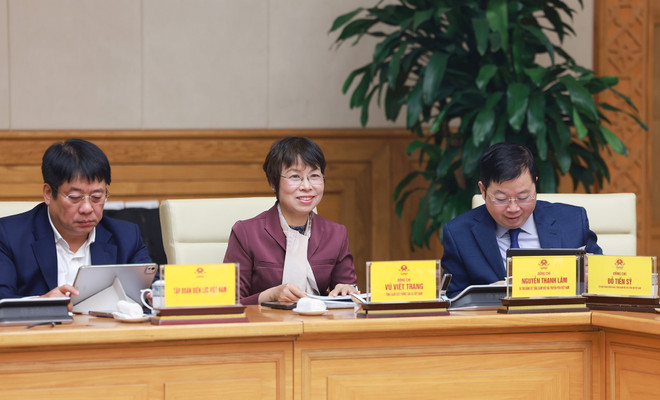
Hanoi (VNA) - Politburo member, Secretary of the Government’s Party Committee, Prime Minister Pham Minh Chinh chaired a conference in Hanoi on January 11 to review the work of the Government’s Party Committee in 2025 and deploy the direction and tasks for 2026.
In his opening remarks, PM Chinh emphasised that 2025 was the final year of the 2021-2025 term, a special year for the Government’s Party Committee as it was the first time the Government’s Party Committee has been established, consolidated, and put into operation.
The establishment of the Government’s Party Committee was a major policy of the Party Central Committee, a step forward in the Party's leadership methods over the Government, strengthening the comprehensive and direct leadership of the Party over the Government's management and administration; ensuring unity and synchronicity in leadership, Party building, and the implementation of political tasks related to socio-economic development, national defence and security, foreign affairs, and the building of a rule-governed socialist state in Vietnam in the new period with higher requirements and greater goals, he said.
The PM noted that 2025 was also a year full of difficulties. The Government’s Party Committee thoroughly implemented the directions of the Party Central Committee, which were set out regularly and directly by the Politburo and the Secretariat, headed by the General Secretary, promoting the spirit of unity and cohesion, focusing on leading and directing the Government, subordinate Party Committees, administrations at all levels, sectors, and localities.

Regarding the summary of Party work and the implementation of political tasks by relevant agencies and units, PM Chinh requested that, based on experience and achievements, assessments of what was done well and what was not done well, the objective and subjective causes, and the lessons learned in leadership, direction, and management over the past year, the direction and tasks for 2026 – the first year of the new term – are driven by a spirit of acceleration and breakthroughs, focusing on leadership and guidance to achieve the major goals set by the coming 14th National Party Congress, including the two centenary strategic goals.
While emphasising that time is limited, the workload is heavy, and the requirements are high, the PM requested delegates to focus on studying the documents, engaging in high-quality discussions, making accurate assessments, and proposing specific, feasible tasks for implementation.
A report of the Government’s Party Committee presented at the conference clearly stated that in 2025, the global and regional situation developed rapidly, complexly, and unpredictably, impacting the country's socio-economic situation deeply and broadly. Domestically, the economy had opportunities and advantages, but also faced more difficulties and challenges.
Under the attentive leadership and guidance of the Party Central Committee, the Politburo, the Secretariat, and the Party General Secretary, with the close coordination of central agencies, the collective efforts and solidarity of the people nationwide, businesses, and international friends, and with high determination, great effort, and decisive action, the Standing Board of the Government’s Party Committee promptly led, directed, and organised the simultaneous implementation of many important, urgent, and unprecedented tasks, achieving comprehensive results in all aspects.
In the work of Party building and the political system, the Government’s Party Committee led and directed the issuance and implementation of three communication plans regarding the congress; promoted the study and emulation of Ho Chi Minh's thought, morality, and lifestyle; and intensified the struggle to protect the Party's ideological foundation and refute erroneous and hostile viewpoints.
The Government’s Party Committee advised on the implementation of projects assigned by the Party Central Committee, the Politburo, and the Secretariat according to the 2025 work programme, and advised on the implementation of the streamlining of the political system's organisational structure.
The Government’s Party Committee promoted the building and consolidation of grassroots Party organisations, improved the quality of Party members; protected internal political security; led and directed Party congresses at all levels and the First Congress of the Government’s Party Organisation for the 2025-2030 term, leading up to the 14th National Party Congress; and the Party's inspection, supervision, and disciplinary work. Efforts to prevent and combat corruption, waste, and negative phenomena have been intensified; while the mass mobilisation work and leadership of political and social organisations have been emphasised.
In leading socio-economic development, national defence, security, and foreign affairs; administrative reform, handling complaints and petitions, and combating corruption, waste, and negative phenomena, the Government’s Party Committee and its Standing Board always attached importance to and promoted the spirit of unity, consensus, and collective intelligence, emphasising individual responsibility coupled with strong decentralisation and delegation of authority.
 |
The Government’s Party Committee led the Government in completing the tasks of summarising the implementation of Resolution No. 18-NQ/TW; issued guiding documents to urge and guide ministries, sectors, and localities to implement the restructuring and streamlining of the organisational apparatus; submitted to the National Assembly for approval the Law on the Organisation of the Government, the Resolution on the organisational structure of the Government, and the Law on the Organisation of Local Administrations; and decisively organised and operated the two-tiered local administration model.
The Government’s Party Committee led the Government, ministries, sectors, localities to achieve and exceed all 15 key targets for socio-economic development in 2025. The Government proactively, flexibly, promptly, and effectively managed monetary policy, coordinating synchronously, harmoniously, and closely with a rational and focused expansionary fiscal policy; strengthened financial and budgetary discipline; thoroughly saved recurrent expenditures; promoted the disbursement of public investment capital and implemented national target programmes; achieved GDP growth of 8.02% (among the highest in the region and the world); the size of the economy reached approximately 514 billion USD, ranking 32nd in the world; per capita income is estimated at approximately 5,026 USD, placing Vietnam among the upper-middle-income countries.
In perfecting institutions and laws, the Government’s Party Committee led and directed the research and development of groundbreaking resolutions in key areas, and submitted them to the Politburo for promulgation. It also submitted 98 draft laws and resolutions to the National Assembly for approval, the highest number ever.
In the fields of culture, society, education, and health, improving the material and spiritual lives of the people has been given attention, including achieving the basic goal of eliminating temporary and dilapidated houses ahead of schedule by 5 years and 4 months with over 334,000 houses; effectively implementing the project to build at least 1 million social housing units; focusing on effective leadership and direction in national defence and security; and organising many major external activities of the Party and State, thereby helping to affirm and enhance Vietnam's role, position, and international responsibilities./.