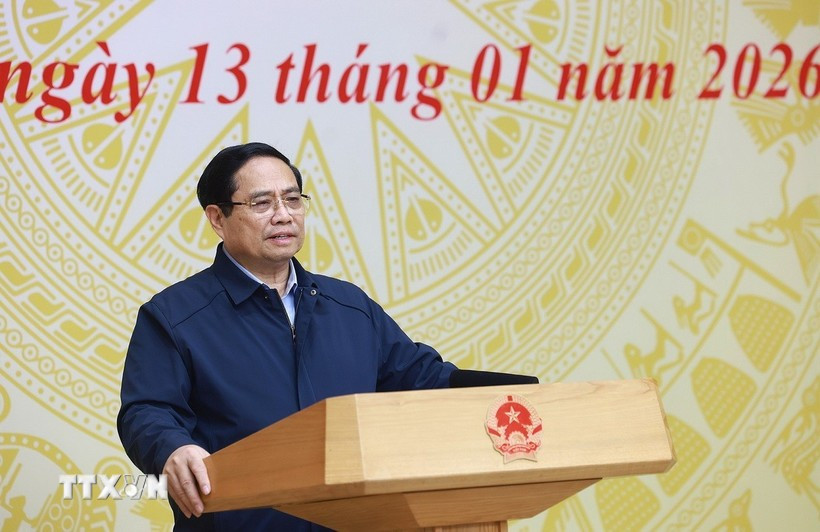
Hanoi (VNA) - Prime Minister Pham Minh Chinh, head of the Central Steering Committee on Housing Policy and the Real Estate Market, chaired the 5th meeting of the committee in Hanoi on January 13.
The meeting was connected online with 34 provinces and cities nationwide.
In his opening remarks, the Government leader emphasised that the right to housing is a fundamental right of citizens, and housing is an essential need of every person. Housing development is an important pillar of social welfare policy, while also serving as a driving force for economic growth, labor market stability, and sustainable socio-economic development.
In recent times, especially in 2025, the Government and the Prime Minister have issued strong and decisive directions on housing development, particularly social housing. Notably, more than 102,000 social housing units were completed last year, contributing to the goal of completing 1 million social housing units by 2028, he said.
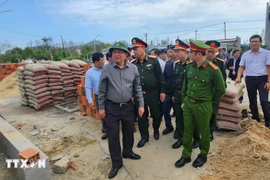
Efforts have been made to eliminate temporary and dilapidated houses and build houses for people with contributions to the revolution ahead of schedule by 5 years and 4 months; and urgently and swiftly implementing the “Quang Trung Campaign” to repair and rebuild houses for people affected by recent natural disasters, with completion expected by mid-January, he added.
The PM acknowledged and commended the efforts, determination, and seriousness of ministries, sectors, and localities, especially the Ministry of Construction, the Ministry of National Defence, the Ministry of Public Security, and the Vietnam Fatherland Front, in implementing housing development tasks, particularly social housing.
These achievements not only reflect the responsibility and engagement of the entire political system, but also clearly demonstrate the humanitarian values and the superiority of the country’s political system, contributing substantially to social security, stabilising the lives of residents, especially low-income earners and workers, and fostering a safe, healthy, sustainable, and equitable real estate market, he affirmed.
According to the cabinet leader, current housing demand is no longer limited to ownership but is shifting strongly toward renting or rent-to-own options to ensure long-term housing stability, in line with affordability, employment characteristics, and labour mobility. Therefore, social housing policies also need to be adjusted toward sustainable housing restructuring, gradually moving away from a mindset focused solely on quantity, while ensuring that everyone has the opportunity to access safe housing suited to their conditions and needs.
“Rental social housing is an important, fundamental, and long-term task, which must not be carried out in a campaign-style or fragmented manner,” he stressed.
The Prime Minister noted that this meeting is of great importance in unifying thinking, discussing approaches, and identifying solutions for implementing social housing development in the coming period, in line with current realities. He requested delegates to focus on reviewing the implementation of tasks assigned at previous meetings, particularly the situation of housing and the real estate market; credit provision for the real estate sector; and proposals for rental social housing targets for 2026 and subsequent years, especially in localities with large urban areas, industrial zones, and concentrated labour forces.

Relevant stakeholders must act in the spirit of “right role, right task, right authority,” especially by accelerating administrative procedure reform, eliminating unnecessary intermediary steps, and placing social housing projects, particularly rental social housing, into “green channels” and “priority lanes,” he emphasised.
According to the Ministry of Construction - the standing body of the Steering Committee, housing policies and the real estate market have continued to receive attention in recent times, particularly in 2025. The Government submitted one resolution to the National Assembly and issued, within its authority, four decrees on special mechanisms and policies for social housing development, amending and supplementing regulations related to housing and real estate market management.
The Prime Minister issued one decision, and the Minister of Construction issued one circular while guiding documents were issued on identifying eligible beneficiaries, conditions, and criteria for preferential loans for social housing development, housing for the people’s armed forces, worker accommodation in industrial zones, and the renovation and reconstruction of apartment buildings.
Ministries and sectors have also urgently proposed the establishment of a state-run “real estate and land use rights exchange”; are finalising a decree amending and supplementing several provisions of decrees in the fields of housing and real estate business. They have submitted to the Government a draft resolution on mechanisms to address difficulties and obstacles arising from legal regulations on social housing development.
Ministries and sectors have coordinated with localities to review and promote the establishment of a national housing fund; abolish procedures requiring registration of standard-form contracts and general transaction conditions for the purchase and sale of apartment units that create barriers and difficulties for enterprises.
They have also clarified demand for rental housing; propose rental housing development targets for 2026 and subsequent years, including the 2027-2030 period; and consolidate Steering Committees on housing policy and the real estate market at the local level./.