PM meets with Southern African President at expanded BRICS Summit

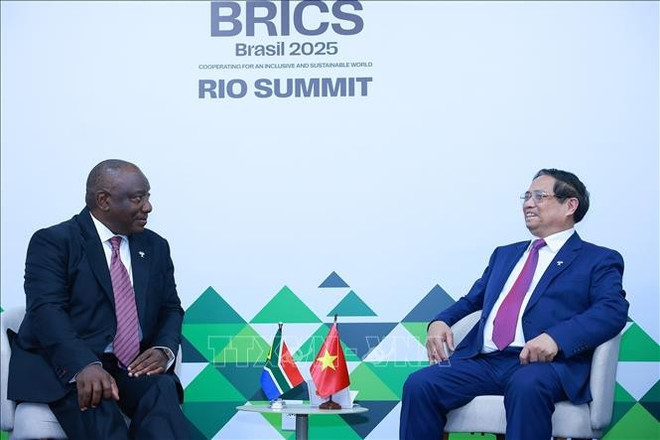
Prime Minister Pham Minh Chinh met with South African President Cyril Ramaphosa on the sidelines of the expanded BRICS summit in Rio de Janeiro, Brazil on July 6 (local time), during which they agreed to foster bilateral cooperation in several specific areas.

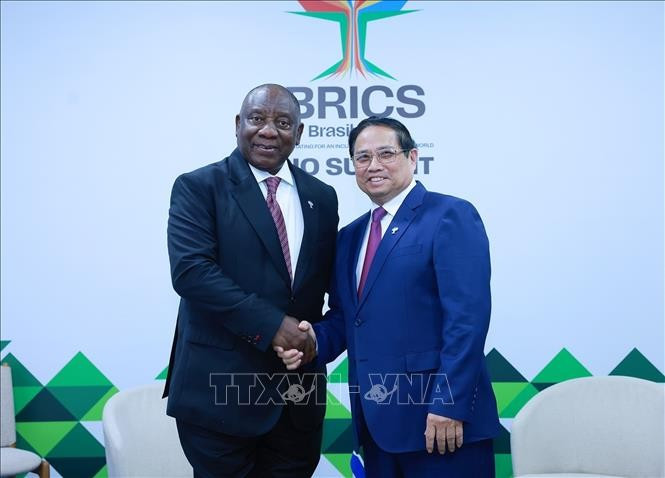
Prime Minister Pham Minh Chinh (R) shakes hands with South African President Cyril Ramaphosa at their meeting in Rio de Janeiro, Brazil, on July 6. (Photo: VNA)

Rio de Janeiro (VNA) – Prime Minister Pham Minh Chinh met with South African President Cyril Ramaphosa on the sidelines of the expanded BRICS summit in Rio de Janeiro, Brazil on July 6 (local time), during which they agreed to foster bilateral cooperation in several specific areas.

The Vietnamese Government leader affirmed that Vietnam considers South Africa one of the most important partners in Africa, and highlighted the African country’s position and prestige in the regional and international arena, especially as it prepares to assume the Presidency of the G20 in 2025. He expressed his wish to further strengthen the partnership for cooperation and development between the two countries.

He stated that there remains huge room for the Vietnam and South Africa to complement each other and deepen their comprehensive cooperation, especially in the areas of economy, trade, investment, education - training, tourism, and people-to-people exchanges, thus paving the way for elevating bilateral relations to a new level.
pm2.jpg
Prime Minister Pham Minh Chinh (R) meets with South African President Cyril Ramaphosa on the sidelines of the expanded BRICS summit in Rio de Janeiro, Brazil, on July 6. (Photo: VNA)

He thanked South Africa for inviting Vietnam’s hihg-ranking leaders to attend the G20 Summit and extended an invitation to Ramaphosa to visit Vietnam at an early date.

For his part, Ramaphosa highlighted the great importance of his phone talks with Party General Secretary To Lam in April, saying that it contributed to further deepening the relations between the two Parties and two countries.

He spoke highly of Vietnam’s socio-economic development achievements, affirming that South Africa attaches great importance to the traditional friendship nurtured by generations of leaders and people of both countries since the struggles against colonialism and apartheid. He noted that this relationship has continued to grow stronger in the present national development. The Southern African President showed his desire to pay a visit to Vietnam in 2025.

The two sides discussed major directions for advancing bilateral relations and agreed to consider signing agreements and legal frameworks to boost economic, education, and defence - security cooperation; and expand collaboration into other potential areas such as energy, mining, sustainable use of natural resources, infrastructure development, and climate change response.

The leaders also exchanged views on regional and international issues of shared concern, reaffirming their commitment to promoting multilateralism, respecting international law, and stepping up South-South cooperation./.
VNA

See more

All members of the NA Standing Committee present at the session vote in favour of resolutions on administrative unit standards and urban classification. (Photo: VNA)

Resolutions on urban classification and administrative unit standards approved

The draft resolution streamlines urban classification around three key areas - role and socio-economic conditions, urbanisation level, and infrastructure development. It also integrates green, smart, climate-resilient, and digital transformation requirements, while promoting decentralisation in urban management.

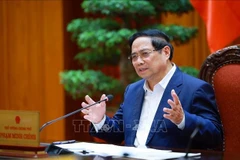
Prime Minister Pham Minh speaks at the working session. (Photo: VNA)

PM requests development of modern, hi-tech, dual-use defence industry

In 2026, the entire military must focus on building a revolutionary, regular, elite, and modern force; strictly implementing the Party Central Committee’s directives on Party building and rectification; flexibly, substantively, and effectively conducting defence diplomacy; and promoting self-reliance and resilience in the defence industry, logistics, and technical operations.

☕ Afternoon briefing on December 24

☕ Afternoon briefing on December 24

Outstanding domestic and international events of 2025 selected by the VNA, the Christmas atmosphere in Vietnam, and a seminar aimed at exploring cooperation opportunities between Vietnam and Russia in the digital era are among news highlights on December 24.

The closing of the 13th Party Central Committee's 15th plenum on December 23 (Photo: VNA)

📝OP-ED: Party Congress personnel: No room for rumours!

As Vietnam stands on the threshold of a promising new development phase brimming with opportunities and high expectations, staying alert to fake news, rumours, and baseless accusations is not merely a voice of rationality but a civic duty towards the nation’s future.

☀️ Morning digest on December 24

☀️ Morning digest on December 24

The PM's demand for coordinated efforts to repair infrastructure and restore livelihoods following storms and floods in the central region; the establishment of the Central Steering Committee for People’s Air Defence; and the phone talks between the Vietnamese and French foreign ministers are among news highlights on December 23 evening.

Deputy Chief of the General Staff of the Vietnam People’s Army Sen. Lieut. Gen Phung Sy Tan presents a souvenir to Gen. Phorn Nara, Secretary General of the National Authority for the Prohibition of Chemical, Nuclear, Biological and Radiological Weapons of Cambodia (CBRNE) in Hanoi on December 23 (Photo: qdnd.vn)

Military official hosts Cambodian chemical weapons authority chief

The success of the second Vietnam - Cambodia border defence friendship exchange in November has contributed to the practical and effective cooperation among the two countries’ armies, local authorities, and border communities, for a borderline of peace, friendship, stability, cooperation, and development.

Vietnamese Minister of Foreign Affairs Le Hoai Trung at the phone talks with French Minister for Europe and Foreign Affairs Jean-Noël Barrot on December 23 (Photo: VNA)

Vietnamese, French foreign ministers hold phone talks

France wishes to increase cooperation with Vietnam in such strategic sectors as energy, transport, and aerospace, while continuing to work closely with Vietnam to promote multilateralism and tackle global challenges, said French Minister for Europe and Foreign Affairs Jean-Noël Barrot.

Party General Secretary To Lam delivers remarks at the closing session of the 15th plenum of the 13th Party Central Committee in Hanoi on December 23 (Photo: VNA)

Announcement on 15th plenum of 13th Party Central Committee

The 15th plenum of the 13th Party Central Committee was held in Hanoi from December 22 to 23. The Party Central Committee agreed to adopt the report of the 13th Party Central Committee to be submitted to the 14th National Party Congress on personnel for the 14th Party Central Committee.

An overview of the closing session of the 15th plenum of the 13th Party Central Committee on the morning of December 23. (Photo: VNA)

Party Central Committee’s 15th plenum wraps up

The implementation of the 1991 Party Platform and its revised and supplemented version in 2011 has reaffirmed the correctness, creativity, and appropriateness of the Party’s "Doi moi" (renewal) path, as well as the inevitability of Vietnam’s socialist-oriented development, which is in line with national realities and global trends, said the Party leader.

The Vesak Day 2025 Celebration in Hue city (Photo: VNA)

📝OP-ED: “Freedom of Religion” not subject to politicisation

It is not difficult to recognise the report’s outdated tone, built on unsubstantiated arguments, entrenched prejudice, and imposed interpretations regarding the freedom of religion in Vietnam. This is also not the first time the organisation’s conclusions have exposed clear shortcomings in objectivity and methodology, raising questions about political motivations behind what is presented as a human rights assessment.