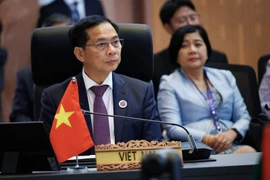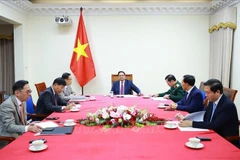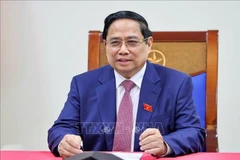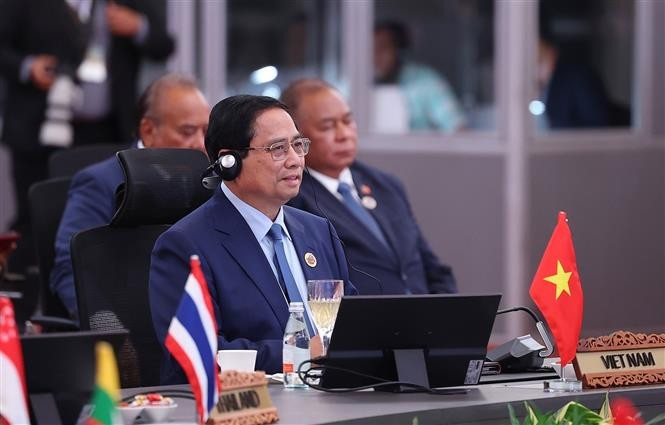
Kuala Lumpur (VNA) - The Association of Southeast Asian Nations (ASEAN) and the Gulf Cooperation Council (GCC) need to work together to shape a new-generation model of inter-regional cooperation, based on sincerity, substance, comprehensiveness, cohesion, and greater effectiveness, Vietnamese Prime Minister Pham Minh Chinh said at the second ASEAN-GCC Summit in Kuala Lumpur, Malaysia, on May 27.
This move will generate strong momentum for development cooperation, enhance the harmonisation of interests between the two sides, and contribute to peace, stability, and shared prosperity in both regions and the world, he stressed.
Speaking highly of the bilateral cooperation potential, PM Chinh noted that both regions possess distinct strengths that are highly complementary and share many commonalities in their development visions. ASEAN stands out for its high growth rate, young population, large market, and rapid adaptability, while the GCC serves as a global energy hub, is abundant in financial resources, and possesses technological advantages and experience in green development.
He called on ASEAN and GCC to strengthen strategic connectivity and promote substantive cooperation towards sustainable and inclusive development, with people and businesses placed at the centre.
The PM proposed the two sides soon establish a flexible and quickly implementable joint economic cooperation agreement to enhance market access, connect supply chains, support two-way investment, and create a practical, mutually-beneficial framework while they are carry out a feasibility study for a comprehensive free trade agreement (FTA).
PM Chinh encouraged the strong activation of the private sector’s role, particularly the engagement of GCC investment funds in ASEAN, and emphasised the importance of promoting the role of the ASEAN Business Advisory Council and GCC business associations to foster a favourable, transparent, and open investment environment, thereby promoting capital flows, technology transfer, and innovation.
The Vietnamese leader proposed ASEAN and GCC make green and sustainable growth a new pillar of cooperation for the future of the people of both regions, with focus on digital transformation, green transition, circular economy, science and technology application, sustainable infrastructure development, smart cities, smart agriculture, the Halal food market, energy security, and food security.
He affirmed that Vietnam is ready to work with other countries to promote concrete cooperation in areas such as 5G digital infrastructure development, artificial intelligence (AI), submarine cable systems, green hydrogen and solar energy production, smart energy storage, the development of high-quality Halal supply chains, and facilitation of labour mobility and working conditions, so as to meet market demands and enhance the resilience of the economy.
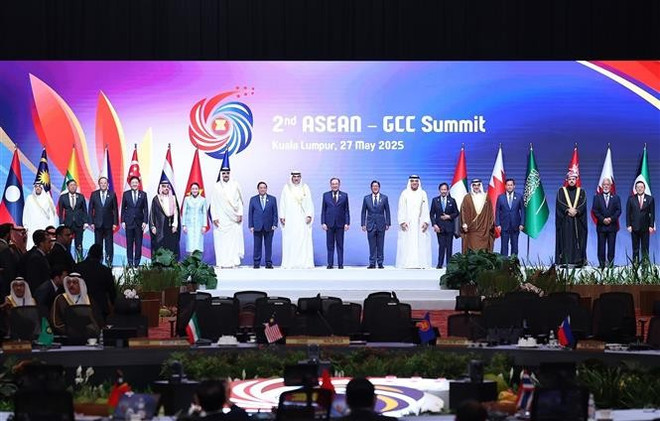
At the summit, participants welcomed the performance of the feasibility study on the ASEAN-GCC Free Trade Agreement, a strategic step that lays a solid foundation for long-term economic connectivity.
They also reached consensus on directions to enhance market connectivity and facilitate investment, trade, logistics infrastructure, tourism, labour, Halal industry development, support for small- and medium-sized enterprises, and supply chain security.
The two sides committed to strengthening cooperation in tourism, education, and young workforce training; promoting people-to-people exchanges; and enhancing connectivity between universities and research centres.
Exchanging views on the international and regional situation, delegates shared concerns over the complicated developments in the Gaza Strip, calling on all parties to cease fire and end acts of violence causing civilian casualties. They reaffirmed support for the peace process, an independent State of Palestine, and a two-state solution in accordance with international law and the United Nations Security Council's relevant resolutions, aiming to ensure lasting peace and stability in the region.
The leaders also reaffirmed their commitments to maintaining peace and stability, ensuring maritime security, and promoting peaceful settlement of disputes based on international law, including the 1982 United Nations Convention on the Law of the Sea (UNCLOS). They also emphasised the importance of cooperation in addressing non-traditional security challenges such as climate change, cybersecurity, and transnational crime./.