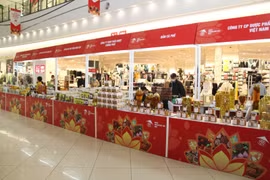
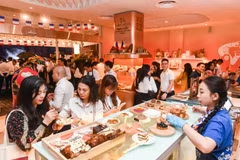
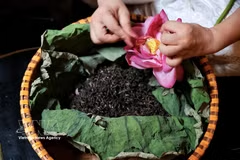
At a trade fair in Hanoi (Photo: VNA)
They said the primaryconcern is to establish synchronised and coherent cooperation and solutions tosimultaneously create sustainable livelihoods for local communities whileenhancing product value and promoting tourism development.
Developing tourismassociated with local specialities and OCOP products is an important solutionto effectively develop tourism in the Mekong Delta region after the PrimeMinister approved the OCOP programme for the 2021-2025 period and the ruraltourism development programme for the 2021-2025 period.
With the certificatedOCOP products, localities have initially implemented the effective developmentof tourism associated with OCOP products, combining the development of manytypes of tourism, such as cultural tourism, agricultural and rural tourism,ecotourism, and shopping tourism.
Currently, the countryhas over 8,800 OCOP products, focusing on six main product groups, includingfood and beverages, textiles and garments, souvenirs, decorations and interiorfurniture, herbs, and community tourism services and attractions.
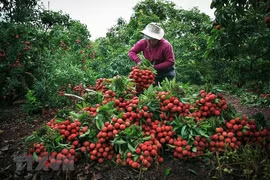
In the Mekong Delta,which produces fruits, rice, and aquatic products with many traditionalcraft villages, many OCOP products have been recognised and supplied to thedomestic and export markets.
The region has takenadvantage of its natural conditions, agricultural production, culture, andcraft villages to create unique tourist destinations.
OCOP products - atourist destination
Ben Tre province, withthree clusters of islets of Minh, Bao, and An Hoa, has been developing itstourism by promoting local specialities, specifically OCOP products.
Nguyen Thi Be Muoi, ViceChairwoman of the provincial People's Committee, said nearly 160 products hadbeen granted OCOP certification in Ben Tre province.
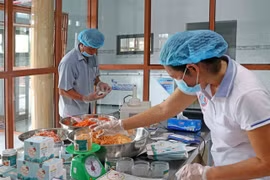
Visitors can participatein various activities, such as visiting production facilities, experiencingharvesting methods, processing raw materials, and tasting OCOP productsassociated with coconut trees. These activities create a unique attraction forlocal tourism in the province, she said.
Phan Thi Ngan from Nguyen Tat Thanh University stated that theuniversity had organised a tour in which tourists can participate in someprocessing stages of coconut candy and rice paper.
Ca Mau, the country’s southernmost province, is a land rich inunique resources from saltwater and freshwater ecosystems, bringing many exoticproducts to the locals.
Tran Hieu Hung, director of the provincial Department of Culture,Sports and Tourism, said visitors could experience harvesting of forestproducts such as reeds, and many other unique OCOP products such as reed honey,salted ba khía fish,eco-friendly crabs, and shrimp chips. Tourists always express their enthusiasmfor participating in these activities and trying the unique OCOP products.
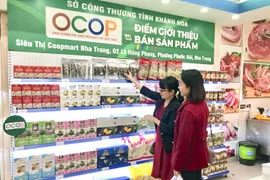
In Soc Trang province, the promotion of OCOP products in touristattractions has been carried out. Visitors can visit the agriculturalproduction facilities and shop at the safe food stores after visiting thefloating market in Nga Nam town.
The community-based tourism destination of Farmstay San Tien in CuLao Dung district brings special experiences such as cycling through theforest, hiking through the jungle, catching snails, clams and fishing, drinkinghoney coconut water, and enjoying grilled snail specialities.
Ca Mau province is currently constructing the Dat Mui CulturalTourism Village, the tourism model associated with local OCOP products.
Vice Chairman of the People's Committee of Dat Mui commune saidthat the commune has gradually perfected traditional craft chains and formedcraft villages serving tourism, such as dried fish, dried shrimp and fishsauce-making villages so that visitors can witness and immerse themselves inthe most authentic and vivid production activities.
Untapped potential
Experts said that each OCOP product represents the culture of aspecific locality and brings special features from its raw materialsand production process, and embraces value in cultural and spiritualaspects.
They said many OCOP products have not become popular despite theirhigh quality. Therefore, it is essential to fully exploit the values inOCOP products and introduce them to tourists, they said.
To link tourism with OCOP products, it is necessary to havecooperation among all authorities and sectors to preserve and convey thecultural values of OCOP products.
Nguyen Trung Khanh, General Director of the Vietnam NationalAdministration of Tourism, said the administration would continue coordinatingwith the Ministry of Agriculture and Rural Development and localities to focuson upgrading and investing in developing rural tourism sites associatedwith OCOP products.
Tran Anh Thu, Vice Chairman of the An Giang Provincial People’sCommittee, said the province would focus on policies to promote the developmentof OCOPs as well as planning and developing raw material areas in a bid tobuild distinctive and sustainable OCOP products.
An Giang is focusing on developing its strengths in localhandicraft products, such as the Khmer traditional silk weaving village in VanGiao commune, the Cham traditional silk weaving village in Chau Phong commune,and the My A silk weaving village in Tan Chau town as well as ironwork productsin Phu Tan district.
To create added value for OCOP products and tourism activities in DongThap province, Vice Chairman of the provincial People's Committee Doan Tan Buusaid the province values the development of ecotourism and agricultural tourismassociated with OCOP products, such as village craft tours and cultural tours.
The province is trying to attract investment to developeco-tourism associated with the value chain of typical products such as lotus,mango, Lai Vung mandarin, and tra fish,he added./.
VNA