President urges more impactful, sustainable tree-planting movement

State President Luong Cuong called on Lao Cai to further reinforce the planting and protection of watershed forests, contributing to socio-economic development, ecological security and national sovereignty, while unlocking the potential of medicinal plants and other high-value forestry and agricultural products.

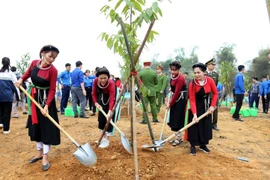
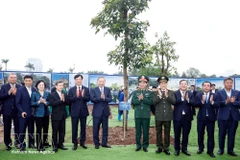
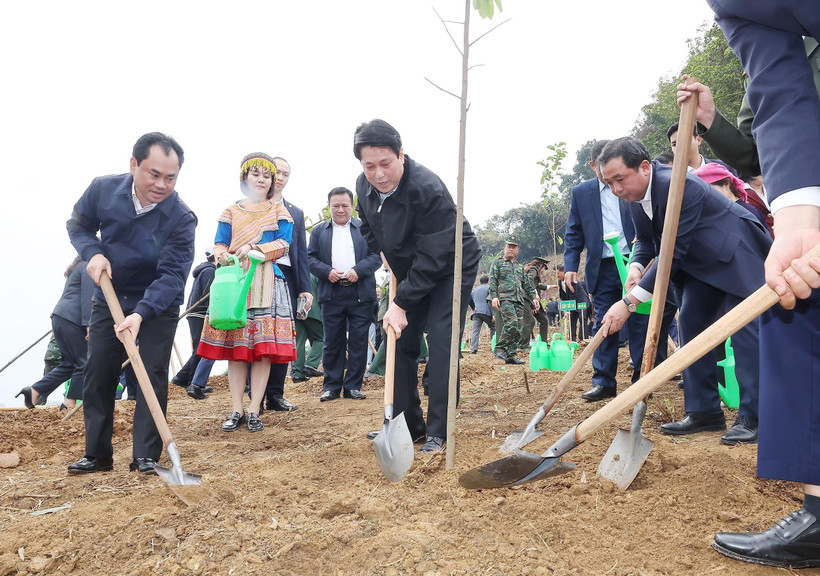
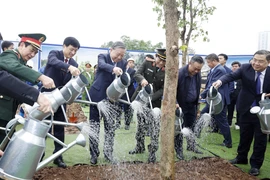
State President Luong Cuong and delegates plant trees in Lao Cai Ward, Lao Cai Province. (Photo: VNA)

Lao Cai (VNA) – State President Luong Cuong has called on ministries, sectors and localities to further elevate the tree-planting movement, intensify public awareness of the annual Tree-Planting Festival, and closely link the initiative with livelihood enhancement, ecological landscape development, environmental protection and climate change response.

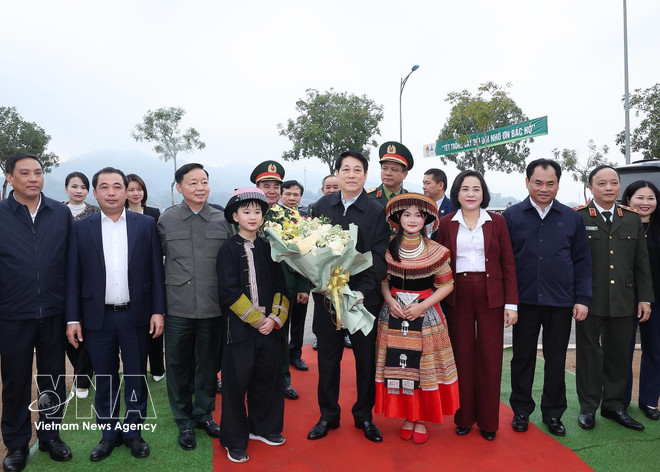
Speaking at the launch of the Tree-Planting Festival in Cam Duong ward, Lao Cai province, on February 23 (the seventh day of the Lunar New Year), the President praised Lao Cai’s achievements and the country’s overall progress in 2025. He commended innovative and practical approaches under the festival, noting their contribution to the effective implementation of the national programme to plant one billion trees.

President Cuong described tree planting as a strategic investment that delivers not only economic returns but also sustainable livelihoods, particularly for people in mountainous areas. He stressed the need to accelerate the transition towards a green and circular economy, strengthen participation in global green value chains, and help fulfil Vietnam’s commitment to achieving net-zero emissions by 2050. Alongside forest protection and development, he urged the expansion of green spaces in both urban and rural areas and greater use of nature-based solutions to absorb carbon and improve living conditions.

He also called on Lao Cai to further reinforce the planting and protection of watershed forests, contributing to socio-economic development, ecological security and national sovereignty, while unlocking the potential of medicinal plants and other high-value forestry and agricultural products. Biodiversity conservation, he added, should go hand in hand with preserving local cultural identities in forest protection, development and new rural construction.
vnanet-luong-cuong.jpg
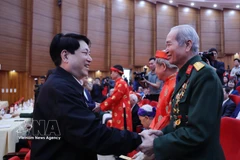
State President Luong Cuong attends the launch ceremony of the Tree-Planting Festival in Lao Cai ward, Lao Cai province. (Photo: VNA)

On the occasion, the President appealed to ministries, central agencies, mass organisations, armed forces units, local authorities, the business community and all citizens to actively participate in tree planting and forest development, encouraging everyone to become a “green ambassador” in building a greener, cleaner and more sustainably developed Vietnam.

More than 66 years ago, while planting trees with Hanoi residents at Bay Mau Lake Park—now Thong Nhat Park, President Ho Chi Minh launched the Tree-Planting Festival. Since then, it has grown into a cherished cultural tradition and a nationwide movement delivering long-term benefits to the country.

In recent years, nationwide efforts in tree planting, forestation, protection and development have made important contributions to socio-economic growth, environmental protection, climate change adaptation, and national defence and security. In 2025 alone, more than 285,000 ha of concentrated forests were planted and 108 million scattered trees added. Exports of wood and forestry products surpassed 18 billion USD, with a trade surplus of 14.8 billion USD, while revenues from forest environmental services reached nearly 4 trillion VND (around 154 million USD). Forest coverage remained stable at 42.03%, providing a solid foundation for 2026.

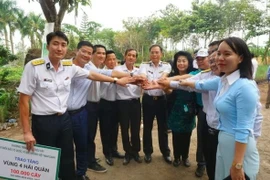
Lao Cai has emerged as one of the country’s leading localities in forest management, protection and development, watershed forest planting and water resource conservation. Ranking second nationwide in tree-planting results, the province has planted more than 100 million trees under the “One Billion Trees for the 2021–2025 period” project. Agriculture and forestry have become key economic pillars, contributing significantly to socio-economic development and national defence and security in Vietnam’s border areas./.
VNA

See more

Glenn Mathews and his wife hand over the diary of Vietnamese martyr Vo Van Cong to Minister Counsellor Nghiem Xuan Hoa, representing the Embassy of Vietnam in Australia. (Photo: VNA)

Australian veteran’s son returns diary of Vietnamese martyr

Entries in the diary show that Vo Van Cong was born in 1944 in the former Phuoc Tho commune, Nhon Trach district, Bien Hoa province, now Dong Nai province. He joined the revolutionary movement in April 1961 and was admitted to the Communist Party of Vietnam in May 1962.

A number of youth union members at the Vietnam Academy of Social Sciences visit the exhibition space showcasing books and materials on culture. (Photo: VNA)

Book week underscores role of knowledge in policymaking

The highlight is a series of activities on April 21, including a book and document exhibition on culture, the launch of a special publication titled “Special scientific information for leadership” and initiatives promoting reading culture, including a book donation programme and a book review contest.

Hanoi has over 1,100 libraries and numerous cultural and educational spaces in the community. (Photo: VNA)

Spreading value of books, building foundations of learning society

Each weekend in Hanoi, the “Reading with Children” Club brings together students to practise reading, explore language, and express ideas creatively. According to founder of the club Nguyen Thuy Anh, the club encourages children to reflect, retell stories, and connect books with personal experiences, making reading more vivid and meaningful.

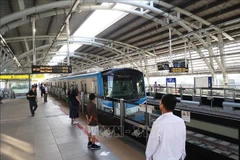
Automated ticketing system is used on the urban railway Cat Linh-Ha Dong line in Hanoi. (Photo: VNA)

Digital transformation powers Hanoi metro expansion

Beyond convenience, stable fares and the elimination of fuel, parking and maintenance costs have made urban rail increasingly attractive. The growing preference for metro travel is also contributing to a greener, more modern urban lifestyle.

Delegates cut the ribbon to inaugurate the operation of electric bus route No. 43. (Photo: VNA)

Hanoi accelerates shift to green buses, targets 100% by 2030

In the 2027–2030 period, the city will accelerate the transition towards the complete phase-out of fossil fuel-powered buses. The share of electric and green energy-fueled buses is projected to reach 79–89% by 2029 and 100% by 2030.

At the second session of the Ho Chi Minh City People’s Council (Photo: VNA)

Ho Chi Minh City greenlights central square, administrative centre in Thu Thiem

The new central city square and administrative centre will create a modern, centralised political-administrative complex for Ho Chi Minh City, designed to house around 8,000 officials, civil servants, and employees. It will also handle daily traffic of 1,500- 2,000 citizens and business representatives through a unified one-stop-shop administrative service system.

A working session at the job fair (Photo: VNA)

Vietnamese students flock to Seoul Job Fair 2026

The second annual Job Fair 2026 was held for Vietnamese students in the Republic of Korea. Organisers pitched it as a straight-up bridge between eager students and bosses hungry for young talent who can actually handle multicultural workplaces.

Defendants at the court (Photo: VNA)

Ho Chi Minh City court opens trial over Agribank lending scandal

The investigation revealed that multiple credit files were incomplete or riddled with inaccurate information, while some pledged assets lacked proper legal standing yet were accepted and grossly overvalued. As a result, the loans became high-risk and largely unrecoverable, leading to losses surpassing 1 trillion VND.