Traffic congestion costs Hanoi 1.2 billion USD a year

Congestion is estimated to cost Hanoi about 1.2 billion USD each year and has driven logistics costs to nearly 17% of GDP, undermining productivity, environmental quality, and the city’s investment appeal, said a local official.

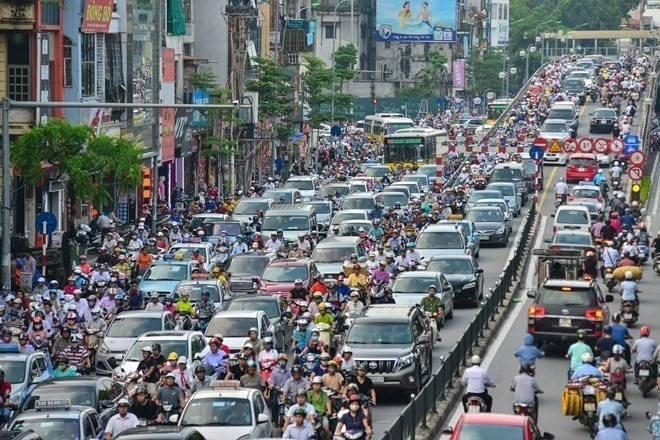
Serious traffic congestion is common in Hanoi during peak hours. (Photo: VNA)

Hanoi (VNS/VNA) – Hanoi is facing mounting urban traffic congestion as the rapid growth of private vehicles, combined with heavy inflows from neighbouring provinces, overwhelms infrastructure and directly constrains the capital’s socio-economic development.

According to the Hanoi Department of Construction, the city’s population has reached 8.7 million, with a high annual mechanical growth rate of 1.96%. Yet transport infrastructure has lagged far behind demand.

Road networks have achieved just over 43% of planned capacity, while land for transport has expanded by only 0.3–0.35% per year, compared with annual private vehicle growth of 4–5% and car growth exceeding 11%.

Hanoi now has more than 9.2 million vehicles, of which motorcycles account for over 72%.

Traffic pressure peaks sharply during rush hours, when 27% of daily trips are concentrated in two, one-hour windows, 7.30–8.30am and 5.30–6.30pm.

The situation is exacerbated by roughly 1.45 million trips entering the city each day from surrounding provinces, overwhelming key gateways and ring roads that remain underdeveloped.

Dao Viet Long, Deputy Director of the Department of Construction, said traffic congestion was no longer merely a mobility problem but had become a direct obstacle to socio-economic development.

He said that congestion is estimated to cost Hanoi about 1.2 billion USD each year and has driven logistics costs to nearly 17% of GDP, undermining productivity, environmental quality, and the city’s investment appeal.

Public transport has struggled to attract users, largely due to poor reliability and weak connectivity. Bus travel times can be more than double those of motorcycles on the same routes, while many passengers must walk over 500 metres to reach bus stops.

Although more than 70% of inner-city trips are under six kilometres, distances well suited to public or non-motorised transport, motorcycles remain the preferred option due to convenience.

With land for new transport infrastructure severely limited, the city has identified technology and management reform as key levers.

Proposed solutions include a unified traffic data system, smart traffic signals, integrated e-ticketing, and a single digital platform linking metro, buses, taxis, ride-hailing services and public bicycles, signalling a shift from private vehicle ownership to on-demand mobility.

Hanoi also plans to restrict private vehicles in central areas through emissions-based controls or congestion charges, alongside pilot programmes for public bicycles, shared electric motorbikes, feeder buses, and dedicated bus lanes on major corridors to improve speed and punctuality.

To support long-term change, the Department of Construction has called for a unified legal framework for data sharing and transport integration, greater investment in green mobility, and adoption of transit-oriented development (TOD) models that place public transport at the core of urban growth./.
VNA

See more

A lotus dance performance by artists from the VietAus Cultural Exchange Organisation - VACEO delighted international guests. (Photo: VNA)

Vietnamese community in Sydney gathers in joyful Tet reunion

The Vietnamese Consulate General in Sydney welcomed the overseas Vietnamese (OV) community to its “Community Tet – Spring from the Homeland” event on February 1, an intimate cultural reunion that fostered emotional and communal links with their beloved homeland.

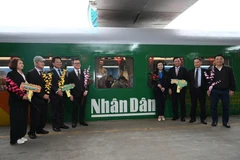
The Happiness Train”, officially launched on February 2 at the Hanoi Railway Station, aims to promote the country’s image and tourism to domestic and international travellers. (Photo: VNA)

“Happiness Train” promotes Vietnam’s image, people and tourism

The programme will continue on New Year’s Eve, when another “Happiness Train” will depart, turning the journey into a festive space of reunion, sharing and good wishes. Passengers on board on Lunar New Year’s Eve (February 17) will also receive lucky money from the organisers.

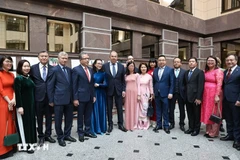
Members of the Vietnamese Embassy in Russia and Russian Foreign Minister Sergey Lavrov in a group photo (Photo: VNA)

Vietnamese in Russia confident in Party’s leadership

The congress’s reaffirmation of the important role of overseas Vietnamese and SMEs in national development not only carries policy significance, but also serves as a major source of spiritual encouragement for Vietnamese communities abroad, said a Vietnamese in Russia.

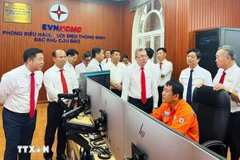
Officials visit the smart power grid operations centre of the Con Dao special zone. (Photo: VNA)

Con Dao special zone switches on smart power grid

The smart grid is expected to significantly improve the reliability and efficiency of power supply, reduce transmission losses, and optimise grid management while providing households and businesses in Con Dao with more transparent, convenient and modern electricity services.

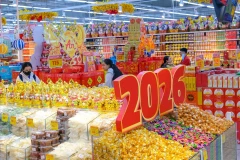
Tet goods on display at the GO! Can Tho supermarket. (Photo: VNA)

Prime Minister urges thorough Tet preparations for all

Prime Minister Pham Minh Chinh has called on ministries, ministerial-level agencies, government-affiliated bodies and localities to step up coordination to ensure that people across the country enjoy a safe, well-supplied and orderly Lunar New Year (Tet) holiday 2026.

Delegates launch the Trade Union Tet Market – Spring 2026. (Photo: VNA)

Tet reunion, trade union market held for workers in Ho Chi Minh City

The Trade Union Tet Market – Spring 2026 features 120 booths offering discounts of 10–30% or more, helping workers reduce Tet expenses. Products include essential goods such as rice, sugar, cooking oil, meat and agricultural produce, alongside Tet items like processed pork rolls, candied fruits, melon seeds, gift baskets, decorations, clothing and cosmetics.

National Assembly (NA) Chairman Tran Thanh Man pays tribute to late Chairman of the Council of Ministers Pham Hung in Long Ho commune, Vinh Long province. (Photo: VNA)

NA Chairman pays tribute to late leaders in Vinh Long

The top legislator and a high-ranking delegation offered incense at the memorial site dedicated to late Chairman of the Council of Ministers Pham Hung in Long Ho commune. He expressed deep gratitude toward Hung - a staunch communist and a preeminent disciple of President Ho Chi Minh.

Party General Secretary To Lam and students of Si Pa Phin Boarding Primary and Secondary School in Nam Chim 1 hamlet, Si Pa Phin commune, Dien Bien province. (Photo: VNA)

Education in border areas a fundamental, long-term priority: Party chief

The Party and the State will continue to study and expand the inter-grade boarding school model to non-border areas that remain especially disadvantaged and have large ethnic minority populations, with the aim of gradually narrowing development gaps and ensuring equity in access to education across regions.

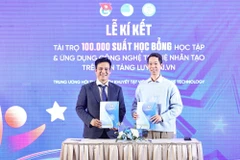
Pham Van Thanh (left), President of the Vietnam Association of Youth with Disabilities, signs cooperation agreements with JMB Vietnam and InfoRe Technology to sponsor 100,000 scholarships for training in the use of AI tools on the LuyenAI.vn platform. (Photo: VNA)

INSPIRE FEST 2026 promotes empowerment of persons with disabilities

The “Vietnam Persons with Disabilities Day – INSPIRE FEST 2026”, scheduled for this April, will launch a nationwide annual event series spanning the northern, central and southern regions, with the aim of delivering practical support to more than eight million persons with disabilities on the occasion of April 18.