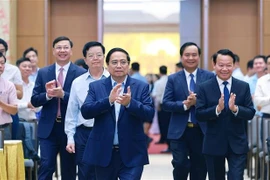
Hanoi (VNA) – Prime Minister Pham Minh Chinh has ordered that the national target programmes on new-style rural area development and sustainable poverty alleviation must result in substantive outcomes that enable people to benefit from.
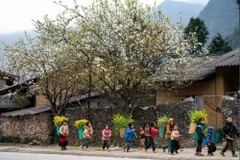
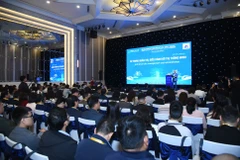
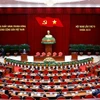
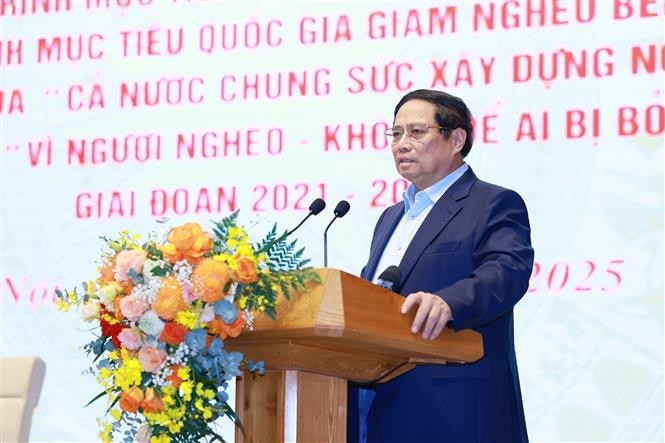
Concluding a national online conference on June 22, the Government leader praised the remarkable achievements of the programmes over the recent past, stating the implementation of the two programmes and the two movements, “The whole nation joins hands to build new-style rural areas” and “For the poor – leaving no one behind”, have brought about positive changes to rural infrastructure, comprehensively improved the material and spiritual lives of farmers, and contributed to Vietnam's economic restructuring.
He added that Vietnam is seen as a global model in realising the Millennium Development Goals.
Pointing out challenges, PM Chinh underscored that as the nation is stepping into a new era – that of the nation rise, it is necessary to push forward the two national target programmes to successfully develop eco-agriculture, modern rural areas and civilised farmers while promoting comprehensive, inclusive and sustainable poverty reduction.
He urged ministries, sectors, and localities to refine mechanisms to serve the principle that farmers are the centre and main actors, agriculture is the driving force, and rural areas are the foundation of development. He laid stress on the significance of building strategic infrastructure for agriculture, encompassing both hard and soft facilities, in a green and sustainable manner.
Human resources development represents another critical focus in the new development phase, and should be aligned with the two-level local government model and the four strategic pillars. The final priority involves diversifying agricultural products to meet both domestic Vietnamese and global consumption demands, diversifying supply chains, and expanding markets, he said.
For farmers, PM Chinh called on them to pioneer in escaping from poverty and enriching themselves, developing civilised farmers, and adopting green, sustainable production and digital transformation to help with the development of a digital Government, digital society, digital economy, and digital citizens.
The Government leader asked ministries, sectors, and localities to seriously implement Party committees' directives while mobilising the entire political system and harnessing society-wide strength through combined resources from the State, businesses, citizens, and broader society to build eco-friendly agriculture, a modern rural landscape, and progressive farmers.
He stressed that all initiatives must be effective and beneficial to the people, and negative phenomena, wastefulness, and group interests must be prevented.
PM Chinh urged the genuine and results-driven implementation of the programmes and movements, ensuring that people truly feel and benefit from their outcomes.
After five years of implementation, the two national target programmes have largely met or exceeded their set goals. Total mobilised resources for the new-style countryside development programme reached 3.7 quadrillion VND (148 billion USD) as of May 2025. Meanwhile, around 44.6 trillion VND from the central budget was allocated for the sustainable poverty reduction programme during the 2021–2025 period.
Meanwhile, the two movements, together with the campaign “All people unite to build new-style rural areas and civilised urban areas”, have gained strong and widespread momentum across the political system and among all strata of society, significantly promoted the role of the people as the central actors in new rural development and sustainable poverty reduction.
Notably, millions of households have voluntarily donated over 98 million sq.m of land, contributed trillions of VND, volunteered countless working days to support new rural development efforts.
")
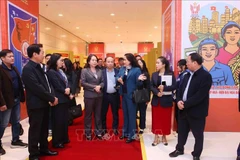
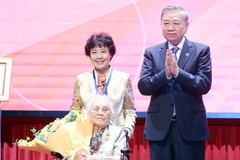
Prime Minister Pham Minh Chinh awards the third-class Labour Order to the Party Committees, administrations and people of the districts with outstanding achievements in the movement "The whole nation joins hands to build new-style rural areas". (Photo: VNA)
The programme on sustainable poverty reduction has achieved its annual targets for reducing the poverty rate as assigned by the National Assembly and the Government. It has fulfilled five specific objectives and five five-year goals, and met nine out of 12 indicators related to addressing basic social service shortages. Meanwhile, the programme on building new-style rural areas has seen 79% of communes meeting new rural standards, 51% of district-level localities recognised as meeting or completing the programme’s goals, and 12 provinces and cities officially acknowledged by the PM for having fulfilled the programme’s objectives.
By the end of 2024, the national household poverty rate had dropped to 1.93%, down 3.27% from the end of 2022.
Delegates said that the results of the two national target programmes reaffirm the sound policies of the Party and State, which have gained strong public support. These programmes have driven the development of ecological agriculture and modern rural areas. Living conditions have markedly improved, rural infrastructure has been upgraded comprehensively, and access to essential services has expanded. The rate of poor households has declined rapidly, while positive shifts in economic and labour structures have helped narrow development gaps and regional disparities.
Rural areas have increasingly embraced emerging development trends such as green transition, digital transformation, rural tourism, nutrition, vocational training, job creation, and gender equality, contributing to achieving sustainable development goals.
They proposed continuing to promote the two national target programmes, saying they should be integrated into a single initiative.
On that basis, delegates recommended reviewing and issuing a comprehensive set of guidelines for programme implementation; improving mechanisms for resource mobilisation and allocation; enhancing decentralisation and delegation of authority to provincial and communal levels; developing a national set of new-style rural criteria; and piloting a “happy rural community” model; and promoting multidimensional poverty reduction, developing sustainable livelihoods, and preventing a return to poverty.
Participants underlined the need to promote public-private partnerships, attract more official development assistance (ODA), and maximise the mobilisation of lawful resources, noting that investment should be prioritised for disadvantaged areas, with effective integration of other programmes and projects.
They also proposed expanding suitable credit mechanisms to support the development of “One Commune, One Product” (OCOP) programme, small-scale production, rural tourism, clean water supply, environmental protection, and mobilisation of international funding.
At the conference, PM Chinh presented the State President and the PM's rewards to 306 collectives and individuals nationwide with outstanding achievements in implementing the programmes and movements./.