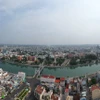
Sa Pa to be upgraded to district-level town

Prime Minister Nguyen Xuan Phuc on March 15 chaired a meeting on the plan to set up the district-level town of Sa Pa in the northwestern province of Lao Cai, highlighting the establishment’s necessity to local development.
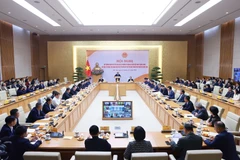
Sa Pa to be upgraded to district-level town ảnh 1Prime Minister Nguyen Xuan Phuc (standing) chairs the meeting on the establishment of Sa Pa town (Photo: VNA)

Hanoi (VNA) – Prime Minister Nguyen Xuan Phuc onMarch 15 chaired a meeting on the plan to set up the district-level town of SaPa in the northwestern province of Lao Cai, highlighting the establishment’snecessity to local development.

Over the past years, Lao Cai has been mobilisingresources for developing Sa Pa district into a big tourism centre of theprovince, as well as Vietnam. The number of tourists there grows by 23.4percent annually, surpassing 2.5 million in 2018.

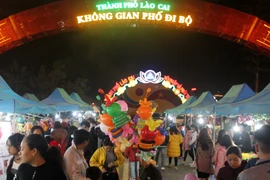
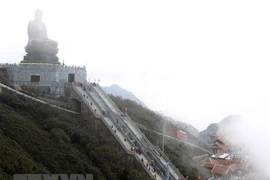
There are 571 services establishments in Sa Pa districtat present, including one- to five-star hotels, and 34 travel agencies. Manytourism projects have been put into use like the Fansipan tourism andentertainment complex and the Sa Pa cultural park. Meanwhile, transport, powerand water supply, and telecom infrastructure has also been improved to meetlocal development demand.

At the Hanoi meeting, officials shared the viewthat as Sa Pa is developing rapidly and comprehensively, it is necessary toestablish a town on the basis of Sa Pa district so that it can truly hold thekey role in terms of defence and security along the Vietnam-China borderline.

They said the establishment will create thelegal foundation to change the local government model from the one of a ruralarea to that of an urban area, which will help with the administrativemanagement in a locality with rapid urbanisation.

Lao Cai officials affirmed that the future townwill have the size of and funding for its apparatus unchanged compared to thoseof the current district. The upgrading is meant to have a suitable governmentapparatus for Sa Pa’s development.

Echoing the view, PM Phuc said upgrading Sa Painto a district-level town is an objective requirement as a result of economicdevelopment and defence-security ensuring demand.

He agreed that the plan to set up Sa Pa town andits wards will be submitted to the National Assembly Standing Committee forconsideration.

He asked Lao Cai to keep good management of SaPa, uphold ethnic groups’ culture, protect and develop forests, ensuredefence-security, promote solidarity among local communities, and maintain itsimage as a hospitable destination in visitors’ eyes.-VNA
VNA

See more

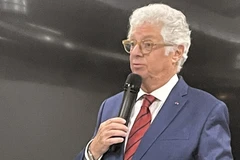
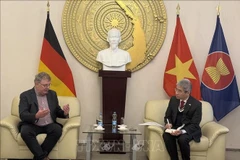
Assaf Talgam, a historian and a journalist of Zo HaDerekh, the official newspaper of the Communist Party of Israel. (Photo: VNA)

CPV's leadership - central factor shaping Vietnam’s enduring stability, impressive achievements: Israeli historian

Talgam said that from a comparative and historical perspective, the CPV’s leadership has been the central factor underpinning the country’s enduring political stability and impressive development trajectory. In a world marked by rapid and unpredictable changes, few political organisations have been able to maintain continuity of leadership while simultaneously adapting their governance approach as effectively as the CPV.

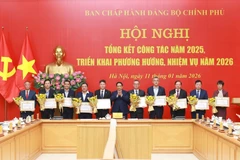
Prime Minister Pham Minh Chinh presents Certificates of merit from the Government’s Party Committee to individuals with outstanding achievements. (Photo: VNA)

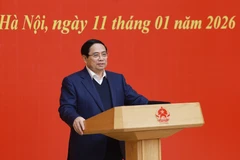
Prime Minister outlines five specific strategies for Government’s Party Committee

PM Chinh noted that the Government’s Party Committee exercised comprehensive leadership over the Government's operations, proactively and effectively responded to emerging issues, with a particular focus on socio-economic development. As a result, 2025 witnessed high economic growth, sustained macroeconomic stability and ensured major balances.

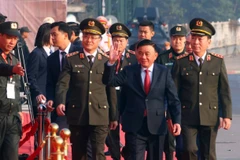
Politburo member, Standing member of the Party Central Committee’s Secretariat Tran Cam Tu attends the rehearsal. (Photo: VNA)

Security forces stage rehearsal for 14th National Party Congress

The People’s Public Security forces have been praised for their core role in closely working with the army and relevant ministries and agencies, with success in thwarting hostile plots at an early stage, drastically combating fake news and disinformation surrounding the 14th National Party Congress.

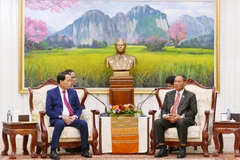
Senior Lieutenant General Le Quoc Hung (L), member of the Communist Party of Vietnam (CPV) Central Committee and Deputy Minister of Public Security, and General Vilay Lakhamfong, Politburo member and permanent member of the Secretariat of the Lao People’s Revolutionary Party (LPRP) Central Committee. (Photo: VNA)

Deputy Minister of Public Security congratulates Lao officials following succesful 12th National Party Congress

Deputy Minister of Public Security Senior Lieutenant General Le Quoc Hungconveyed the warmest congratulations of the Central Public Security Party Committee, the Ministry of Public Security leadership, and the Vietnamese People’s Public Security Forces to Lakhamfong and other Lao public security leaders on the congress’s success and their election to key leadership positions for the new term.

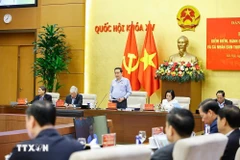
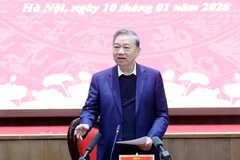
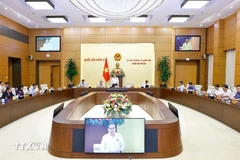
A session of the National Assembly Standing Committee. (Photo: VNA)

NA Standing Committee's key work agenda for 2026 approved

A major focus will be preparations for the election of deputies to the 16th NA and to People’s Councils at all levels for the 2026–2031 term. The NASC will coordinate with the National Election Council, the Government, the Vietnam Fatherland Front Central Committee, and relevant agencies and organisations to continue implementing the election plan, organise oversight of the electoral process, and carry out its duties and powers as prescribed.

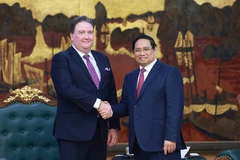
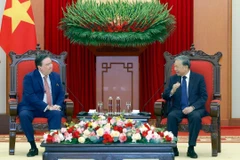
Party General Secretary To Lam receives US Ambassador Marc Evans Knapper in Hanoi on January 9, 2026. (Photo: VNA)

Party leader receives outgoing US Ambassador

Vietnam always values its relationship with the US and looks forward to continuing close cooperation with the US government to deepen bilateral relations based on mutual respect for each other’s independence, sovereignty, territorial integrity, and political institutions, contributing positively to peace, stability, cooperation, and development regionally and globally.