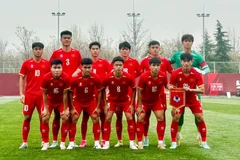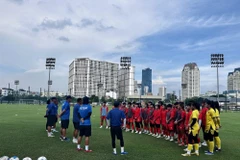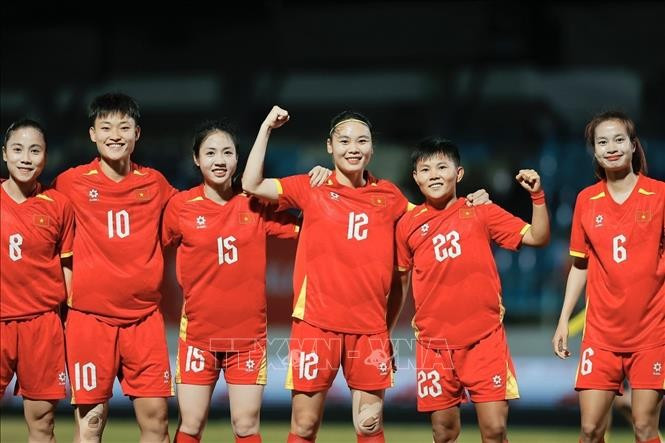
Hanoi (VNA) – The Vietnamese women’s national team made a strong start at the 33rd SEA Games 2025 with a dominant victory over Malaysia in their Group B opening match on December 5 evening.
The win is especially important as the group also includes Myanmar and the Philippines - both direct rivals for a semi-final spot.
Facing the group’s lowest-ranked opponent, coach Mai Duc Chung’s side imposed a high-pressing, possession-based game from the opening whistle. Superior technique, speed and cohesion allowed Vietnam to quickly convert their early dominance into goals.
Vietnam took the lead in the 4th minute after Nguyen Thi Hoa’s lofted ball forced an error from the Malaysian goalkeeper, allowing Hai Yen to score. The team continued to dominate, with Bich Thuy heading in the second goal in the 23rd minute and Hai Yen adding another just two minutes later. Thanh Nha then delivered an accurate cross for Hai Linh to score from outside the box, giving Vietnam a 4–0 lead by the 32nd minute. Malaysia dropped deep in defence but struggled under Vietnam’s constant pressure throughout the first half.
Early in the second half, Thai Thi Thao made it 5–0 with a one-touch finish from a corner in the 49th minute, then struck again from outside the box in the 59th minute. She completed her hat-trick with a header in the 78th minute after a cross from Cu Thi Huynh Nhu, extending the score to 7–0. In the remaining minutes, Vietnam controlled the tempo comfortably while Malaysia failed to produce any dangerous opportunities.
With the 7–0 victory, the Vietnamese women’s team temporarily moved to the top of Group B after the opening round of SEA Games 33.
In the earlier match of the same group, Myanmar defeated the Philippines 2–1. Thanks to their emphatic win over Malaysia, Vietnam improved their goal difference and gained an important advantage in the race for a place in the semifinals./.
Vietnam recognised as most valuable team at SEA Games 33
Vietnam, Indonesia and Thailand are all strong contenders for the gold medal in SEA Games 33, as youth football in Southeast Asia continues to grow in competitiveness and unpredictability.