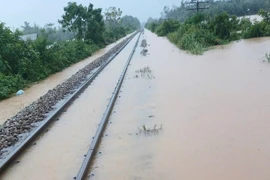
Da Nang (VNA) – Vietnam’s UNESCO World Heritage sites - the Complex of Hue Monuments and Hoi An Ancient Town in the central cities of Hue and Da Nang have suffered the worst flooding in decades, forcing municipal authorities to confront accelerating climate threats to irreplaceable cultural assets.
Floodwaters encircle heritage sites
Iconic structures vanished beneath floodwaters, with only the roof of Hue’s Nghinh Luong Pavilion poking above the swollen Huong river. Torrents poured through imperial gates, submerging the entire Dai Noi (Imperial Palace) and leaving courtyards and pathways under 1.2-1.5m of water.
The Hue Monuments Conservation Centre (HMCC) reported multiple palaces inside the Imperial Citadel flooded to depths of 0.2-0.3m, while royal tomb courtyards saw water levels reach 1.7m.
In the most dramatic incident, a 14m section of the Citadel’s northern wall collapsed around 6:45 on November 2, one of the gravest heritage losses recorded in the deluge.
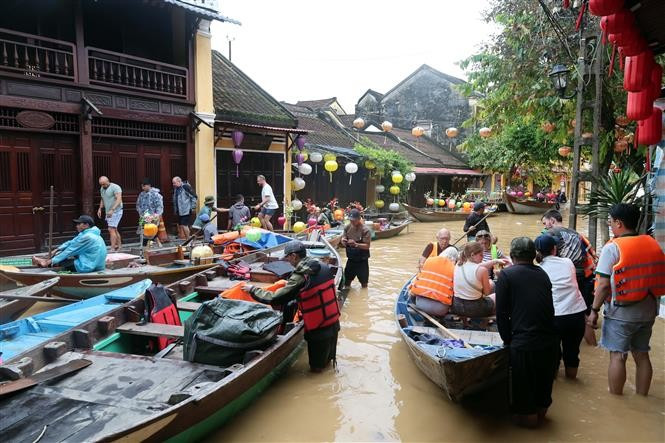
Further downstream along the Vu Gia-Thu Bon river system, Hoi An’s centuries-old wooden houses and lantern-lit streets remain underwater for days, crippling daily life and inflicting widespread damage on fragile historic architecture.
The Hoi An Centre for Cultural Heritage Management and Preservation (HACCHMP) said roughly 30 relic sites have deteriorated, nine of them critically and 14 severely. It has called on Da Nang authorities to urgently repair or temporarily dismantle 10 previously reinforced structures now deemed too unstable, warning they risk total collapse.
Confronting extreme climate impacts
Located in one of Vietnam’s most flood-prone corridors, Hue and Hoi An have long coped with seasonal inundation, but the rapid degradation of ancient buildings amid more intense and erratic weather demands a fundamental rethink of preservation strategies.
HMCC Director Hoang Viet Trung said the Citadel’s collapsed wall segment should be rebuilt within two months once technical approvals are secured, while a broader restoration plan for perimeter walls, balustrades and the Ngoai Kim Thuy moat embankments is being prepared for the 2026-2030 public investment cycle.
HACCHMP Deputy Director Pham Phu Ngoc urged Da Nang city's Department of Culture, Sports, and Tourism to seek approval for the centre’s hiring of consulting units and research institutes for a full climate impact assessment focused on the recent extreme floods, with results to shape future mitigation efforts.
He further wished for immediate state-funded emergency repairs for at-risk heritage buildings and homes inside Hoi An’s protected zone, a cost-sharing mechanism covering 40%-100% of restoration expenses for listed properties citywide, and the establishment of a dedicated preservation fund to enable rapid response when structures are endangered./.