Lao Cai works hard to preserve Pa Di people’s traditional crafts

To preserve their cultural heritage and values, and prevent traditional crafts, especially traditional costume-making, from fading away, the Pa Di people in Muong Khuong, Lao Cai province, are actively working with local authorities and agencies on preservation efforts.

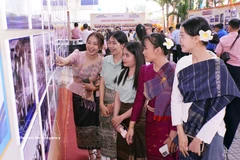
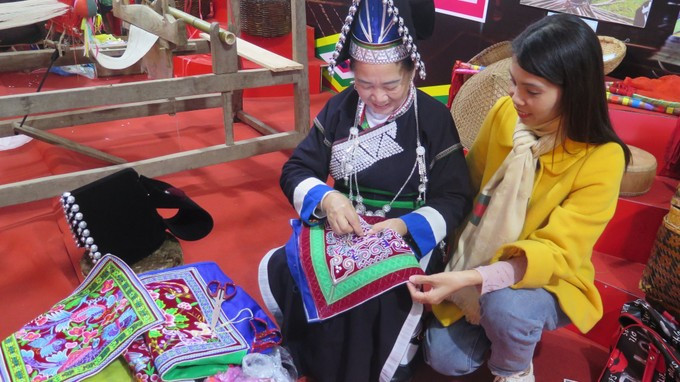
A visitor learn about the traditional embroidery craft of the Pa Di ethnic group in Muong Khuong commune (Photo: VNA)

Lao Cai (VNA) – To preserve their cultural heritage and values, and prevent traditional crafts, especially traditional costume-making, from fading away, the Pa Di people in Muong Khuong, Lao Cai province, are actively working with local authorities and agencies on preservation efforts.

Distinctiveness of traditional crafts

Visitors to Muong Khuong commune are immediately struck by Pa Di traditional costumes, most notably the distinctive upward-curving hat shaped like a house roof, which embodies a deeply humanistic legend about the community’s origins.

Pa Di elders recall that to honour their ancestry and lineage, their people designed the traditional hat inspired by the shape of a house roof.

Craftsman Po Chin Din from Chung Chai B village said that the hat is made from handwoven linen. Multiple layers of beeswax are applied to stiffen the fabric, and the top is folded into a house-roof shape.

“The hat symbolises a family’s prosperity and warmth, which is why it is a cherished gift a mother-in-law gives her daughter-in-law when welcoming a new member into the family,” Din said.

Pa Di women’s attire is made from handwoven natural materials, predominantly indigo with accents of green and black. Silver jewellery shaped like locks, roosters, and fish highlights wealth, prosperity, and harmony with nature, reflecting gratitude for the life it provides. Through simple and heartfelt ideas and skilled craftsmanship, Pa Di women have created a distinctive and humble aesthetic unique to their community.

Craftsman Din noted that a complete Pa Di outfit takes 2-3 months to make, or up to a year if done intermittently, since every step is handcrafted.

Recognising the artistic value of their embroidered clothing, in 2020, the Ministry of Culture, Sports and Tourism officially designated the decorative clothing art of the Pa Di people as a national intangible cultural heritage.

Efforts to revitalise heritage

Preserving traditional clothing is challenging for ethnic minority communities, and it is even more difficult for small groups like the Pa Di.

Po Min Thuy, who was born and raised in Ta Chu Phung village, nestled on a misty mountainside, recalled that Pa Di children wore traditional attire from a young age. However, with the tide of modern life, these garments are gradually disappearing.

Elders here worry that without passing down weaving, dyeing, and sewing skills, both the craft and the unique identity of Pa Di clothing will be lost, Thuy said.

To preserve traditional cultural identity and revitalise heritage, the Muong Khuong authority has recently organised classes on decorative clothing art of the Pa Di people, with artisans and village elders teaching young people how to weave and sew, contributing to safeguarding the cultural heritage.

Lao Cai province began a project on preserving traditional costumes of local ethnic groups for tourism development in 2021–2025, collecting and photographing Pa Di clothing, jewellery and patterns for display at the provincial museum. People are encouraged to wear the traditional attire during festivals, conferences, cultural exchange programmes, and sporting events.

Deputy Director of the provincial Department of Culture, Sports and Tourism Duong Tuan Nghia shared that the value and charm of Lao Cai’s traditional cultural heritage are reaching far and wide, inspiring pride and a greater sense of preservation.

With the approach of ‘turning heritage into assets,’ the locality aims to leverage culture as an internal resource for socio-economic development, he added./.
VNA

See more

Nguyen Van Than, Chairman of the Vietnam Classical Music Association (VCMA), speaks at a press briefing in Hanoi on January 13. (Photo: The organisers of the concert)

Concert to be held to celebrate 14th National Party Congress

The programme, jointly organised by the VCMA and the Vietnam Association of Small and Medium Enterprises, will feature nearly 150 artists, performers and musicians, representing the finest of Vietnam’s and the international classical music scene.

Visitors to Vietnam's booth at International Cultural Festival 2026 (Photo: VNA)

Vietnamese image introduced at International Cultural Festival 2026 in Greece

The Vietnamese Embassy in Greece took part in the International Cultural Festival 2026, organised by the UNESCO Club of Piraeus and Islands in Greece, marking the embassy’s first activity of the new year and highlighting its efforts to bring the image of Vietnam closer to the Greek public and international friends through traditional Vietnamese cuisine.

A dish of Vietnamese fried spring rolls (Photo: VNA)

Vietnamese rice paper makes way into European kitchens

Vietnamese rice paper is increasingly winning the hearts of European diners thanks to its versatility, easy preparation and ability to pair well with a wide range of Western ingredients. This culinary exchange not only broadens the reach of Vietnamese cuisine but also enriches the multicultural culinary landscape of Belgium and many other countries.

A visitor to the exhibition (Photo: VNA)

Colours of Friendship: Hanoi welcomes Vietnam-RoK artistic encounter

The harmonious mingling of works by artists from both nations conjures a multi-layered, dynamic space where distinct visual languages intersect with shared emotional depth, aesthetic thinking and creative spirit. The result is a rich and refreshing visual experience.

Artists take part in a parade at the Hanoi Creative Design Festival 2024. (Photo the HFCD organiser)

'Creative Meetup' programme takes place in Hanoi

The 'Creative Meetup' programme in Hanoi showcases initiatives from the creative community across eight cultural industry sectors, celebrating creativity and innovative solutions within the creative community.

A student from Nguyen Du Lao-Vietnamese bilingual school participates in a story-telling competition in Vietnamese with the theme "Vinh Moc Tunnel - Quang Tri, where life is immortal" (Photo: VNA)

Culture expected to remain pillar of Vietnam’s sustainable development: ethnologist

Ha noted that the upcoming congress is also expected to improve institutions and infrastructure for cultural industries, intellectual property and the creative economy sector. These fields are not only drivers of identity-based economic growth but also key tools for strengthening soft power and projecting the national image in an increasingly interconnected world.

Heritage innovation drives Hanoi’s cultural growth (Photo: VNA)

Heritage renewal energises Hanoi’s cultural sector

According to Hanoi Department of Tourism Director Dang Huong Giang, these innovative products not only diversify experiences but also demonstrate the city’s adaptability to modern trends, contributing to improved visitor satisfaction and reinforcing Hanoi’s creative and forward-looking spirit.

Tourists visit the Hue Imperial Citadel. (Photo: VNA)

Hue digitises imperial heritage to mitigate disaster and climate risks

As science and technology advance rapidly, the Hue Monuments Conservation Centre was asked to accelerate the digitisation of documents, drawings, images and artefacts, build a unified database of monuments, and apply 3D, VR and AR technologies in research, exhibitions, and heritage interpretation.