Solutions to help businesses avoid accusations of origin fraud

A circular on "Made in Vietnam" products was expected to help businesses avoid accusations of fraud, said Deputy Minister of Industry and Trade Tran Quoc Khanh at a conference held in Hanoi on September 25.
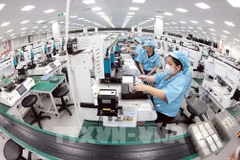
Solutions to help businesses avoid accusations of origin fraud ảnh 1The factory of the Duc Giang Garment Co. Ltd in Long Bien district, Hanoi (Photo: VNA)

Hanoi (VNA) - A circular on"Made in Vietnam" products was expected to help businesses avoidaccusations of fraud, said Deputy Minister of Industry and Trade Tran Quoc Khanh at a conference heldin Hanoi on September 25.

Theevent was organised tohear opinions from enterprises and associations on the draft circular, whichdescribes how to identify Vietnamese goods and products.

Manyproducts and goods whose accessories are imported from foreign countries andassembled and processed in Vietnam are sometimes labelled "Made inVietnam", which has sparked public concern.

Khanh said the Ministry ofIndustry and Trade (MoIT) in August had completed a draft circular on how toidentify Vietnamese-made goods.

MoIThas published the draft publicly and will organise two seminars in Hanoi andHCM City to collect comments from the public, businesses and relevantministries before finalising the report and sending it to the Prime Minister.It will then be reviewed again before it is officially issued.

“Thiscircular will not incur costs for enterprises, but help enterprises to moreaccurately label their products to avoid the risk of alleged fraud of origin,and gradually eliminate the situation of imported goods being disguised asVietnamese goods," Khanhnoted.

Sharingthe urgency of the Circular, TranThanh Hai, Deputy Director of MoIT'sImport-Export Department, said the quality of many Vietnamese products andgoods had risen significantly, creating consumer confidence.

However,this situation has also led to more goods being "disguised" asVietnamese goods, causing bad competition and pressure on domestic producers.

"Thiscircular not only concerns the labelling of 'made in Vietnam' goods, but moreimportantly, defines what a Vietnamese product is," Hai said.

Hesaid the circular's most important principle was to lessen the need foradministrative procedures for businesses.

Thedraft will be the basis for creating fair competition for businesses that arediligent in their research, creativity and branding.

Regardinglabelling, TranThi Thu Huong, Director of the Centrefor Commercial Document Certification under the Vietnam Chamber of Commerce and Industry (VCCI), pointed out there wasalready a decree issued by the Government on labels that clearly defined thescope to regulate the matter.

Therefore,it was necessary to consider whether or not this draft circular should beissued or to focus on expanding the existing circular for goods in Vietnam, Huong suggested./.
VNA

See more

Electronic components are produced at a factory in Hanoi. (Photo: VNA)

Hanoi's imports surge 41% in first eight months of 2026

Hanoi aims to achieve average annual export growth of at least 12% during 2026-30, with the city seeking to diversify export markets, boost high-tech and value-added products and reduce reliance on traditional markets.

Ben Thanh Market in Ho Chi Minh City attracts a large numbers of domestic and international visitor.( Photo: VNA)

Vietnam targets 50 million international visitors by 2030

The Ministry of Culture, Sports and Tourism has outlined three scenarios for 2027–2030. Under the high-growth scenario, international arrivals would rise 15–18 percent annually to reach 45–50 million, while domestic tourism would reach around 160 million trips. Total tourism revenue is projected at 80–90 billion USD.

Factories and production facilities in the Chu Lai Open Economic Zone, Da Nang city, are equipped with modern production lines. (Photo: VNA)

Ready-built factories gain from new manufacturing FDI wave

Ready-built factories attracted 73% of new manufacturing FDI in northern Vietnam over the past two quarters, as foreign investment continued to surge at the region's industrial hubs during the first eight months of 2026. The trend points to growing demand for premises that can be put into operation quickly.

Vietnamese durian industry pivots from volume to value

Vietnamese durian industry pivots from volume to value

Durian has morphed from a high-value crop into a strategic Vietnamese export. But as output climbs and importing markets tighten rules on quality, food safety and traceability, the industry must pivot from volume growth to sustainable value chains, better quality and diversified markets.

A display area for Mid-Autumn Festival cakes at a supermarket (Photo: VNA)

Mid-Autumn Festival cake market heats up at affordable end

Industry insiders say competition is no longer just about the cake itself. Product quality, packaging, brand reputation, delivery services and personalisation are increasingly shaping consumer choices in a market crowded with both domestic and foreign players.

Minister of Foreign Affairs Le Hoai Trung (Photo published by VNA)

Vietnam, India set 25 billion USD trade goal

Vietnam and India agreed to make better use of complementary strengths, ease market access difficulties and facilitate business activities toward achieving the 25 billion USD bilateral trade target.

Delegates at the meeting between Vietnamese businesses operating in Cambodia and the Council for the Development of Cambodia (CDC) on September 14. (Photo: VNA)

Vietnamese businesses seek to expand investment in Cambodia

Vietnam currently has 223 investment projects in Cambodia with total registered capital of nearly 3.4 billion USD. Vietnamese companies operate in agriculture, particularly large-scale farming, finance and banking, telecommunications, aviation, processing, trade and services.

Children visit President Ho Chi Minh's hometown and learn about his childhood. (Photo: VNA)

Vietnam's tourism sector faces labour shortage

A 2026 survey by Hoteljob.vn found that nearly 90% of tourism businesses planned to recruit. In Ho Chi Minh City alone, 89.7% of businesses were hiring, while 71.8% said recruitment was difficult or very difficult. The biggest shortages were among frontline workers, particularly in housekeeping, engineering, food service, front-office operations, and kitchens.