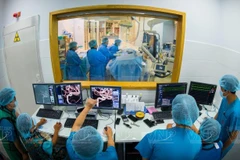
Doctors at the HCM City University of Medicine and Pharmacy’s Medical Centre perform laparoscopic surgery on a stomach cancer patient. (Photo courtesy of the medical center)
 HCM City (VNS/VNA) - Doctors at the HCM City University of Medicine and Pharmacy’sMedical Centre have warned of an increasing incidence of stomach cancer amongyoung people.
Overthe past two months, the hospital offered treatment for two young womendiagnosed with stomach cancer.
An 18-year-old patient from the Tay Nguyen (Central Highlands) province of Lam Dongwho had been suffering indigestion and abdominal discomfort usedover-the-counter drugs for six months. But she later visited doctors afterexperiencing unexplained weight loss of 5kg, lack of appetite, feeling offullness, weakness and fatigue.
At the university’s Medical Centre, she was diagnosed with stomach cancer.
Doctors could not perform surgery to remove the stomach as the cancer hadspread to her abdomen, so chemotherapy was used to stop the growth of cancercells.
Anotheryoung patient, Mai Thi H, 23, visited doctors at the hospital with pain abovethe navel and was diagnosed with stomach cancer.
Doctors performed surgery to remove the part of the stomach that containedcancer and nearby lymph nodes. She had chemotherapy after surgery.
Stomach cancer is found most often in people aged 40-60 and is more common inmen than in women, according to doctors.
However, the increase in stomach cancer in young patients has been morepronounced among women.
Accordingto the Medical Centre’s gastrointestinal surgical department, the incidence ofstomach cancer among young patients grew to 22 percent in 2015 from 16 percentin 2014.
Dr Vo Duy Long, deputy head of the hospital’s gastrointestinal surgicaldepartment, said: “The rising trend in the incidence of stomach cancer amongyoung patients is a warning sign for the public and shows the need for earlydiagnosis.”
The most common risk factor associated with stomach cancer is H. pyloriinfection, Long said.
Other common stomach cancer risk factors include cigarette smoking, obesity, some types ofstomach polyps, a family history, type-A blood and diets with large amounts ofsmoked, salty and pickled foods or processed meats, he said.
Longadvised people aged 40 and above to have an endoscopy to diagnose stomach cancer ifthey experience symptoms such as persistent stomach pain, indigestion, andfeeling of fullness, and have family medical history related to the illness.
“Stomach cancer in the early stage can be treatable. Unfortunately, mostpatients have advanced stages before a diagnosis is made as the signs andsymptoms of stomach cancer are not apparent,” he said.
Prof.Mai Trong Khoa, former director of Bach Mai Hospial in Hanoi, said theincidence of stomach cancer in young patients had risen recently, with somepatients under 20 years old.
In the past, it was rare to find stomach cancer cases among young people.Stomach cancer was found most often in people over 40, Khoa said.
Based on GLOBOCAN 2018 data, stomach cancer is the third most frequent cancerafter liver cancer and lung cancer, with an estimated 17,527 new stomach cancercases and 15,065 deaths in 2018.-VNS/VNA
Overthe past two months, the hospital offered treatment for two young womendiagnosed with stomach cancer.
An 18-year-old patient from the Tay Nguyen (Central Highlands) province of Lam Dongwho had been suffering indigestion and abdominal discomfort usedover-the-counter drugs for six months. But she later visited doctors afterexperiencing unexplained weight loss of 5kg, lack of appetite, feeling offullness, weakness and fatigue.
At the university’s Medical Centre, she was diagnosed with stomach cancer.
Doctors could not perform surgery to remove the stomach as the cancer hadspread to her abdomen, so chemotherapy was used to stop the growth of cancercells.
Anotheryoung patient, Mai Thi H, 23, visited doctors at the hospital with pain abovethe navel and was diagnosed with stomach cancer.
Doctors performed surgery to remove the part of the stomach that containedcancer and nearby lymph nodes. She had chemotherapy after surgery.
Stomach cancer is found most often in people aged 40-60 and is more common inmen than in women, according to doctors.
However, the increase in stomach cancer in young patients has been morepronounced among women.
Accordingto the Medical Centre’s gastrointestinal surgical department, the incidence ofstomach cancer among young patients grew to 22 percent in 2015 from 16 percentin 2014.
Dr Vo Duy Long, deputy head of the hospital’s gastrointestinal surgicaldepartment, said: “The rising trend in the incidence of stomach cancer amongyoung patients is a warning sign for the public and shows the need for earlydiagnosis.”
The most common risk factor associated with stomach cancer is H. pyloriinfection, Long said.
Other common stomach cancer risk factors include cigarette smoking, obesity, some types ofstomach polyps, a family history, type-A blood and diets with large amounts ofsmoked, salty and pickled foods or processed meats, he said.
Longadvised people aged 40 and above to have an endoscopy to diagnose stomach cancer ifthey experience symptoms such as persistent stomach pain, indigestion, andfeeling of fullness, and have family medical history related to the illness.
“Stomach cancer in the early stage can be treatable. Unfortunately, mostpatients have advanced stages before a diagnosis is made as the signs andsymptoms of stomach cancer are not apparent,” he said.
Prof.Mai Trong Khoa, former director of Bach Mai Hospial in Hanoi, said theincidence of stomach cancer in young patients had risen recently, with somepatients under 20 years old.
In the past, it was rare to find stomach cancer cases among young people.Stomach cancer was found most often in people over 40, Khoa said.
Based on GLOBOCAN 2018 data, stomach cancer is the third most frequent cancerafter liver cancer and lung cancer, with an estimated 17,527 new stomach cancercases and 15,065 deaths in 2018.-VNS/VNA
VNA