Thailand moves to curb salt consumption through proposed sodium tax

A sodium tax is intended to address unhealthy dietary habits among Thais, who consume an average of 3.6 grammes of sodium per day - more than twice the level recommended by the World Health Organisation (WHO).

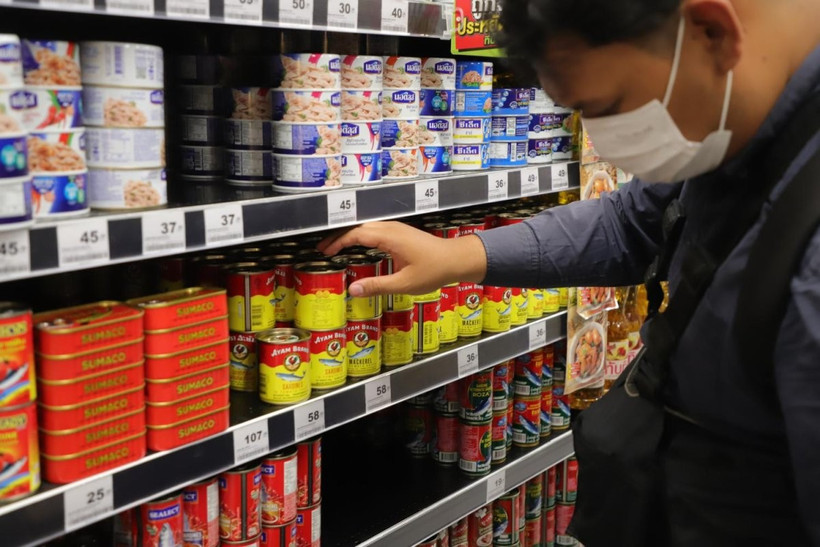
A shopper browses items at a supermarket. A grace period of one year is expected for a potential sodium tax to allow manufacturers sufficient time to adjust product formulations. (Photo: bangkokpost.com)

Bangkok (VNA) – Food manufacturers in Thailand will be given a one-year adjustment period to reformulate their products to reduce salt content if a sodium tax is introduced, according to the head of the Excise Department.

Pornchai Thiraveja, director-general of the department, said the proposal for a sodium tax is being considered by the agency.

Relevant stakeholders were invited to jointly design the tax measure to ensure the policy is carefully developed.

The proposed sodium tax aims to regulate salt levels in popular snack products that currently exceed recommended standards. The measure is intended to address unhealthy dietary habits among Thais, who consume an average of 3.6 grammes of sodium per day - more than twice the level recommended by the World Health Organisation (WHO).

Excessive sodium intake has been linked to a growing incidence of non-communicable diseases, particularly kidney disease and hypertension.

Pornchai said the Excise Department has consulted WHO Thailand, the Less Salt Network, the Ministry of Public Health and other relevant organisations to analyse and develop an appropriate tax framework. In addition, the department and the Thai Health Promotion Foundation have organised seminars to gather feedback from both public- and private-sector stakeholders on the proposed scheme.

The draft proposal suggests a phased implementation, with sodium thresholds tailored to specific product categories in line with international standards. Manufacturers would be given about one year to adjust production processes and conduct research and development to create healthier product formulations.

The Excise Department introduced a sugar tax on beverages in 2017, implementing it in phases to allow producers to gradually reduce sugar content. On April 1, 2025, the sugar tax entered its fourth phase.

Beverages containing 0-6 g of sugar are exempt from the tax, while those containing 6-8 grammes are taxed 1 THB (O.032 USD) per litre, with the maximum rate of 5 THB per litre applying to beverages containing 14 grammes of sugar or more./.


VNA

See more

Thatluang festival in Vientiane, Laos (Photo: VNA)

Laos meets UN criteria for graduation from least developed country status

A resolution by United Nations acknowledging Laos’ eligibility for graduating from the group of least developed countries (LDCs) in 2026 reflects international recognition of the country’s sustained efforts and achievements over the past five decades under the leadership of the Lao People’s Revolutionary Party (LPRP).

Head of the IKN Authority Basuki Hadimuljono (wearing a black cap) converses with a resident during a visit to Muara Sembilang Village in Kutai Kartanegara, East Kalimantan. (Photo:ANTARA)

Indonesia advances community development, healthcare in new capital

Basuki Hadimuljono, head of the Nusantara Capital Authority (OIKN), stressed that the authority is committed to ensuring projects in the new capital serve residents living within the designated development area, which covers parts of North Penajam Paser and Kutai Kartanegara Districts.

Illustrative photo (Photo: bangkokpost.com)

Thai government issues heatstroke warning

The Thai Meteorological Department stated that between March 3 and 6, a summer storm will develop over upper Thailand, starting in the eastern part of the Northeast region first.

Malaysia steps up cyber security resilience

Malaysia steps up cyber security resilience

To ensure accountability, Malaysia plans to finalise the Cybercrime Bill this year which addresses both cyber-dependent and cyber-enabled offences, introducing stricter penalties and prison terms to enhance deterrence.

Illustrative image (Photo: Straitstimes)

Singapore’s fertility rate sinks to new low

Deputy Prime Minister Gan Kim Yong said on February 26 that with birth rates falling at an unprecedented pace, Singapore’s citizen population may start to shrink by the early 2040s without new interventions.

Ambassador Do Hung Viet, Head of the Permanent Mission of Vietnam to the United Nations, addresses a symposium in New York on February 25, 2026 on the treaty’s role as a regional arrangement under Chapter 8 of the UN Charter on the occasion of the 50th anniversary of the TAC signing. (Photo: VNA)

TAC bolsters ASEAN centrality in evolving regional order: Ambassador

ASEAN member states reaffirmed their commitment to advancing the values and principles of the Treaty of Amity and Cooperation in Southeast Asia, stepping up dialogue, cooperation and confidence-building efforts in support of peace, stability and sustainable development in the region and beyond.

Illustrative image (Photo: VNA)

Malaysia welcomes record air passenger traffic in January

Kuala Lumpur International Airport (KLIA) and Penang International Airport (PEN) recorded the highest year-on-year growth within the network. KLIA led with 5.9 million passenger movements, an 8.2% increase, followed by PEN with 741,183 passengers, a 3.8% rise.

Singapore studies AI’s impact on student learning

Singapore studies AI’s impact on student learning

International research has shown that inappropriate or ill-structured use of AI by students can result in over-reliance, negatively impacting students’ basic recall and understanding of simple concepts, he said, adding that this would, in turn, hamper the development of higher-order thinking.