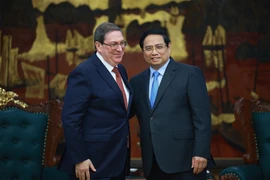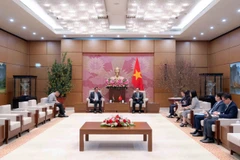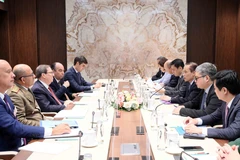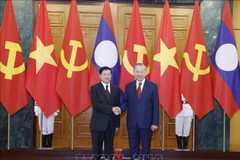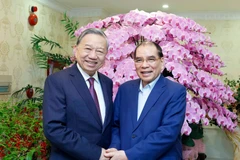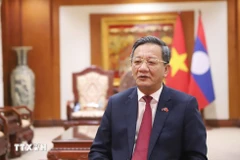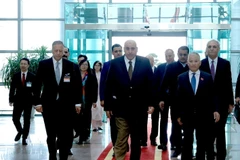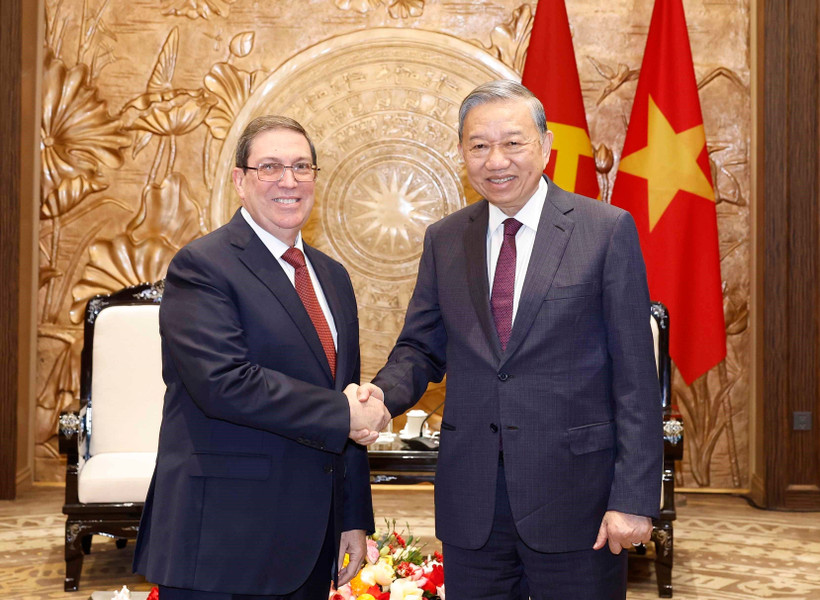
Hanoi (VNA) - General Secretary of the Communist Party of Vietnam (CPV) Central Committee To Lam on February 2 received Bruno Rodríguez Parrilla, Politburo member and Minister of Foreign Affairs of Cuba, who is visiting Vietnam as special envoy of the Communist Party and the State of Cuba.
Welcoming the special envoy shortly after the CPV’s 14th National Congress, General Secretary Lam affirmed that the dispatch of a high-ranking special envoy by the Cuban leadership on this occasion demonstrates the special importance attached by Cuba, as well as the close-knit, faithful, pure and exemplary relationship between the two Parties, States and peoples.
Briefing the guest on the outcomes of the 14th National Party Congress, he stressed that the Congress not only reviewed past achievements but also charted strategic orientations for national development toward 2030 with a vision to 2045. Within this external relations orientation, ties with traditional friends, especially Cuba, always hold a top priority. Sharing the difficulties and challenges Cuba is facing due to the impacts of blockades, embargos and natural disasters, the Party leader reaffirmed the Vietnamese Party, State and people’s consistent stance of standing in solidarity with, supporting and accompanying the Cuban people, and once again called for the lifting of unilateral blockade and embargo measures against Cuba.
He emphasised that the Vietnamese people never forget the immortal words of Leader Fidel Castro: “For Vietnam, Cuba is willing to shed even its own blood,” and affirmed that today, in the cause of national construction and defence, Vietnam is also willing to support Cuba to the best of its ability to help the country overcome difficulties and advance development.
On behalf of the Cuban Party and State leaders, Bruno Rodríguez once again conveyed the warm congratulations of Cuba’s top leaders on the successful 14th National Congress of the CPV - a major political event marking a glorious milestone in the historical process of the Vietnamese nation, as well as on the Party’s 96th founding anniversary.
He emphasised that the Communist Party of Cuba highly values the great and historically significant achievements Vietnam has recorded over 40 years of Doi moi (Renewal), and firmly believes that the Resolution of the 14th Congress will serve as a “guiding compass” leading Vietnam into a new era – the era of national rise. Bruno Rodríguez again affirmed the stance of the Cuban Party and State: “Vietnam’s success is also Cuba’s success. Vietnam’s experience in Party building and economic development is a powerful source of encouragement and inspiration, and the most suitable model of reference for the Cuban Revolution.”
At the meeting, the two sides exchanged views and reached high consensus on major directions and measures to further deepen, substantiate and enhance the effectiveness of the traditional friendship and comprehensive cooperation between Vietnam and Cuba in the coming period, in line with the new context of each country and the international situation.
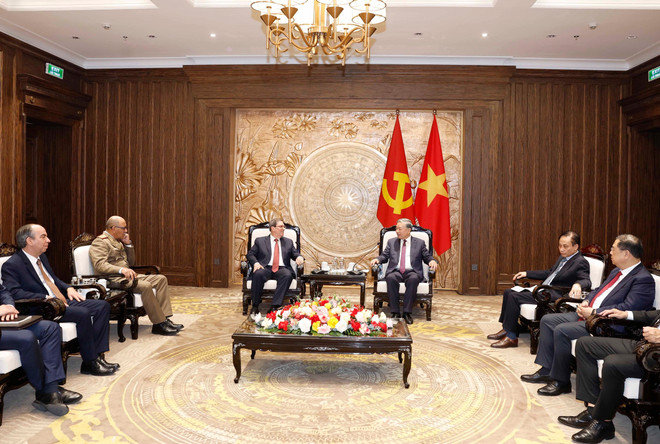
Both sides agreed to continue strengthening high-level exchanges; regularly and flexibly maintaining cooperation mechanisms, theoretical exchanges, and the sharing of practical experience in Party building, personnel training and state governance, considering these an important political foundation for consolidating strategic trust between the two Parties.
Regarding economic cooperation, the Party General Secretary emphasised the need for breakthrough steps to make it commensurate with the excellent political relationship, affirming that Vietnam will continue to share experience and effectively implement cooperation projects on rice production to help Cuba gradually achieve food and foodstuff self-sufficiency, while encouraging and creating favourable conditions for enterprises to invest in Cuba.
Bruno Rodríguez affirmed that the Cuban Party and State always prioritise strengthening cooperation with Vietnam in potential fields such as solar energy, consumer goods production, tourism and pharmaceuticals; continue close coordination at multilateral international forums; and educate younger generations about the tradition of bilateral relations so as to further develop this special friendship and cooperation./.