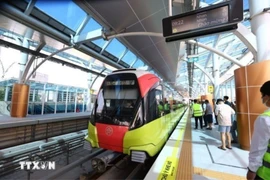
Hanoi (VNS/VNA) – Vietnam is stepping up plans to develop a new generation of highly skilled railway workers, as the country prepares for an unprecedented expansion of its rail network, including the long-awaited North–South high-speed line.
The Ministry of Construction has drafted a comprehensive project on training and developing railway personnel through to 2030, with a longer-term vision to 2045.
Officials warn that without decisive investment in people, Vietnam could remain dependent on foreign expertise to design, build and operate its new transport systems.
The Government has recently approved nine new railway routes and upgrades to seven existing lines, along with plans for 28 urban railways in Hanoi and Ho Chi Minh City, covering over 1,100km in total by 2045.
Flagship projects such as the North–South express railway and the Lao Cai–Ha Noi–Hai Phong line are regarded as central to the country’s industrialisation, modernisation and regional connectivity.
The ministry said in its submission that the projects would be of immense scale and complexity, requiring a workforce not only able to build and operate them, but also capable of absorbing and advancing world-class technology.
Skills gap looms large
Vietnam’s railway sector remains hampered by limited technological capacity. Expertise in core fields such as locomotive design, rolling stock manufacturing, signalling, automation and electrification is still largely imported, with little domestic research and production.
The ministry’s report warns that without early workforce development plans, it will be difficult to master technology, and the country will remain dependent on foreign experts throughout project lifecycles.
International experience shows that countries that successfully launched high-speed rail — including Japan, France, China and the Republic of Korea — paired infrastructure investment with systematic, long-term workforce training.
The draft project sets a target of training more than 140,000 workers for the railway sector by 2045, in phases.
Between 2025 and 2030, some 35,000 people are expected to undergo training, focusing on high-speed rail, electrified lines and urban metro systems. The plan includes 1,000 postgraduate students, 14,000 university graduates, 11,000 college-level trainees and 9,000 intermediate-level workers.
Fields of study will range from construction engineering, electrical systems and signalling to transport economics and operations.
About 12,000 people will be trained specifically for railway operations and maintenance, including 4,500 for national railways and 7,500 for urban lines.
The project also envisions training specialists in management and regulation to build institutional capacity alongside technical skills.
From 2031 to 2045, a further 105,000 workers will be trained, with a shift towards research, technology transfer and homegrown innovation.
The aim is to build a core of 5,000 personnel engaged directly in research and technology mastery, gradually reducing reliance on foreign expertise.
Making rail an attractive career
The draft project sets out seven groups of tasks and solutions. It calls for the creation of incentives and supportive policies that can attract and keep skilled workers in areas such as railway management, engineering and research.
At the same time, it urges closer cooperation between universities, enterprises and Government agencies so that training programmes are aligned with the actual demands of major projects.
Another priority is to expand investment in training institutions, equipping them with modern laboratories, simulation centres and research hubs that can provide advanced education and hands-on experience.
The draft also highlights the need for public–private partnerships to mobilise additional resources for workforce development, while strengthening international cooperation with leading railway nations to facilitate the exchange of expertise and the transfer of technology.
Ultimately, the goal is to ensure that the railway industry becomes an attractive destination for top talent, rather than merely a temporary or stopgap option, according to the draft.
A mix of funding sources will be used. Training costs will be built into investment budgets for major railway projects, ensuring operators and maintenance staff are properly prepared before lines enter service.
The State budget will support training for Government officials and upgrades to teaching institutions. Enterprises will help train their own employees, while learners and employers will also share part of the cost.
Authorities hope to draw on international assistance and cooperation, both financial and technical, from development partners and railway powers with experience in high-speed systems./.
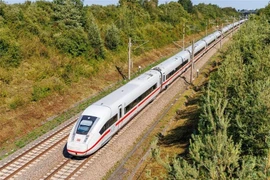
Vietnam taps global expertise to develop high-speed railway
With clear planning and a complete legal framework, Vietnam could draw private firms’ participation in the project. This is not only about mobilising capital, but also about fostering supporting industries, improving management capacity, and advancing sustainable economic and social development.